01Facts
On 16.01.2023 at about 3:30 p.m., in front of SRS College, Challakere, a KSRTC bus (KA-42-F-2259) collided with a motorcycle (KA-16/EK-5192).
¶ 3Govardhana (MVC 49/2021; aged 19 at accident) was the rider, and Thimmakka (MVC 50/2021) was the pillion rider.
¶ 3, 10Both claimed that the bus approached from behind at high speed, rashly and negligently, and struck the motorcycle.
¶ 4KSRTC denied the claims and, in its defence, alleged that the rider turned right into his village road from the National Highway, causing the collision.
¶ 5, 17Govardhana suffered fractures of the right femur shaft and right tibia and fibula shafts, was hospitalised for 16 days, and was assessed at 39% disability to the limb (Ex. P.20).
¶ 10, 19The Tribunal fixed 13% whole-body disability for Govardhana.
¶ 19Thimmakka suffered a right clavicle fracture with mal-union, a head injury with minimal extra-axial bleeding (referred to NIMHANS), and was hospitalised for 5 days.
¶ 11, 22Thimmakka was assessed at 32% disability to the right limb, and the Tribunal fixed 11% whole-body disability.
¶ 11, 22The Tribunal awarded ₹4,85,590 in MVC 49/2021.
¶ 6The Tribunal awarded ₹2,02,760 in MVC 50/2021.
¶ 7KSRTC had satisfied the award in both cases.
¶ 17The claimants appealed for enhancement under s. 173(1) of the Motor Vehicles Act, 1988, and KSRTC filed cross-objections (CROBs) challenging negligence and quantum.
¶ 1, 802Issues
i.1. Whether KSRTC established contributory negligence on the part of the motorcycle rider in causing the accident.
¶ 14ii.2. Whether the claimants in both cases are entitled to enhancement of compensation.
¶ 1403Law Applied
The statutory framework for claims and appeals under the Motor Vehicles Act, 1988, namely claims under s. 166 and appeals under s. 173(1), the latter being the basis for both the claimants' appeals and KSRTC's CROBs.
¶ 1, 25(a)A party alleging contributory negligence must prove it.
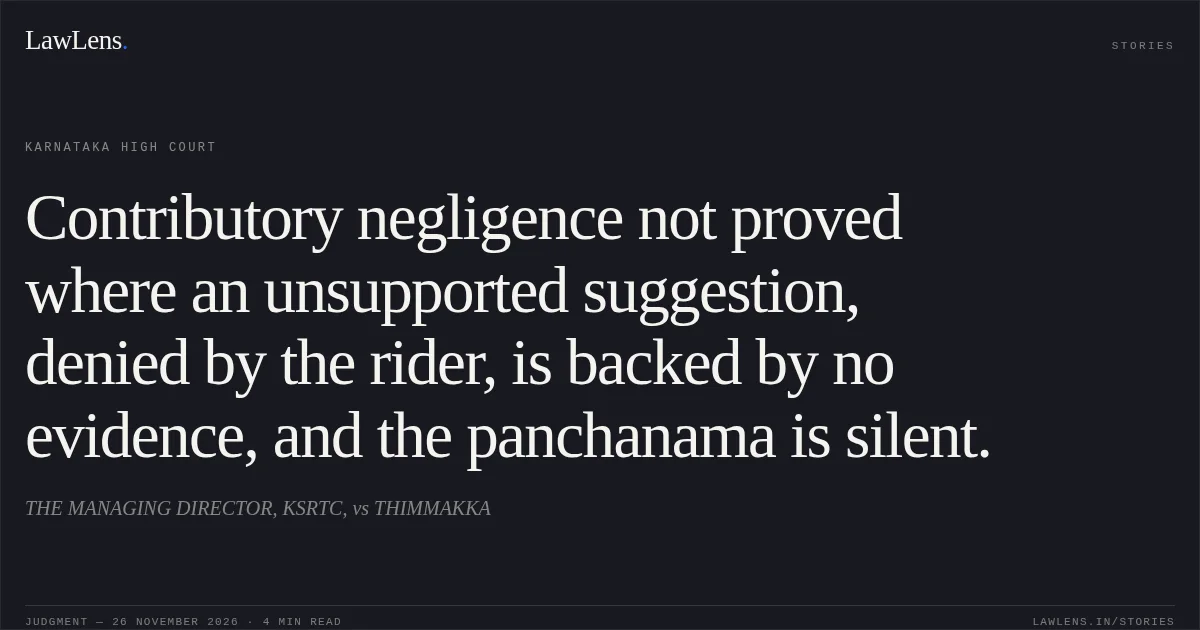
¶ 17–18A bare suggestion put to a witness that is denied, unsupported by other evidence, and not borne out by the panchanama does not discharge the burden of proving contributory negligence.
¶ 17–18Compensation under the head of loss of future earning capacity (functional disability), once based on credible medical evidence that remained unchallenged in cross-examination, should not be disturbed.
¶ 19, 22Awards under the remaining heads must be reasonable and proportionate to the nature of the injuries and the duration of treatment.
¶ 20, 23The judgment does not cite any specific precedent or statutory provision beyond the Motor Vehicles Act framework.
Provisions in the judgment · 3 · Linked ones open on LawLens
Motor Vehicles Act, 1988 Section 173Section 166
Code of Civil Procedure, 1908 Section 41
04Reasoning
KSRTC's contention that the rider was turning right was made only as a suggestion in cross-examination, was denied by the rider, and was not supported by any independent evidence.
¶ 17–18The panchanama did not establish the defence and, on its account, the collision occurred on the left side of the road as viewed from the motorcycle.
¶ 17–18Because the Court found no evidence of contributory negligence, it held that liability rested wholly on the KSRTC bus.
¶ 18The judgment noted that KSRTC had satisfied the award, though this was treated as a supplementary observation rather than a ground of decision.
¶ 17The absence of the bus driver's testimony and of a spot sketch, raised by the claimants' counsel, was not expressly discussed as a separate ground.
¶ 12The Court upheld the Tribunal's functional disability awards. For Govardhana, the 39% limb disability was unchallenged in cross-examination, and the 13% whole-body assessment, multiplier, and notional income of ₹15,500 were accepted.
¶ 19For Thimmakka, the doctor explained the mal-union, stiffness, and restricted movement in affidavit evidence, so the 11% whole-body assessment and multiplier were accepted.
¶ 22For Govardhana, the Court found that medical, incidental, and food expenses were adequate.
¶ 20For Govardhana, the awards for pain and suffering, laid-up period, and loss of amenities were too low given the fractures, hospitalisation, and long-term sequelae, and were enhanced accordingly.
¶ 20, 23For Thimmakka, the Court enhanced pain and suffering, incidental and food expenses, laid-up income, and loss of amenities, but left medical expenses unchanged.
¶ 2305Holding
KSRTC failed to establish contributory negligence on the part of the rider.
¶ 18The claimants were entitled to enhancement under the non-earning heads, while the functional disability awards required no interference.
¶ 19–24MFA Nos. 5950/2024 and 5933/2024 were allowed in part, and MFA CROB Nos. 63/2025 and 64/2025 were dismissed.
¶ 25(a)–(b)The compensation in MVC 49/2021 was modified to ₹5,99,090, an enhancement of ₹1,13,500 over the award of ₹4,85,590.
¶ 21, 25(c)The compensation in MVC 50/2021 was modified to ₹2,79,760, an enhancement of ₹77,000.
¶ 24, 25(d)Enhanced compensation carries 6% interest per annum from the date of petition until realisation. KSRTC must deposit the amount with accrued interest before the Tribunal within eight weeks of receipt of the certified copy. Disbursement is to follow the Tribunal's order. No order as to costs was made.
¶ 25(e)–(h)Original Court PDF
THE MANAGING DIRECTOR, KSRTC,vsTHIMMAKKA
Click to open original judgment
Original judgment, available to read, download and summarize on LawLens.in