01Facts
On 25.11.2016, the deceased, Ganesh (aged 21), was travelling as cleaner in Insulator Lorry No. KA-20/D-747 on NH-17 at Goa when the driver, allegedly driving rashly and negligently, lost control and struck motorcycle No. GA-08/AJ-2470. The deceased died on the spot.
¶ 4His mother, the appellant, filed a claim under s. 166 of the Motor Vehicles Act, 1988 (MV Act), asserting he was her only earning member with a salary of Rs. 15,000 per month.
¶ 5The owner (Respondent No. 1) was proceeded ex parte. The insurer (Respondent No. 2) denied the claim and contended the compensation sought was exorbitant.
¶ 5.1The Tribunal found negligence by the lorry driver and death due to the accident.
¶ 8The Tribunal assessed notional income at Rs. 9,000 per month, added 40% future prospects, deducted 1/2 for personal expenses (bachelor), applied multiplier 18, and arrived at loss of dependency of Rs. 13,60,800.
¶ 8.1The Tribunal further awarded Rs. 15,000 (loss of estate), Rs. 40,000 (loss of love and affection), and Rs. 15,000 (transport and funeral), totalling Rs. 14,30,800 with 6% interest.
¶ 8.2–8.3The appellant sought enhancement on the basis of the KSLSA notional income chart (Rs. 9,500 for 2016) and 30% escalation.
¶ 9The insurer conceded the Rs. 9,500 figure but defended the non-pecuniary awards.
¶ 10The appeal was taken up for final hearing at the admission stage with consent.
¶ 202Issues
i.1. Whether the Tribunal erred in adopting a notional income of Rs. 9,000 per month instead of the Rs. 9,500 per month prescribed by the KSLSA Notional Income Chart for the year 2016, thereby requiring recalculation of loss of dependency.
¶ 9 · ¶ 10 · ¶ 11.1ii.2. Whether the conventional heads of compensation (loss of estate, loss of consortium/love and affection, and funeral expenses) are liable to be escalated by 30% in view of the accident year 2016 and the pendency of the claim.
¶ 9 · ¶ 12iii.3. Whether the award of interest at 6% per annum is liable to be enhanced, and if so, at what rate and from what date.
¶ 13 · ¶ 1403Law Applied
The Court relied on s. 166 of the MV Act for the claim framework.
¶ 13Section 171 of the MV Act vests discretion in the Tribunal to award simple interest from the date of the claim at a rate it specifies.
¶ 13On quantum, the Court applied the principles in National Insurance Co. Ltd. v. Pranay Sethi (2017) 16 SCC 680, under which the notional income is multiplied by the applicable multiplier (18 for a deceased aged about 21), future prospects are added, a deduction is made for personal expenses, and conventional heads are escalated by 10% for every three years from the year of accident, i.e., 30% for a 2016 accident.
¶ 8.1, 12The Court applied Sarla Verma (Smt) v. Delhi Transport Corporation (2009) 6 SCC 121 for the multiplier and dependency computation.
¶ 8.1On interest, the Court relied on Abati Bezbaruah v. Geological Survey of India (2003) 3 SCC 148, holding that no fixed rate applies and that the rate must be just and reasonable, considering inflation, RBI policy, pendency, and loss of income.
¶ 16.1The Court relied on the Supreme Court line of authority fixing 9% per annum in motor accident claims: Supe Dei v. National Insurance Co. (2009) 4 SCC 513; Jagadish v. Mohan (2018) 4 SCC 571; Savita Devi v. SBI General Insurance (order dated 02.09.2024); Oriental Insurance Co. v. Niru @ Niharika (2025 INSC 822); Nidhi Bhargava v. National Insurance Co. (2025 INSC 526); and S. Kumar v. United India Insurance Co. (2019 INSC 217).
¶ 19–23, 29The Court followed the Division Bench decision in Divya V.M. v. Veerabhadrashetti K.C. (2026 SCC OnLine Kar 14537), which affirmed 9% interest in death and disability cases.
¶ 13.1Provisions in the judgment · 4 · Linked ones open on LawLens
Motor Vehicles Act, 1988 Section 173Section 166Section 171
Code of Civil Procedure, 1908 Section 34
04Reasoning
The Court first noted that the insurer conceded the Rs. 9,500 KSLSA figure for 2016, and that the accident and the deceased's status as the sole earning dependant were undisputed.
¶ 10, 11Because the Tribunal's Rs. 9,000 notional income was below the applicable chart figure, the Court recalculated loss of dependency as Rs. 9,500 + 40% = Rs. 13,300; less 1/2 = Rs. 6,650; × 12 × 18 = Rs. 14,36,400.
¶ 11.1On the conventional heads, the Court applied 30% escalation to Rs. 15,000 (loss of estate), Rs. 40,000 (loss of consortium), and Rs. 15,000 (funeral expenses), yielding Rs. 19,500, Rs. 52,000, and Rs. 19,500 respectively. Escalation was not expressly applied to the loss of dependency figure.
¶ 12The revised total of Rs. 15,27,400 produced an enhancement of Rs. 96,600 over the Tribunal's award.
¶ 12On interest, the Court surveyed precedent and noted that, over the preceding 5–10 years, the Supreme Court has consistently awarded or upheld 9% per annum, which the Court considered appropriate for death cases with prolonged pendency.
¶ 24, 29.3, 31In the operative finding, the Court fixed interest at 8% per annum from the date of the petition until realisation, stating only that this was "in terms of the judgment of the Supreme Court as well as this Court." The judgment does not expressly explain why 8% was chosen over the 9% rate it had identified as consistently applied.
¶ 1405Holding
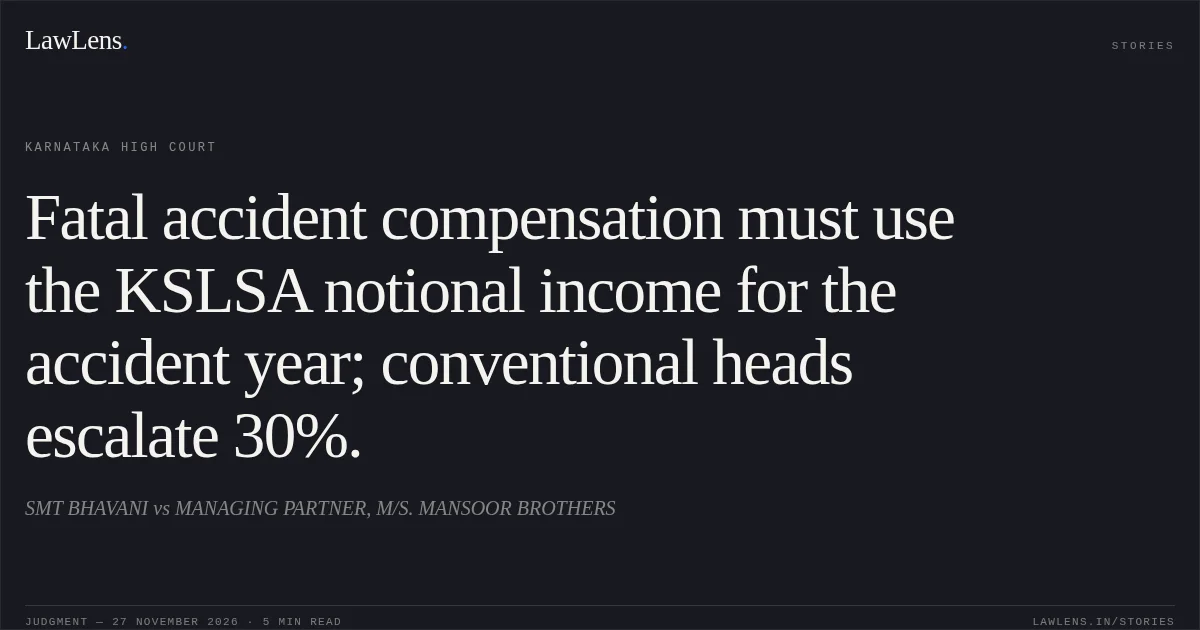
The Tribunal erred in adopting Rs. 9,000 as notional income; the applicable KSLSA figure of Rs. 9,500 governs, and loss of dependency is recomputed at Rs. 14,36,400.
¶ 11.1The conventional heads are escalated by 30%, producing a total compensation of Rs. 15,27,400. Interest is enhanced from 6% to 8% per annum on the entire compensation from the date of the petition until realisation.
¶ 12, 12.1, 14, 15(ii)The appeal is partly allowed. The award is modified by enhancing compensation by Rs. 96,600 with 8% interest from the date of petition. The rest of the Tribunal's award stands undisturbed. The insurer (Respondent No. 2) must pay the entire compensation with interest within eight weeks. The amount is to be released to the claimant on application, as ordered by the Tribunal. Pending applications are closed, no costs are awarded, and the Registry is to draw the modified award and transmit it to the Tribunal.
¶ 15(ii)–(ix)Original Court PDF
SMT BHAVANIvsMANAGING PARTNER, M/S. MANSOOR BROTHERS
Click to open original judgment
Original judgment, available to read, download and summarize on LawLens.in