Facts
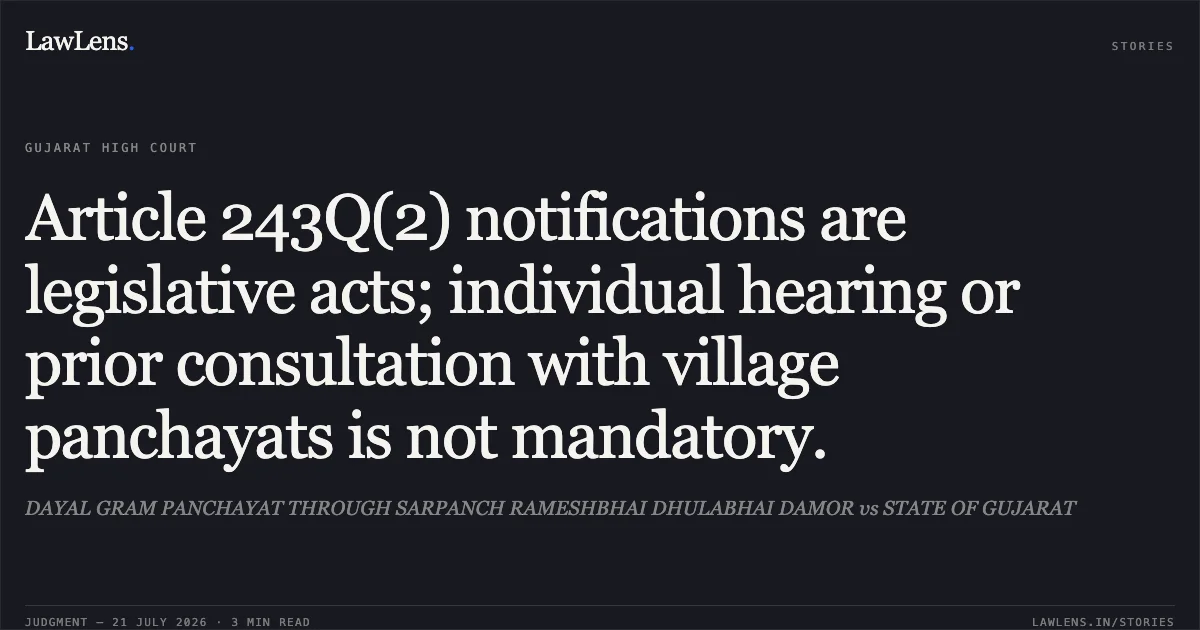
This batch of petitions challenges various notifications issued by the Urban Development and Urban Housing Department of Gujarat under Article 243Q(2) of the Constitution of India.
Source reference: p. 5These notifications merged several village panchayats into existing Municipalities or Municipal Corporations.
Source reference: para 2The petitioners, comprising village panchayats and residents, argued that the notifications were issued without following the mandatory parameters of Article 243Q(2), such as population density, revenue generation, and non-agricultural employment.
Source reference: para 14.2, 19.1They also alleged a lack of meaningful consultation as required by Section 7(2) of the Gujarat Panchayats Act, 1993.
Source reference: para 18.2Procedurally, the court noted that during the pendency of these petitions, elections for the newly expanded municipal bodies were concluded in April 2026, and elected representatives had assumed office.
Source reference: para 12.1, 43Issues
1. Whether the notifications are invalidated for non-compliance with the factors prescribed under Article 243Q(2) of the Constitution.
Source reference: para 27(i)2. Whether the scope of judicial review extends to examining the adequacy of material considered by the State.
Source reference: para 27(ii)3. Whether consultation with an Administrator, rather than an elected body, violates Section 7(2) of the Gujarat Panchayats Act.
Source reference: para 27(iii)4. Whether the court should exercise writ jurisdiction to quash foundational notifications after the completion of the electoral process and assumption of office by elected representatives.
Source reference: para 27(iv)Law Applied
The court applied Article 243Q(2) of the Constitution, which empowers the Governor to specify urban areas "having regard to" specific demographic and economic factors.
Source reference: para 28It relied on the Supreme Court's decision in State of Rajasthan v. Ashok Khetoliya, which held that Article 243Q does not require a separate notification or an independent adjudicatory procedure, as the function is legislative.
Source reference: para 39, 39.1The court also applied Section 7(2) of the Gujarat Panchayats Act, 1993, regarding consultation for the cesser of a village.
Source reference: para 33It distinguished Champa Lal v. State of Rajasthan based on subsequent larger bench clarifications that "having regard to" implies consideration of factors rather than an exhaustive recital in the notification.
Source reference: para 41, 42Finally, it applied the principle of discretionary jurisdiction under Article 226, where the court may refuse relief if it unsettles completed democratic processes.
Source reference: para 43.2Reasoning
The court reasoned that the issuance of a notification under Article 243Q(2) is a legislative/policy function, not a quasi-judicial one.
Source reference: para 35, 40Consequently, the principles of natural justice and individual hearings are not mandatory unless specified by statute.
Source reference: para 42Upon examining the original government files, the court found that the State had indeed collected and analyzed data on population, revenue, and infrastructure, satisfying the "having regard to" requirement.
Source reference: para 41.1, 42The court rejected the argument that Section 7(2) of the Panchayats Act acts as a fetter on the Governor’s constitutional power under Article 243Q(2); the two operate in distinct fields, and the cesser of a village is an incidental consequence of municipal expansion.
Source reference: para 42Furthermore, consultation with an Administrator during an interregnum was deemed valid as the Administrator is a statutory functionary.
Source reference: para 42Holding
The High Court dismissed the petitions, holding that the notifications were issued in lawful exercise of constitutional and legislative powers.
The court held that judicial review is limited to the legality of the decision-making process, not the wisdom of the policy.
Source reference: para 41, 42Crucially, the court declined to interfere because the electoral process had already been completed and subsequent rights had intervened; quashing the notifications at this stage would create an administrative vacuum and unsettle democratic institutions.
Source reference: para 43.1, 43.2All interim reliefs were vacated.
Source reference: para 44Acts & Sections Cited
7 provisions across 3 statutes referred to in this judgment. Each provision opens on LawLens.
Gujarat Panchayats Act, 19933
RAJASTHAN MUNICIPALITIES ACT,20091
Original Court PDF
DAYAL GRAM PANCHAYAT THROUGH SARPANCH RAMESHBHAI DHULABHAI DAMORvsSTATE OF GUJARAT
Click to open original judgment
Original judgment, available to read, download and summarize on LawLens.in