Facts
The respondent was selected as a Recruit (under training) for the post of Rakshak in the Railway Protection Special Force (RPSF) and was directed by the Commandant’s call letter dated 03.05.1979 to undergo initial training, with the proposed appointment expressly subject to successful completion of that training.
Source reference: paras. 3.1, 7–9After completing the training, Battalion Order No. 2BN/9/4/9/409 dated 04.12.1979, issued by the Assistant Commandant, appointed him as a Rakshak with effect from that date and posted him to the 7th Battalion.
Source reference: paras. 3.2, 8A subsequent Battalion Order dated 25.02.1980 confirmed that the recruits had been appointed as regular Rakshaks with effect from 04.12.1979.
Source reference: para. 3.3, 11The respondent overstayed sanctioned leave and remained absent from 27.05.1982 to 06.08.1982. A charge-sheet was issued under Rule 44 of the Railway Protection Force Rules, 1959; after the respondent failed to appear at the departmental enquiry, the Enquiry Officer proceeded ex parte and found the charges proved.
Source reference: paras. 3.4–3.7Following a show-cause notice, the Adjutant removed the respondent from service on 18.03.1983. His departmental appeal was rejected by the Commandant on 07.11.1984.
Source reference: para. 3.8The Trial Court dismissed his suit, but the First Appellate Court and the Allahabad High Court held that the removal violated Article 311(1) because the respondent had allegedly been appointed by the Commandant while removal was ordered by a subordinate Adjutant.
Source reference: paras. 2.1–2.2, 3.9–3.11Issues
1. Whether the respondent was appointed as a regular Rakshak by the Commandant/Chief Security Officer under the call letter dated 03.05.1979, or by the Assistant Commandant under Battalion Order dated 04.12.1979.
Source reference: para. 62. Whether the Adjutant who passed the removal order dated 18.03.1983 was subordinate in rank to the authority that appointed the respondent, thereby rendering the removal contrary to Article 311(1) of the Constitution.
Source reference: paras. 13, 16, 243. Whether the departmental enquiry was vitiated for violation of the principles of natural justice because it proceeded ex parte while the respondent was allegedly ill and because of the alleged non-service of the relevant documents and show-cause notice.
Source reference: paras. 27–28Law Applied
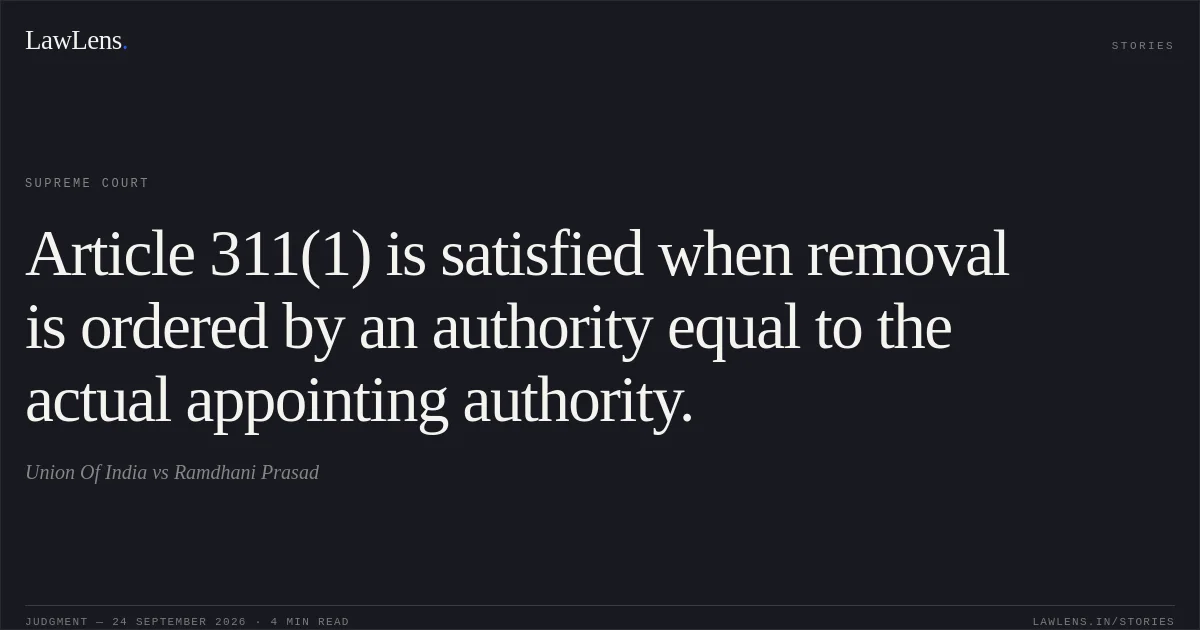
Article 311(1) prohibits dismissal or removal by an authority subordinate in rank to the authority by which the employee was appointed; the appointing authority must be identified from the operative appointment order and the governing statutory framework.
Source reference: paras. 13–14Under Sections 6 and 9 of the Railway Protection Force Act, 1957, read with Rules 20 and 43 and Schedules I and II of the Railway Protection Force Rules, 1959, appointment power is not vested exclusively in the Chief Security Officer: the Assistant Security Officer/Assistant Commandant may appoint Rakshaks and impose the penalty of removal upon them.
Source reference: paras. 17–22Krishna Kumar v. Divisional Assistant Electrical Engineer, Central Railway, (1979) 4 SCC 289, establishes that delegation of appointment power does not alter the delegate’s hierarchical status.
Source reference: para. 14Union of India v. Chandra Pal Pandey, 1993 Supp (2) SCC 176, holds that the expression “shall rest with the Chief Security Officer” denotes overall control and does not exclude appointment by other officers authorised under the Rules.
Source reference: para. 23Ramanand Singh v. State of Bihar, (1984) 2 SCC 447, recognises that one order may simultaneously operate as an appointment and posting order.
Source reference: paras. 10, 25A departmental enquiry is not invalid merely because it proceeds ex parte where the delinquent employee had notice of the proceedings and a reasonable opportunity to participate.
Source reference: para. 28Reasoning
The Court distinguished the Commandant’s call letter from the operative appointment order. The call letter merely required the selected candidates to report for training and made the proposed appointment conditional upon successful completion of that training; it did not constitute an unconditional appointment as a regular Rakshak.
Source reference: paras. 7–9In contrast, the 04.12.1979 Battalion Order expressly recorded that, upon successful completion of training, the recruits were “appointed as RK” with effect from that date and posted to their respective battalions. The 25.02.1980 order independently confirmed that appointment.
Source reference: paras. 8–11Accordingly, the Assistant Commandant was the appointing authority. Under Schedule I, the Assistant Security Officer was competent to appoint Rakshaks, and under Schedule II, the same authority was empowered to impose the penalty of removal upon Rakshaks.
Source reference: paras. 18–22The Adjutant was of the same rank as the Assistant Commandant and the respondent produced no evidence showing that the Adjutant was subordinate in rank; therefore, the constitutional bar under Article 311(1) was not attracted.
Source reference: para. 24On natural justice, the respondent had acknowledged the charge-sheet, submitted a response, received notice of the enquiry, and was issued a show-cause notice before removal. His failure to attend the enquiry or submit a representation did not, on the material before the Court, establish denial of a reasonable opportunity.
Source reference: para. 28Holding
The Supreme Court held that the respondent was appointed as a regular Rakshak by the Assistant Commandant under the Battalion Order dated 04.12.1979, which operated as both the appointment and posting order; the earlier call letter was only a direction to undergo initial training.
The Adjutant was not subordinate in rank to the appointing authority and was competent under the Rules to impose removal. The removal order therefore did not violate Article 311(1), and the departmental enquiry was not vitiated by breach of natural justice.
Source reference: paras. 26, 28The appeal was allowed; the Allahabad High Court’s judgment and the First Appellate Court’s judgment were set aside, the Trial Court’s dismissal of the respondent’s suit was restored, and the removal order dated 18.03.1983 was reinstated.
Source reference: para. 29Acts & Sections Cited
3 provisions across 1 statute referred to in this judgment. Each provision opens on LawLens.
Original Court PDF
Union Of IndiavsRamdhani Prasad
Click to open original judgment
Original judgment, available to read, download and summarize on LawLens.in