Facts
The petitioner, an election agent for an independent candidate, filed a writ petition under Article 226 of the Constitution challenging the acceptance of the nomination papers of Respondent No. 5 for the 54 No. Morigaon Legislative Assembly Constituency
Source reference: p. 2-3The petitioner alleged that Respondent No. 5 failed to disclose material facts regarding his second wife and her assets in the Form-26 affidavit, violating the Representation of the People Act, 1951 (RP Act) and the Conduct of Election Rules, 1961
Source reference: p. 3Despite an objection filed before the Returning Officer on 25.03.2026, the nomination was accepted without a speaking order
Source reference: p. 4-5The petitioner sought a mandamus to decide the objection and a declaration that the nomination was invalid due to the suppression of material information
Source reference: p. 4Issues
1. Whether a writ petition under Article 226 is maintainable to challenge the acceptance of a nomination paper once the election process has commenced
Source reference: para. 8, 122. Whether the non-disclosure of a spouse’s assets in a Form-26 affidavit allows for the rejection of a nomination by the Returning Officer during a summary inquiry
Source reference: para. 15, 20Law Applied
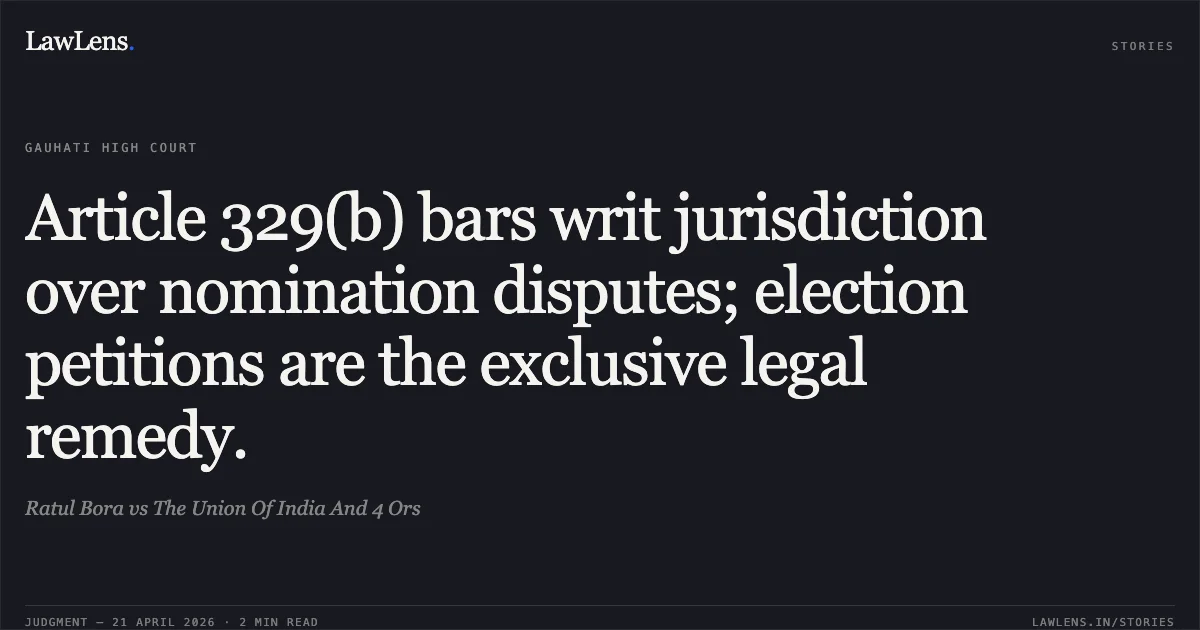
Article 329(b) of the Constitution of India, which mandates that no election shall be called into question except by an election petition
Source reference: para. 8Sections 80 and 80A of the Representation of the People Act, 1951, which designate the High Court as the authority for election petitions
Source reference: para. 9Establishing that "election" covers the entire process and bars intermediate judicial interference (N. P. Ponnuswami v. Returning Officer (1952))
Source reference: para. 11, 17Defining the election period from notification to result declaration (Election Commission of India v. Ashok Kumar (2000))
Source reference: para. 12, 18Holds that complex allegations of non-disclosure in affidavits cannot be resolved by a Returning Officer through a summary inquiry (Kisan Shankar Kathore v. Arun Dattatray Sawant (2014))
Source reference: para. 15, 20Reasoning
The court found that because the election notification had been issued, the constitutional bar under Article 329(b) was active, ousting the jurisdiction of the court under Article 226
Source reference: para. 17, 19The court reasoned that the term "election" encompasses all stages, including the scrutiny of nominations, and any irregularities must be addressed via an election petition after the results are declared
Source reference: para. 18-19Regarding the merits of the non-disclosure claim, the court noted that per Kisan Shankar Kathore, a Returning Officer is not equipped to perform the detailed factual verification required to prove suppression of assets during the summary inquiry stage
Source reference: para. 20Consequently, the court determined that allowing a "two-pronged attack"—one during the election and one after—would unduly obstruct the democratic process
Source reference: para. 10-14Holding
The court held that the writ petition was not maintainable due to the specific bar under Article 329(b) of the Constitution
The court dismissed the petition at the motion stage, clarifying that the petitioner's remedy lies exclusively in filing an election petition under Sections 80 and 80A of the RP Act after the conclusion of the election process
Source reference: para. 19, 22No interim relief was granted against the respondent’s candidacy
Source reference: para. 22Acts & Sections Cited
5 provisions across 1 statute referred to in this judgment. Each provision opens on LawLens.
Representation of the People Act, 19515
Original Court PDF
Ratul BoravsThe Union Of India And 4 Ors
Click to open original judgment
Original judgment, available to read, download and summarize on LawLens.in


