Facts
The petitioner challenged the Foreigners’ Tribunal’s opinion dated 30 June 2022 declaring her a foreigner who entered Assam after 25 March 1971.
Source reference: p. 3, para. 2She claimed descent from Abed Ali and relied on voter lists, identity documents, legacy data, and testimony from projected brothers to establish her link to persons said to have resided in Assam before the relevant date.
Source reference: pp. 5–7, paras. 9–11She also relied on a marriage-register record produced by a witness from the Deputy Registrar’s office.
Source reference: p. 9, para. 16The High Court called for and examined the Tribunal record; the Tribunal proceedings included the petitioner’s evidence and cross-examination and evidence from three defence witnesses.
Source reference: pp. 4–5, paras. 7–8The petitioner argued, among other things, that the LVO report was blank, that the notice misstated the alleged period of entry, and that her documents had not been properly considered.
Source reference: pp. 3–4, para. 3; p. 18, para. 30Issues
1. Whether the petitioner proved, through admissible and reliable evidence, her citizenship and her claimed link to the persons named in the historical voter lists.
Source reference: pp. 9–12, paras. 17–20; pp. 25–27, paras. 40–432. Whether the omissions in the LVO report invalidated the reference or the Tribunal proceedings.
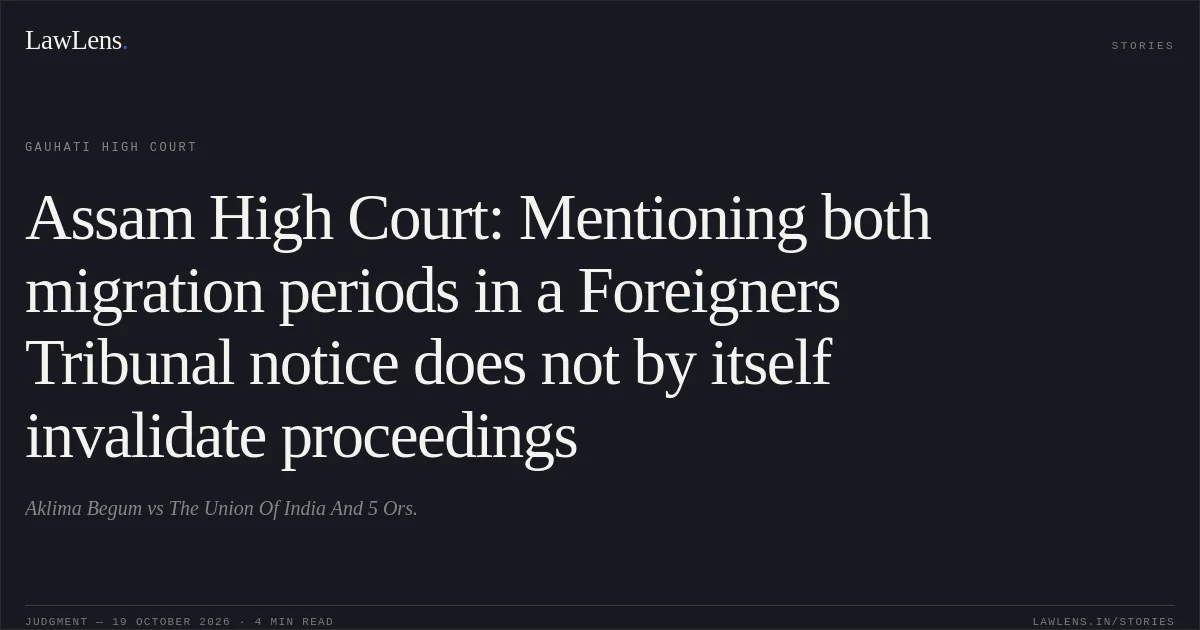
Source reference: pp. 12–18, paras. 22–293. Whether the Tribunal’s notice, which referred to more than one period of entry, prejudiced the petitioner or invalidated the opinion.
Source reference: pp. 18–24, paras. 30–394. Whether the marriage-register record was admissible and capable of establishing the petitioner’s claimed marriage and identity.
Source reference: pp. 11–12, paras. 21–22Law Applied
Under Section 2(a) of the Foreigners Act, 1946, a “foreigner” is a person who is not a citizen of India; paragraph 2(1) of the Foreigners (Tribunals) Order, 1964 empowers a Tribunal to give its opinion on that question.
Source reference: p. 18, para. 31; pp. 20–22, paras. 32–33Section 9 of the Foreigners Act places the burden of proving that the person is not a foreigner on that person.
Source reference: p. 26, para. 43Section 6-A of the Citizenship Act, 1955 provides the special citizenship framework for Assam, including the distinct consequences applicable to entry before 1 January 1966, between 1 January 1966 and 24 March 1971, and on or after 25 March 1971.
Source reference: pp. 21–24, paras. 33, 37–39The Court applied Sayam Uddin v. Union of India to hold that, in a reference originating from an Electoral Registration Officer’s exercise concerning a “D” voter, the Superintendent of Police need not conduct a fresh inquiry before forwarding the reference.
Source reference: pp. 13–18, paras. 26–29It also relied on Ananda Ghosh v. Union of India and Rukia Begum Barbhuiya v. Union of India in addressing the effect of an incorrectly or incompletely stated entry stream in the notice.
Source reference: pp. 19–24, paras. 32–39The Court further applied the evidentiary principles that documentary entries do not, without supporting evidence, establish a relationship between persons; pleadings must be supported by cogent evidence; and a post-reference voter ID or PAN card does not by itself prove citizenship or the claimed family link.
Source reference: pp. 10–11, paras. 17–20; pp. 25–27, paras. 40–43The marriage register was assessed under the Assam Moslem Marriages and Divorces Registration Act, 1935 and Rules, which require relevant signatures and prescribe who may produce the register in court.
Source reference: pp. 11–12, para. 21Reasoning
The petitioner did not establish how the persons named in the historical voter lists were related to her, nor did she prove the claimed links through the projected brothers’ testimony or other supporting records.
Source reference: pp. 10–11, paras. 17–20The Court noted that voter-list entries establish, at most, that the named person was recorded as a voter in the relevant area; they do not alone prove a relationship to another person listed in a different voter list.
Source reference: p. 10, para. 19The voter ID and PAN card were post-reference documents and could not substitute for proof of the asserted family link; the petitioner also failed to prove the documents in the manner required or show that the Tribunal had refused a request to mark them as exhibits.
Source reference: p. 10, para. 17; pp. 25–26, paras. 40–42The marriage-register record lacked the petitioner’s and her guardian’s signatures, and the witness who produced it did not establish the authority required to prove the register; it therefore did not assist her case.
Source reference: pp. 11–12, para. 21The LVO report arose from the ERO’s “D” voter process, and the Court held that the omissions identified did not warrant remanding the transferred reference for a fresh inquiry.
Source reference: pp. 13–18, paras. 23–29Finally, the Court found that the notice’s failure to strike out one of the stated periods did not invalidate the proceedings: the Tribunal’s statutory task was to determine whether the petitioner was a foreigner, and the asserted defect did not prejudice her in the circumstances.
Source reference: pp. 18–24, paras. 31–39Holding
The Court held that the petitioner failed to discharge her burden under Section 9 of the Foreigners Act, 1946, to establish her citizenship and her claimed connection to the persons appearing in the historical voter lists.
It rejected the challenges concerning the LVO report, the notice, and the evidentiary material, dismissed the writ petition, and allowed the consequences of the Tribunal’s opinion declaring her a foreigner of the post-25 March 1971 stream to follow.
Source reference: p. 27, para. 46The interim bail granted during the writ proceedings was recalled and revoked; there was no order as to costs.
Source reference: p. 27, paras. 47–49Acts & Sections Cited
5 provisions across 3 statutes referred to in this judgment. Linked provisions open on LawLens.
Muslim Marriage Act (alias, unresolved)1
Assam Moslem Marriage Rules, 19363
Citizenship Act, 19551
Original Court PDF
Aklima BegumvsThe Union Of India And 5 Ors.
Click to open original judgment
Original judgment, available to read, download and summarize on LawLens.in