Facts
The petitioner challenged the opinion dated 20 December 2018 of the Foreigners Tribunal, 4th, Nagaon, which declared her a foreigner who entered India after 25 March 1971.
Source reference: p. 3, para. 1Before the Tribunal, she filed a written statement, relied on voter lists from 1965 and 1970, a Gaonburah certificate and other documents, and examined herself and two other witnesses.
Source reference: p. 3, para. 2; pp. 4–5, paras. 4–7The High Court examined the Tribunal record and considered whether the opinion disclosed grounds for interference under Article 226.
Source reference: pp. 3, 10–11, paras. 3, 21–22Issues
1. Whether the petitioner discharged the burden under Section 9 of the Foreigners Act, 1946, of proving that she was not a foreigner.
Source reference: pp. 9–10, paras. 19–202. Whether the Tribunal’s opinion contained an error or other defect warranting interference under the High Court’s certiorari jurisdiction.
Source reference: pp. 10–11, paras. 21–22Law Applied
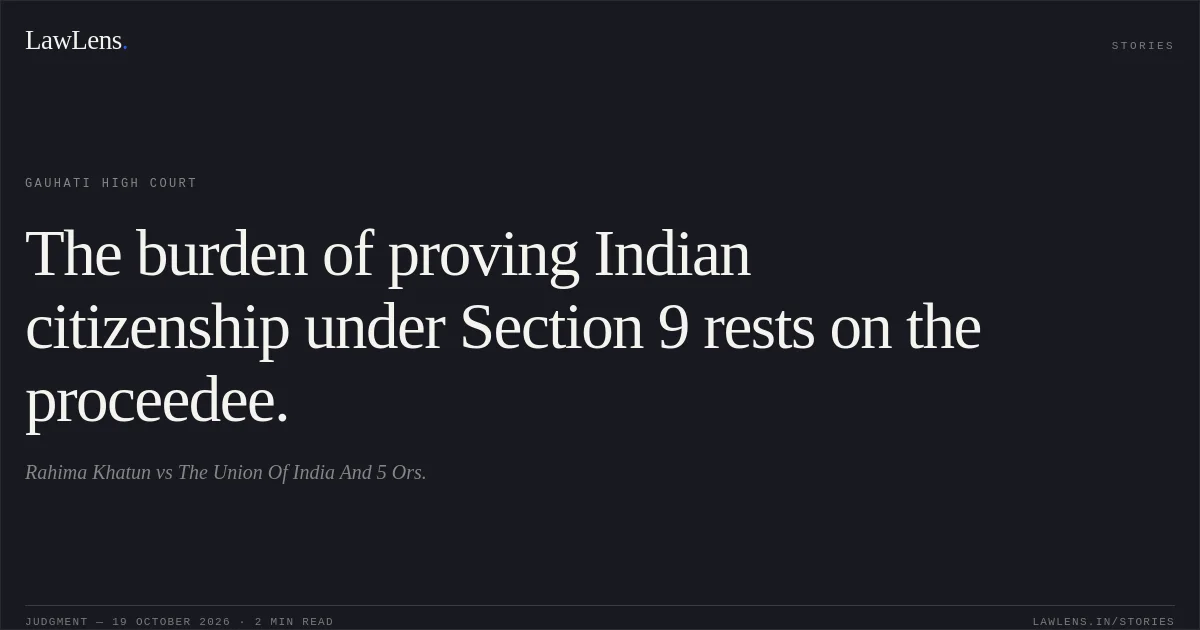
Section 9 of the Foreigners Act, 1946 places on the person concerned the burden of proving that they are not a foreigner, notwithstanding the Indian Evidence Act, 1872.
Source reference: p. 9, para. 19Relying on Sarbananda Sonowal v. Union of India, the Court noted that a proceedee should ordinarily establish matters such as date and place of birth and the identity, place of birth and citizenship of their parents, which are especially within their knowledge.
Source reference: pp. 6, 11, paras. 10, 23Under Article 226, a writ court does not reweigh evidence or substitute its own findings for those of a tribunal; certiorari may issue for jurisdictional or apparent legal error.
Source reference: pp. 10–11, para. 22Documentary evidence must be proved as to both the document and its contents, and oral testimony or an unsupported certificate may not establish the claimed relationship.
Source reference: pp. 12–14, paras. 25–28Reasoning
The petitioner’s written statement omitted material particulars, including her date of birth and the names of her parents.
Source reference: p. 11, para. 23Although the 1965 and 1970 voter lists contained names of projected relatives, they did not name the petitioner, and she failed to establish a reliable link to those persons; the Court also noted that her name first appeared in the 1997 voter list, when she was apparently 28.
Source reference: p. 12, para. 24The Gaonburah certificate was unsupported by contemporaneous records, the projected brother’s oral evidence lacked documentary corroboration, and the school certificate was obtained decades later and was not proved by school authorities.
Source reference: pp. 12–14, paras. 25–27The Court therefore found no basis to disturb the Tribunal’s factual conclusion in certiorari review.
Source reference: pp. 14–15, paras. 29–30Holding
The Court held that the petitioner failed to discharge her burden of proving Indian citizenship and that the Tribunal’s opinion did not warrant interference.
The writ petition was dismissed, the interim order vacated, and consequential action was left to proceed in accordance with law.
Source reference: p. 14, para. 31Acts & Sections Cited
4 provisions across 3 statutes referred to in this judgment. Linked provisions open on LawLens.
Foreigners Act, 19462
Foreigners (Tribunals) Order, 19641
Indian Evidence Act, 18721
Original Court PDF
Rahima KhatunvsThe Union Of India And 5 Ors.
Click to open original judgment
Original judgment, available to read, download and summarize on LawLens.in