Facts
The respondent, Boeing India Pvt. Ltd. (BIPL), was the amalgamated entity of Boeing International Corporation India Pvt. Ltd. (BICIPL), which had merged with BIPL on February 27, 2018, with an appointed date of April 1, 2017
Source reference: p.16BICIPL had filed its return of income for Assessment Year (AY) 2016-17 on November 29, 2016
Source reference: p.2, para. 3A notice for scrutiny assessment under Section 143(2) of the Income Tax Act, 1961 (the Act) was issued to BICIPL on July 21, 2017
Source reference: p.2, para. 3The respondent informed the Revenue about the amalgamation via a letter dated April 10, 2018
Source reference: p.3, para. 9Subsequently, the Transfer Pricing Officer (TPO) issued an order under Section 92CA(3) on October 31, 2019, in the name of BIPL
Source reference: p.3, para. 10However, the Assessing Officer (AO) issued the draft assessment order on December 21, 2019, and the final assessment order on March 30, 2021, in the name and Permanent Account Number (PAN) of BICIPL, the non-existent amalgamating entity
Source reference: p.3, para. 12; p.17The Dispute Resolution Panel (DRP) directions on October 19, 2020, were issued in the name of BIPL
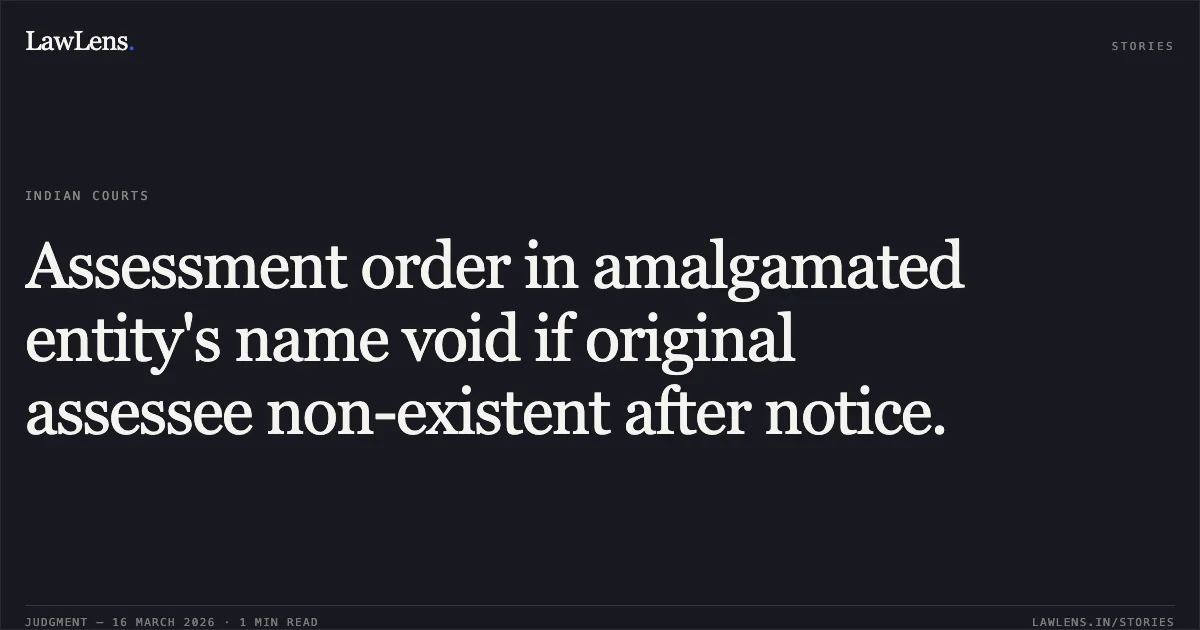
Source reference: p.4, para. 12; p.16The Income Tax Appellate Tribunal (ITAT) set aside the final assessment order, holding it void ab initio because it was issued in the name of a non-existent entity, relying on PCIT v. Maruti Suzuki and CIT v. Sony Mobile Communications India Pvt. Ltd.
Source reference: p.2, para. 2The Revenue appealed to the High Court, arguing that the error was a technical glitch in the ITBA portal and curable under Section 292B of the Act
Source reference: p.6, para. 7Issues
Whether the final assessment order dated March 30, 2021, issued in the name of the non-existent amalgamating entity (BICIPL), is valid, and consequently, whether the assessment can be continued against the amalgamated entity (BIPL)
Source reference: p.15, para. 21Whether the issuance of the final assessment order in the name of the non-existent entity constitutes a merely procedural irregularity curable under Section 292B of the Income Tax Act, 1961
Source reference: p.6, para. 9; p.14, para. 20bLaw Applied
The court primarily applied Section 292B of the Income Tax Act, 1961, which addresses the non-invalidation of proceedings due to mistakes, defects, or omissions, provided they are in substance and effect in conformity with the intent and purpose of the Act
Source reference: p.26, para. 32It relied on the Supreme Court's decision in PCIT v. Maruti Suzuki, (2020) 18 SCC 331, which established that an assessment order issued against a non-existent company, especially when the AO was informed of the amalgamation, is a substantive illegality and not a procedural violation curable under Section 292B
Source reference: p.26, para. 32; p.27, para. 36The court also referred to its Coordinate Bench judgment in CIT v. Sony Mobile Communications India Pvt. Ltd., 2023/DHC/001366, which reinforced the Maruti Suzuki principle even when the jurisdictional notice was issued before amalgamation
Source reference: p.27, para. 36Additionally, the court cited Spice Entertainment Ltd. v. Commissioner of Service Tax, (2012) 247 CTR 500, affirmed by the Supreme Court, holding that an assessment against an amalgamating entity after cessation of its existence constitutes a jurisdictional defect, not a curable defect under Section 292B
Source reference: p.27, para. 31Reasoning
The court found that the final assessment order was issued in the name of BICIPL, which had ceased to exist after amalgamation with BIPL, despite the Revenue being informed of the merger on April 10, 2018
Source reference: p.24, para. 28Unlike the facts in PCIT v. Mahagun Realtors (Private) Limited, (2022) 19 SCC 1, where the assessee concealed the amalgamation and consistently participated as the amalgamating entity, BIPL had duly informed the AO
Source reference: p.24, para. 28-29The court distinguished Sky Light Hospitality LLP v. CIT, (2018) 405 ITR 296, noting that the Supreme Court in Maruti Suzuki clarified that Sky Light involved a peculiar clerical error and not a substantive illegality of assessing a non-existent entity
Source reference: p.25, para. 30; p.26, para. 32The court reiterated that assessing a non-existent entity is a "substantive illegality" and not a "procedural violation... curable under Section 292B" based on Maruti Suzuki and Spice Entertainment
Source reference: p.26, para. 32The argument of a "technical glitch" in the ITBA portal was rejected, as the Revenue is responsible for its systems' compliance with the Act, and an assessee cannot be held accountable for such malfunctions
Source reference: p.13, para. 17; p.31, para. 35The court also noted the inconsistency of the Revenue's action, as the TPO and DRP orders were in the amalgamated entity's name, while the final order reverted to the defunct entity's name
Source reference: p.17, para. 30; p.39, para. 38Holding
The court concluded that no substantial question of law arose
It upheld the ITAT's decision, dismissing the appeal and affirming that the final assessment order dated March 30, 2021, issued in the name of the non-existent amalgamating entity BICIPL, was void ab initio
Source reference: p.38, para. 42This defect was deemed a substantive illegality and not a curable procedural irregularity under Section 292B of the Act, especially given the AO was informed of the amalgamation
Source reference: p.26, para. 32; p.32, para. 36Acts & Sections Cited
18 provisions across 2 statutes referred to in this judgment. Linked provisions open on LawLens.
Companies Act, 19561
Income Tax Act, 1961
Original Court PDF
Principal Commissioner Of Income Tax-1vsBoeing India Pvt. Ltd.
Click to open original judgment
Original judgment, available to read, download and summarize on LawLens.in