Facts
The petitioner-trust, eligible for exemption under Section 10(23C)(vi) of the Income-tax Act, 1961, filed its return for AY 2017–18 declaring nil income. During scrutiny, the Assessing Officer sought details concerning remuneration of ₹42 lakh paid to a trustee and other expenditure-related matters. After examining the materials, the Assessing Officer completed assessment under Section 143(3) on 10 December 2019 without disturbing the exemption claim.
Source reference: para. 2In 2024, the respondent issued a notice under Section 148A(b), alleging escapement of income on account of remuneration, gratuity provision, staff welfare expenses, fee waivers/scholarships and sponsorship expenditure. Despite the petitioner’s detailed reply, an order under Section 148A(d) and notice under Section 148 were issued on 8 April 2024, alleging escapement of ₹3,01,56,352.
Source reference: para. 3During the pendency of the writ petition, and despite an interim order restraining final assessment, the Assessing Officer passed an assessment order under Sections 147 and 144B on 6 March 2026. The Revenue acknowledged the breach but claimed that the assessment order could not be withdrawn through the income-tax portal.
Source reference: paras. 7–9Issues
1. Whether the reassessment proceedings under Sections 147, 148 and 148A were sustainable when, even after the alleged disallowances of ₹3,01,56,352, the petitioner had applied 86.92% of its income towards its educational objects and therefore continued to satisfy the 85% application requirement under Section 10(23C)(vi).
Source reference: paras. 12–152. Whether the reassessment constituted an impermissible change of opinion, particularly when the relevant issues and supporting documents had been examined during the original scrutiny assessment.
Source reference: paras. 5, 16–173. Whether the assessment order dated 6 March 2026, passed in breach of the Court’s interim restraint, could be sustained merely because the Revenue’s electronic system lacked functionality to withdraw it.
Source reference: paras. 7–11, 204. Whether the petitioner was entitled to seek dropping of the reassessment proceedings under Section 152(2) on demonstrating that inclusion of the alleged escaped income would not result in any additional taxable income.
Source reference: paras. 18–19Law Applied
The Court applied Section 10(23C)(vi) of the Income-tax Act, including its proviso requiring an approved educational institution to apply its income wholly and exclusively to its objects while permitting accumulation of up to 15%, thereby requiring application of at least 85% of income in the relevant circumstances.
Source reference: paras. 14–15Sections 147, 148 and 148A govern reassessment and require a legally sustainable basis for concluding that income chargeable to tax has escaped assessment.
Source reference: paras. 1, 3Section 152(2) permits an assessee to seek dropping of reassessment proceedings where it demonstrates that it has already been assessed on an amount not lower than the amount on which it would properly be assessed even if the alleged escaped income were taken into account.
Source reference: paras. 18–19Section 264 empowers the Principal Commissioner or Commissioner to revise an order passed by a subordinate authority and to pass an order, including setting aside or modifying the order, provided it is not prejudicial to the assessee.
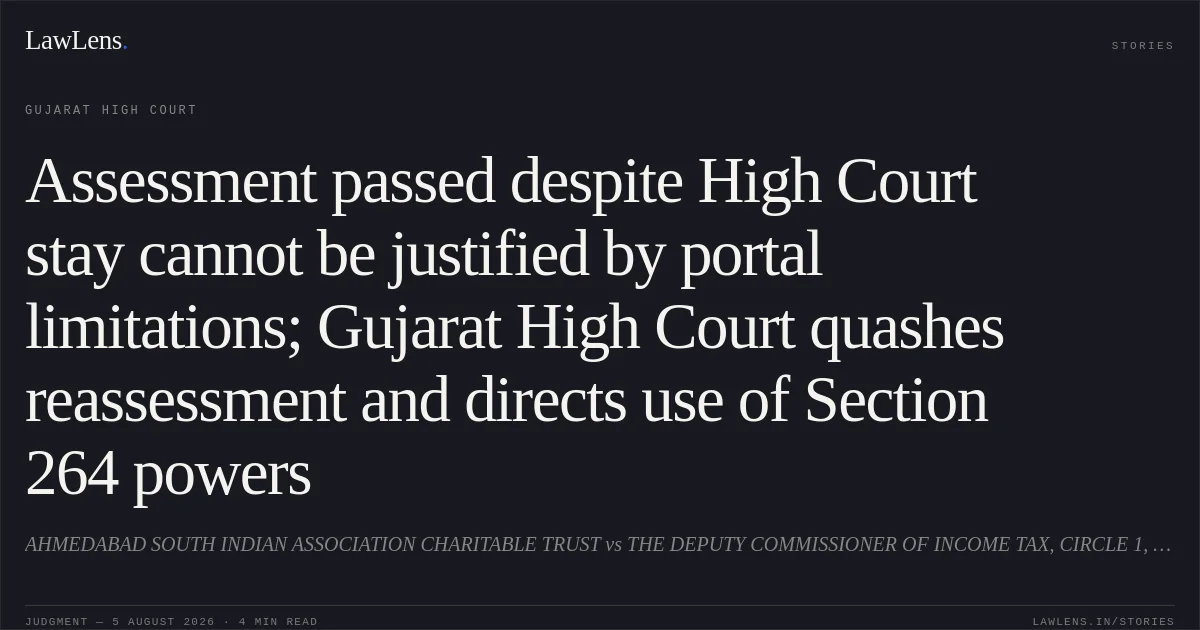
Source reference: paras. 10–11An administrative or technical limitation in the income-tax portal cannot justify non-compliance with a binding judicial order.
Source reference: para. 11Reasoning
The Court found that the petitioner had reported gross receipts of ₹33,16,43,048 and application of income of ₹31,84,16,553, representing 96.01% utilisation. Even after accepting the Revenue’s proposed disallowance of ₹3,01,56,352, the utilisation remained ₹28,82,60,201, or 86.92%, which exceeded the statutory 85% threshold under Section 10(23C)(vi). Consequently, the alleged disallowances would not create taxable income or deprive the petitioner of its exemption.
Source reference: paras. 13–15The Court also noted that the petitioner had furnished documentary material during the original scrutiny regarding trustee remuneration, gratuity, staff welfare, fee concessions and sponsorship expenses, but the reassessment order failed to properly consider those explanations. The reassessment therefore lacked a meaningful application of mind and could not be sustained where the alleged escaped income had no effective tax consequence.
Source reference: paras. 16–17Further, the Assessing Officer’s decision to pass the assessment order despite the interim restraint was impermissible; the Revenue’s inability to withdraw the order electronically did not absolve it of compliance, and the competent Commissioner could exercise Section 264 powers to set aside or revise such an order.
Source reference: paras. 9–11, 20Holding
The Court held that the reassessment proceedings were unsustainable because, even on the Revenue’s own computation, the petitioner had applied more than 85% of its income for its educational purposes and there was no effective escapement of taxable income under Section 10(23C)(vi).
The Court also found that the reassessment disregarded material already furnished during scrutiny and that the subsequent assessment order had been passed in breach of the interim order.
Source reference: paras. 16–20The writ petition was allowed; the notice under Section 148, the order under Section 148A(d), both dated 8 April 2024, and the assessment order dated 6 March 2026 were quashed and set aside. Rule was made absolute.
Source reference: para. 21Original Court PDF
AHMEDABAD SOUTH INDIAN ASSOCIATION CHARITABLE TRUSTvsTHE DEPUTY COMMISSIONER OF INCOME TAX, CIRCLE 1, EXEMPTION, AHMEDABAD
Click to open original judgment
Original judgment, available to read, download and summarize on LawLens.in