Facts
The Petitioner, SK Finance Limited, filed a petition under Section 9 of the Arbitration and Conciliation Act, 1996, seeking interim measures against the Respondent, UP Money Limited
Source reference: para. 1The dispute arose from a Servicing Agreement dated 18.02.2025, under which certain loan assets and receivables were assigned to the Petitioner
Source reference: para. 1The Petitioner alleged that the Respondent failed to facilitate the collection of assigned receivables, failed to hand over original loan files and KYC documents, and was clandestinely settling loan transactions with erstwhile customers to the Petitioner’s detriment
Source reference: para. 3-6While certain interim reliefs were granted on 02.12.2025, the Petitioner contended that the disclosures made by the Respondent via affidavit were incomplete and non-compliant with the agreement
Source reference: para. 2-3Issues
1. Whether the Respondent, as the assignor, can be restrained from collecting receivables or settling loan accounts after the underlying assets have been assigned to the Petitioner
Source reference: para. 11-122. Whether the Court should direct the Respondent to hand over original underlying documents and records to enable the Petitioner to proceed with its Statement of Claims
Source reference: para. 4-5, 14Law Applied
The Court applied Section 9 of the Arbitration and Conciliation Act, 1996, which provides for interim measures by the Court to secure the subject matter of the dispute
Source reference: para. 1The court also relied on the principle of contractual assignment, asserting that once receivables and loan agreements are legally transferred, the assignor (Respondent) loses the right to interfere with, collect, or settle those debts independently
Source reference: para. 11-12Reasoning
The Court noted that it was an admitted fact that the loan agreements and their respective receivables had been transferred to the Petitioner
Source reference: para. 11Consequently, the Court found that allowing the Respondent to continue collecting dues or negotiating independent settlements with customers would be legally inconsistent with the assignment and detrimental to the Petitioner’s rights
Source reference: para. 12-13Addressing the Petitioner’s need for documentation, the Court observed that the lack of KYC and original loan files materially hindered the Petitioner’s ability to file a Statement of Claims
Source reference: para. 4Since the Respondent did not object to notifying the public about the transfer of assets, the Court found it appropriate to permit public advertisements to clarify the change in the servicer and owner of the debt
Source reference: para. 9Holding
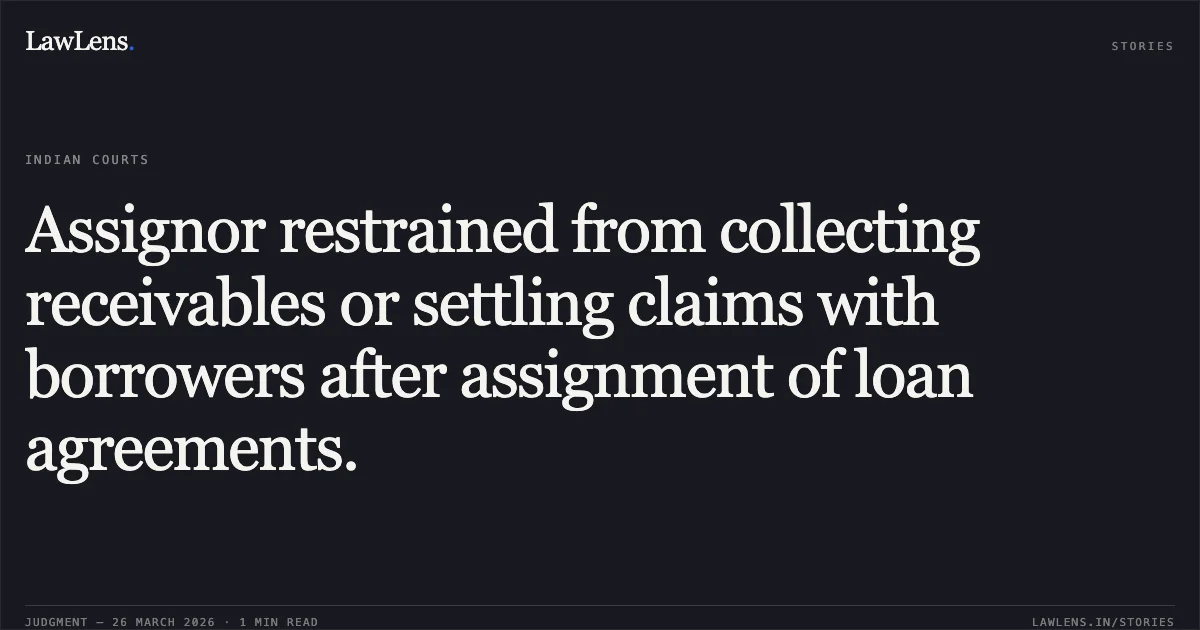
The Respondent is strictly interdicted from making any collections or attempting to settle any issues with erstwhile customers whose loans were assigned to the Petitioner
The Respondent must hand over all available documents relating to the assigned transactions to the Petitioner within four weeks
Source reference: para. 14The Petitioner is permitted to publish public notices in English and local language newspapers at its own expense to inform borrowers of the assignment
Source reference: para. 7-9The Petition was disposed of on these terms
Source reference: para. 15Acts & Sections Cited
1 provisions across 1 statute referred to in this judgment. Each provision opens on LawLens.
Arbitration and Conciliation Act, 19961
Original Court PDF
Sk Finance LimitedvsUp Money Limited
Click to open original judgment
Original judgment, available to read, download and summarize on LawLens.in