Facts
Shubham Equipment Private Limited (“SEPL”) and Rothwell Water Company Limited (“RWCL”) entered into a Technical Collaboration Licence Agreement in 2019.
Source reference: paras. 4–8In 2021, their promoters executed a Joint Venture Agreement (“JVA”) to establish an Indian joint venture; in 2023, SEPL and RWCL entered into a Memorandum of Understanding (“MoU”) concerning services for a Mumbai project.
Source reference: paras. 4–8The JVA and MoU contained arbitration clauses providing for arbitration in Mumbai.
Source reference: paras. 4–8SEPL later alleged, among other matters, that RWCL had breached the JVA and owed amounts under the MoU.
Source reference: paras. 9–14After SEPL issued notices invoking arbitration, RWCL argued that the disputes were governed by the Licence Agreement’s arbitration clause, providing for arbitration in Seoul, and that RBIPL—a non-signatory to the JVA and MoU—could not be bound.
Source reference: paras. 9–14SEPL applied under Section 11 of the Arbitration and Conciliation Act, 1996, for appointment of an arbitrator under the JVA and MoU.
Source reference: para. 13Issues
1. Whether the arbitration clause in the Licence Agreement governed disputes arising under the JVA and MoU, such that the disputes should be referred to arbitration in Korea rather than under the arbitration clauses in those agreements.
Source reference: paras. 16, 20–212. Whether RBIPL’s status as a non-signatory to the JVA and MoU prevented its participation in the arbitration at the referral stage.
Source reference: paras. 16–17, 22Law Applied
Section 11(6-A) of the Arbitration and Conciliation Act, 1996, limits the referral court’s inquiry to the prima facie existence of an arbitration agreement; once that existence is established, the court should refer the parties to arbitration.
Source reference: para. 19The Court relied on In re: Interplay Between Arbitration Agreements under the Arbitration and Conciliation Act, 1996 and the Indian Stamp Act, 1899, (2024) 6 SCC 1, for this principle.
Source reference: para. 19Disputes about the scope of the arbitration agreement and the proper parties to the arbitration may be left to the arbitrator where they require adjudication beyond the referral court’s limited inquiry.
Source reference: paras. 21–22Reasoning
The existence of the arbitration agreements in the JVA and MoU was undisputed.
Source reference: paras. 16, 18The Court found that the agreements prima facie dealt with distinct subject matters: the Licence Agreement concerned patent licences, the JVA established an Indian joint venture, and the MoU provided for services by SEPL in connection with a project.
Source reference: para. 21The JVA’s entire-agreement clause and the MoU’s clause superseding prior agreements supported treating their arbitration clauses as applicable to disputes arising under those agreements.
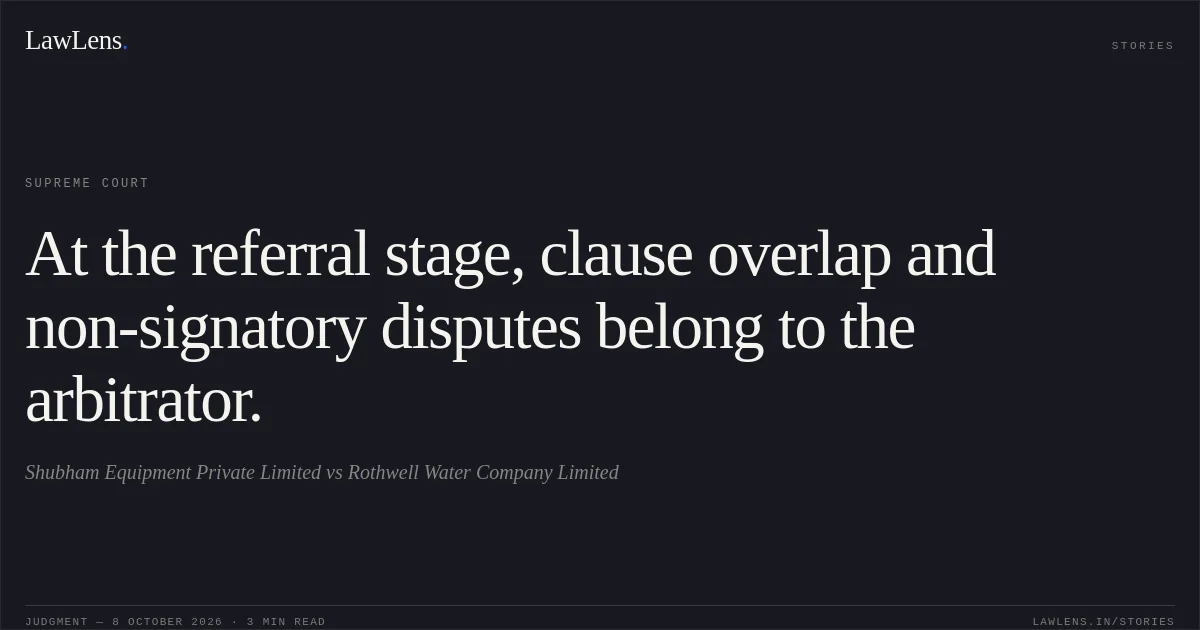
Source reference: paras. 18, 21Whether the claims also overlapped with disputes under the Licence Agreement was a matter for the arbitrator, not a basis to refuse referral at the threshold.
Source reference: para. 21Likewise, RBIPL’s non-signatory status raised a contentious issue, particularly given its relationship with RWCL and the allegation that it was incorporated in breach of the JVA; the Court therefore left that issue to the arbitrator.
Source reference: para. 22Holding
The Supreme Court allowed both arbitration petitions and appointed Justice Ramesh Deokinandan Dhanuka, former Chief Justice of the Bombay High Court, as sole arbitrator, with liberty to fix his remuneration.
It did not determine whether RBIPL was ultimately bound by the arbitration agreements or resolve the scope of any overlap with the Licence Agreement; those matters were left for the arbitrator.
Source reference: paras. 21–23There was no order as to costs.
Source reference: para. 24Acts & Sections Cited
1 provisions across 1 statute referred to in this judgment. Each provision opens on LawLens.
Arbitration and Conciliation Act, 19961
Original Court PDF
Shubham Equipment Private LimitedvsRothwell Water Company Limited
Click to open original judgment
Original judgment, available to read, download and summarize on LawLens.in