Facts
The Petitioner, a supplier of electrical items to the Indian Railways since 2019, succeeded in an e-tender floated by the Respondent in September 2025 for a contract valued at approximately ₹2.62 crores. It furnished the requisite security deposit and performance bank guarantee and placed purchase orders in December 2025.
Source reference: pp. 1–2On 2 February 2026, the Respondent issued correspondence proposing termination on the ground of a discrepancy between the Petitioner’s firm name in the e-tender and its Electrical Contractor’s licence.
Source reference: pp. 1–2On 26 February 2026, the Respondent issued a termination notice alleging that the Petitioner had failed to commence work or demonstrate progress within 48 hours, thereby rescinding the contract under Clause 62 of the Standard General Conditions of Contract (“SGCC”).
Source reference: pp. 1–2The Petitioner invoked the arbitration clause contained in Clause 64(1) of the SGCC and served a notice under Section 21 of the Arbitration and Conciliation Act, 1996, dated 13 March 2026.
Source reference: pp. 2–4During the Section 11 proceedings, the Respondent stated that it had no objection to the appointment of a sole arbitrator.
Source reference: p. 4Issues
Whether the parties had a valid arbitration agreement covering the disputes arising from the termination of the contract, warranting reference under Section 11 of the Arbitration and Conciliation Act, 1996.
Source reference: paras. 1, 12–13; pp. 1, 4Whether a sole arbitrator ought to be appointed in view of the arbitration provision in Clause 64(1) of the SGCC and the Respondent’s consent to the reference.
Source reference: paras. 10–15; pp. 4–5Whether questions concerning arbitrability, jurisdiction, and the merits of the parties’ claims should be determined at the referral stage.
Source reference: paras. 18–19; p. 5Law Applied
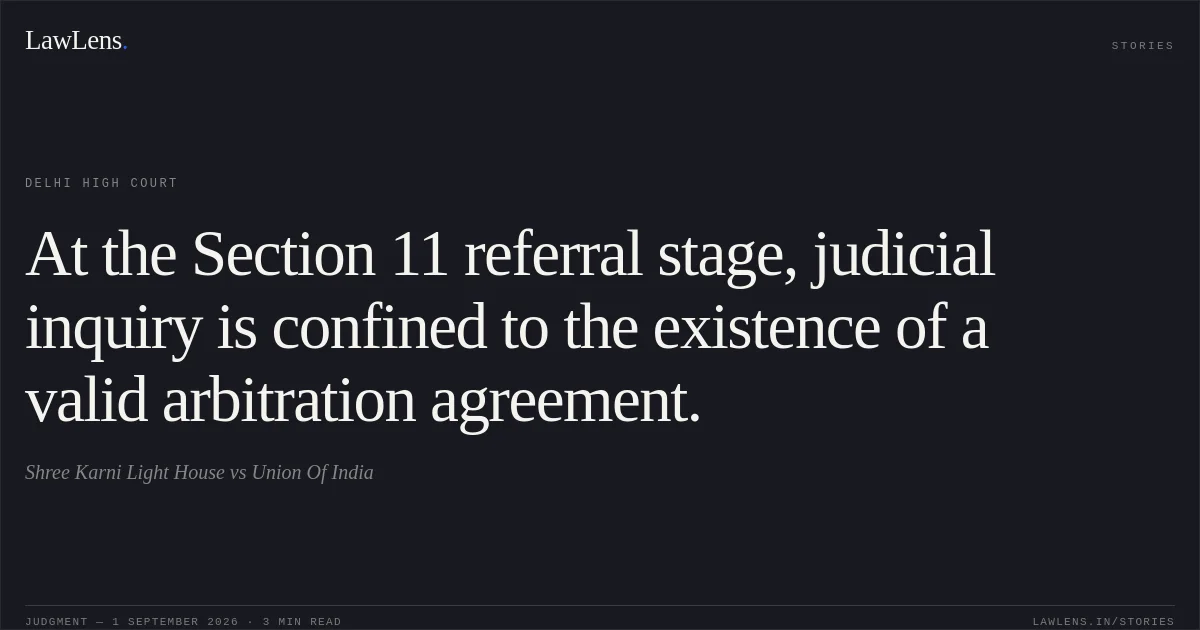
The Court applied Section 11(6) of the Arbitration and Conciliation Act, 1996, under which the referral court’s inquiry at the appointment stage is confined to examining the existence of a valid arbitration agreement.
Source reference: pp. 2–4Clause 64(1) of the SGCC provided for arbitration of disputes or differences concerning the construction or operation of the contract and the parties’ rights and liabilities, subject to specified exceptions.
Source reference: pp. 2–4The Court relied on SBI General Insurance Co. Ltd. v. Krish Spinning, 2024 SCC OnLine SC 1754, for the principle that the Section 11 inquiry is limited to the existence of a valid arbitration agreement.
Source reference: p. 4Issues of arbitrability, jurisdiction, claims, and counterclaims may be raised before and decided by the arbitral tribunal, and observations in a Section 11 order do not determine the merits.
Source reference: p. 5Reasoning
Clause 64(1) of the SGCC constituted a valid arbitration agreement capable of covering the disputes arising from the Respondent’s termination of the contract.
Source reference: pp. 2–4The Petitioner had invoked the clause and served a Section 21 notice, while the Respondent expressly stated that it had no objection to the appointment of a sole arbitrator.
Source reference: pp. 2–4Since the statutory inquiry was limited to the existence of a valid arbitration agreement, the Court found no impediment to constituting the tribunal and did not adjudicate the validity of the termination, the alleged discrepancy in the Petitioner’s name, or the merits of the claims.
Source reference: paras. 12–19; pp. 4–5Those matters, including any objections to arbitrability or jurisdiction, were left open for determination by the arbitrator.
Source reference: paras. 12–19; pp. 4–5Holding
The Court allowed the petition and appointed Ms. Anamika Tiwari, Advocate, as the Sole Arbitrator to adjudicate the disputes between the parties, the Petitioner’s claim being stated at ₹16,14,030.
The arbitration was directed to be conducted under the rules and aegis of the Delhi International Arbitration Centre, with fees payable according to the DIAC Schedule of Fees.
Source reference: para. 17; p. 5The arbitrator was directed to furnish the disclosures required under Section 12(2) within three weeks of entering reference.
Source reference: paras. 16–21; pp. 5–6The parties were permitted to raise all pleas, including objections concerning arbitrability and jurisdiction, before the tribunal, and the petition was disposed of accordingly.
Source reference: paras. 16–21; pp. 5–6Acts & Sections Cited
3 provisions across 1 statute referred to in this judgment. Each provision opens on LawLens.
Arbitration and Conciliation Act, 19963
Original Court PDF
Shree Karni Light HousevsUnion Of India
Click to open original judgment
Original judgment, available to read, download and summarize on LawLens.in