Facts
The informant alleged that on 3 July 2023, while staying at Hotel New Ros Common, Kasauli, two men, identified as Mohan Lal and Rocky Mittal, induced her and her friend to visit their room by promising a government job and a role in a music album.
Source reference: p.2–3She alleged that the accused forcibly administered liquor, raped her in the presence of her friend, recorded the incident, took photographs, and threatened her.
Source reference: p.2–3She lodged the complaint on 13 December 2024, approximately 18 months after the alleged incident.
Source reference: p.2–3During investigation, the police recorded statements, inspected the hotel, seized photocopies of the hotel register, and found that the CCTV footage had been overwritten after its one-month retention period.
Source reference: p.3–4The informant’s friend denied witnessing any rape and stated that no such incident had occurred in her presence.
Source reference: p.3–4Hotel occupants and employees also did not corroborate the allegation.
Source reference: p.3–4The police filed a cancellation report.
Source reference: p.4–5The informant filed a protest petition alleging defective and one-sided investigation and seeking cognizance and further investigative directions.
Source reference: p.4–5The Additional Chief Judicial Magistrate accepted the cancellation report and dismissed the protest petition on 8 January 2026, principally finding the allegation inherently improbable, belated, uncorroborated, and contradicted by the informant’s friend.
Source reference: p.5–6The informant challenged that order in revision.
Source reference: p.5–6Issues
Whether the Magistrate was justified in accepting the police cancellation report and dismissing the protest petition after assessing the credibility and inherent probability of the informant’s allegations at the pre-summoning stage.
Source reference: p.10–12, 14–15Whether the informant’s statement, recorded before the Magistrate and alleging rape, by itself constituted sufficient material to summon the accused despite the contradictory statement of the alleged eyewitness and absence of corroboration.
Source reference: p.16–19Whether alleged defects in investigation—such as non-arrest of the accused, non-seizure of original records and mobile phones, and non-availability of CCTV footage—required interference with the Magistrate’s order.
Source reference: p.17–20Law Applied
The Court applied the principle that issuing process is a serious judicial act and cannot follow mechanically merely because a complainant makes allegations on oath; the Magistrate must scrutinise the complaint and supporting material and determine whether a prima facie case exists, as held in Pepsi Foods Ltd. v. Judicial Magistrate, (1998) 5 SCC 749.
Source reference: p.10–11Under Sections 200, 203 and 204 of the Code of Criminal Procedure, the Magistrate must assess whether the evidence discloses sufficient grounds for proceeding and may consider inherent improbabilities apparent from the complaint or evidence, as explained in Gulam Mohd. Kabir Mohd. Mir v. State of Maharashtra and Khan Mohammad v. Talib Hussain.
Source reference: p.11–12, 14–15Although the testimony of a prosecutrix in a sexual-offence case ordinarily deserves predominant consideration, it need not be accepted where the account is improbable or contradicted by material evidence; the Court relied on Tameezudeen v. State and Raju v. State of Madhya Pradesh.
Source reference: p.16–17The Court also applied Joginder Kumar v. State, (1994) 4 SCC 260, that arrest is not automatic merely because a complaint has been made and must be justified by necessity.
Source reference: p.17–18Reasoning
The Court held that the Magistrate was entitled to examine the inherent probability and credibility of the allegation at the stage of deciding whether process should issue, rather than blindly accept the informant’s statement.
Source reference: p.10–13The informant had identified her friend as an eyewitness, but the friend categorically denied that any rape had occurred in her presence and alleged that she had been asked to depose falsely.
Source reference: p.12–13This contradiction materially undermined the informant’s account, particularly because there was no independent corroboration from hotel occupants, employees, or the informant’s employer.
Source reference: p.14–15The Court also considered the unexplained 18-month delay, the informant’s failure to disclose the rape in an earlier statement, her refusal to undergo internal and local medical examination, and the absence of CCTV footage due to the hotel’s retention policy.
Source reference: p.13–14, 16The alleged investigative deficiencies did not cure the fundamental absence of credible prima facie material; the original hotel register, CCTV footage, and further electronic material would not materially alter the undisputed fact of the parties’ presence at the hotel or establish the alleged assault.
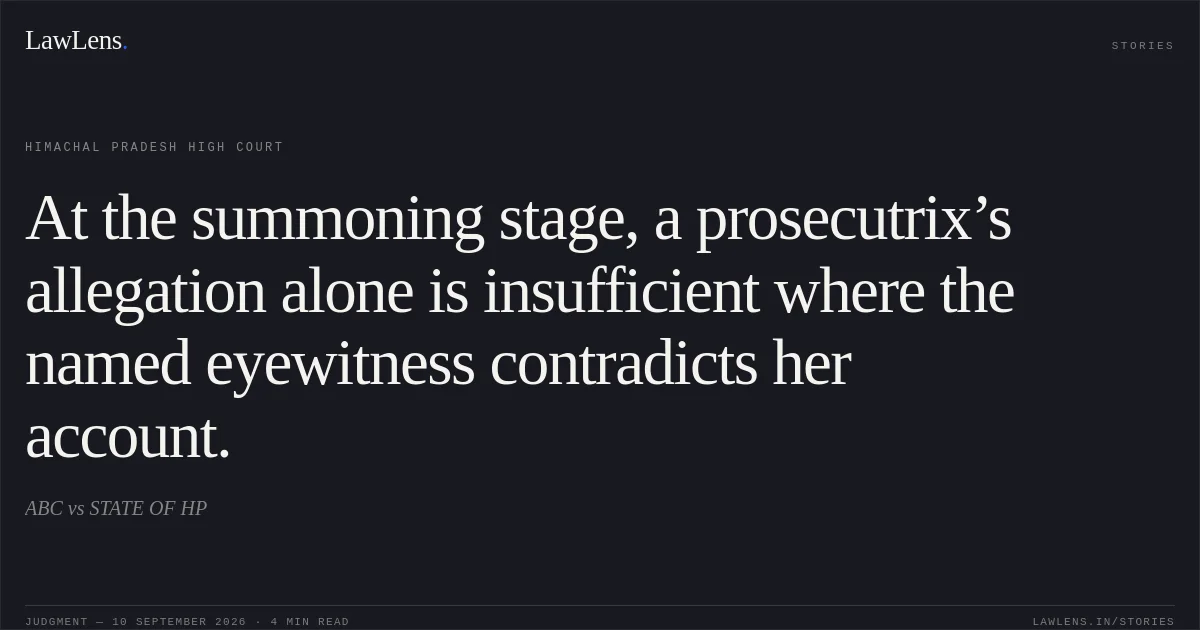
Source reference: p.17–20Accordingly, the informant’s sworn statement alone was insufficient to justify summoning the accused in circumstances where her named eyewitness had contradicted her version.
Source reference: p.18–19Holding
The High Court answered the issues against the informant.
It held that the Magistrate had properly assessed the available material, was justified in finding the allegation insufficiently credible for summoning the accused, and rightly accepted the cancellation report.
Source reference: p.14–16, 18–20The revision petition was dismissed, and any pending applications were also disposed of.
Source reference: p.20Acts & Sections Cited
6 provisions across 1 statute referred to in this judgment. Each provision opens on LawLens.
Code of Criminal Procedure, 19736
Original Court PDF
ABCvsSTATE OF HP
Click to open original judgment
Original judgment, available to read, download and summarize on LawLens.in