Facts
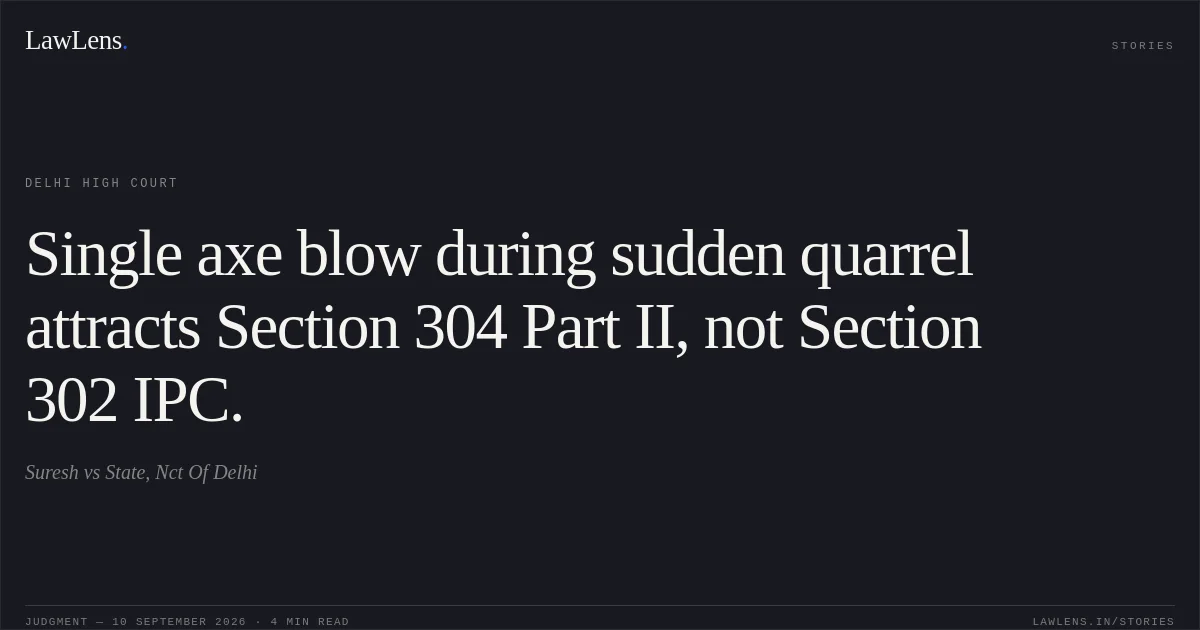
On 6 April 2019, following an altercation concerning the alleged pushing of the appellant’s dog, the appellant, Suresh, allegedly threatened Mahajan, fetched a domestic axe from his jhuggi, and inflicted a single blow on Mahajan’s head.
Source reference: pp. 2–4, paras 5–9Mahajan was taken to hospital and died on 8 April 2019 from the head injury.
Source reference: pp. 2–4, paras 5–9The appellant was arrested and an axe was recovered pursuant to his disclosure statement, although no blood was detected on it in the FSL examination.
Source reference: p. 9, para 21The Trial Court convicted him under Sections 302 and 174-A IPC and sentenced him to life imprisonment for murder and one year’s simple imprisonment for evading court proceedings, with the sentences to run concurrently.
Source reference: pp. 4–5, paras 10–13In appeal, the appellant accepted that he had caused the fatal injury but argued that the incident constituted culpable homicide not amounting to murder under Section 304 Part II IPC because it arose from a sudden quarrel without premeditation.
Source reference: p. 5, para 14Issues
1. Whether the appellant’s act of inflicting a single axe blow on the deceased’s head constituted murder under Section 302 IPC or culpable homicide not amounting to murder under Section 304 Part II IPC by virtue of Exception 4 to Section 300 IPC?
Source reference: pp. 9–11, paras 22–262. Whether the conviction and sentence under Section 174-A IPC required interference?
Source reference: p. 23, para 373. What sentence was appropriate if the conviction was altered to Section 304 Part II IPC?
Source reference: pp. 23–24, paras 38–42Law Applied
The Court applied Section 300 IPC, including Exception 4, which excludes culpable homicide from the category of murder where the act is committed without premeditation, in a sudden fight, in the heat of passion, upon a sudden quarrel, and without the offender taking undue advantage or acting cruelly.
Source reference: pp. 13–14, paras 26, 29Section 304 Part II IPC applies where death is caused with knowledge that the act is likely to cause death, but without the intention to cause death or such bodily injury as is likely to cause death.
Source reference: p. 11, para 27Relying on Sita Ram Kuchhbedia v. Vimal Rana, following Virsa Singh v. State of Punjab, the Court applied the three-stage inquiry of determining homicide, culpable homicide, and whether the act falls within Section 300 or any of its Exceptions.
Source reference: pp. 10–11, para 24It also relied on Pulicherla Nagaraju v. State of A.P. for assessing intention from factors including the weapon, situs and number of injuries, suddenness of the quarrel, premeditation, and whether undue advantage was taken.
Source reference: pp. 11–13, para 28The requirements of Exception 4 were drawn from Surinder Kumar v. UT, Chandigarh and Arjun v. State of Chhattisgarh.
Source reference: pp. 13–14, para 29The Court further considered Atul Thakur v. State of Himachal Pradesh, Surain Singh v. State of Punjab, Jagraj Singh v. State of Delhi, Sanjay Singh v. State (NCT of Delhi) and Mukesh v. State (NCT of Delhi), which recognise that a single or even multiple weapon blows do not, by themselves, exclude Exception 4 where the assault is sudden, unpremeditated and not cruel.
Source reference: pp. 14–22, paras 30–35Reasoning
The Court accepted the eyewitness account that the appellant had inflicted the fatal axe blow and held that the injury was sufficient to cause death in the ordinary course of nature, thereby satisfying clause (3) of Section 300 IPC at the initial stage.
Source reference: p. 9, para 22However, applying Exception 4, it found that the incident originated in a trivial dispute over a dog, occurred between neighbouring families without established prior enmity, unfolded within two to three minutes, and involved only one blow followed by cessation of the assault.
Source reference: pp. 20–22, paras 33–34Although the appellant fetched the axe from his jhuggi, the Court treated it as a readily available domestic tool and found no evidence of prior planning or deliberate preparation to kill.
Source reference: p. 21, para 33The words “abhi maja chakhata hoon” were held insufficient, in the circumstances of the ongoing quarrel, to establish an intention to commit murder.
Source reference: p. 22, para 35The appellant nevertheless must have known that striking a person’s head with an axe was likely to cause death; hence, the requisite mental element for Section 304 Part II was established, but the intention required for Section 302 was not.
Source reference: p. 22, para 34The conviction under Section 174-A IPC was not challenged and the one-year sentence had already been served.
Source reference: p. 23, para 37Considering the appellant’s nearly six years of actual incarceration, satisfactory jail conduct and clean antecedents, the Court considered eight years’ rigorous imprisonment proportionate.
Source reference: pp. 23–24, paras 39–42Holding
The appeal was partly allowed.
The conviction under Section 302 IPC was altered to one under Section 304 Part II IPC, and the sentence of life imprisonment was reduced to eight years’ rigorous imprisonment.
Source reference: pp. 24–25, paras 43–45The fine of ₹10,000 was maintained, with one month’s simple imprisonment in default.
Source reference: pp. 24–25, paras 43–45The conviction and sentence under Section 174-A IPC, comprising one year’s simple imprisonment and a ₹2,000 fine, were affirmed and treated as already served concurrently.
Source reference: pp. 24–25, paras 43–45The direction for consideration of compensation to the deceased’s legal heirs under the Delhi Victim Compensation Scheme, 2018 was left undisturbed.
Source reference: pp. 24–25, paras 43–45Acts & Sections Cited
10 provisions across 3 statutes referred to in this judgment. Each provision opens on LawLens.
Bharatiya Nagarik Suraksha Sanhita, 20232
Indian Penal Code, 18605
Code of Criminal Procedure, 19733
Original Court PDF
SureshvsState, Nct Of Delhi
Click to open original judgment
Original judgment, available to read, download and summarize on LawLens.in