Facts
The complainant, who belongs to a Scheduled Caste, alleged that the respondents assaulted her and her sisters-in-law with sticks, used abusive and caste-related language, and threatened them while they were working in an agricultural field on 6 June 2016.
Source reference: para. 1–2, 5–6The respondents were charged under Sections 323, 504, 506(2) and 114 of the IPC and Sections 3(1)(r) and 3(1)(s) of the Scheduled Castes and Scheduled Tribes (Prevention of Atrocities) Act, 1989.
Source reference: para. 1–2The trial Court acquitted them on 17 July 2017.
Source reference: para. 1–2, 5–6The complainant appealed under Section 378 CrPC.
Source reference: para. 1–2, 5–6Issues
Whether the trial Court’s acquittal was unreasonable or legally erroneous so as to warrant appellate interference
Source reference: para. 14–16, 19–20Whether the prosecution proved the ingredients of the offences, including that the alleged caste-based insult occurred within public view
Source reference: para. 12–13Law Applied
The Court considered the charged offences under Sections 323, 504, 506(2) and 114 IPC and Sections 3(1)(r) and 3(1)(s) of the Atrocities Act, and the complainant’s right to appeal under Section 378 CrPC.
Source reference: para. 1–2For an acquittal appeal, Chandrappa v. State of Karnataka, (2007) 4 SCC 415, as reaffirmed in Rajesh Prasad v. State of Bihar, (2022) 3 SCC 471, Babu Sahebagouda Rudragoudar v. State of Karnataka, (2024) 8 SCC 149, and Ramesh v. State of Karnataka, (2024) 9 SCC 169, recognises the appellate court’s power to reappraise evidence while requiring due regard to the double presumption of innocence; where two reasonable views are possible, the acquittal should not be disturbed.
Source reference: para. 15–18For Sections 3(1)(r) and 3(1)(s), the Court relied on Gunjan alias Girija Kumari v. State (NCT of Delhi), 2026 INSC 468, and stated that the insult or abuse must occur in a place within public view.
Source reference: para. 12–13Reasoning
The Court found that the medical evidence did not support material aspects of the alleged assault: the doctor found only simple injuries and no injury corresponding to the alleged dharia blow or dragging, and no injury was found on one of the alleged victims.
Source reference: para. 10The scene panchnama yielded no supporting articles, and the evidence disclosed a pending land dispute and a civil suit in which the complainant had failed to establish ownership or possession of the land.
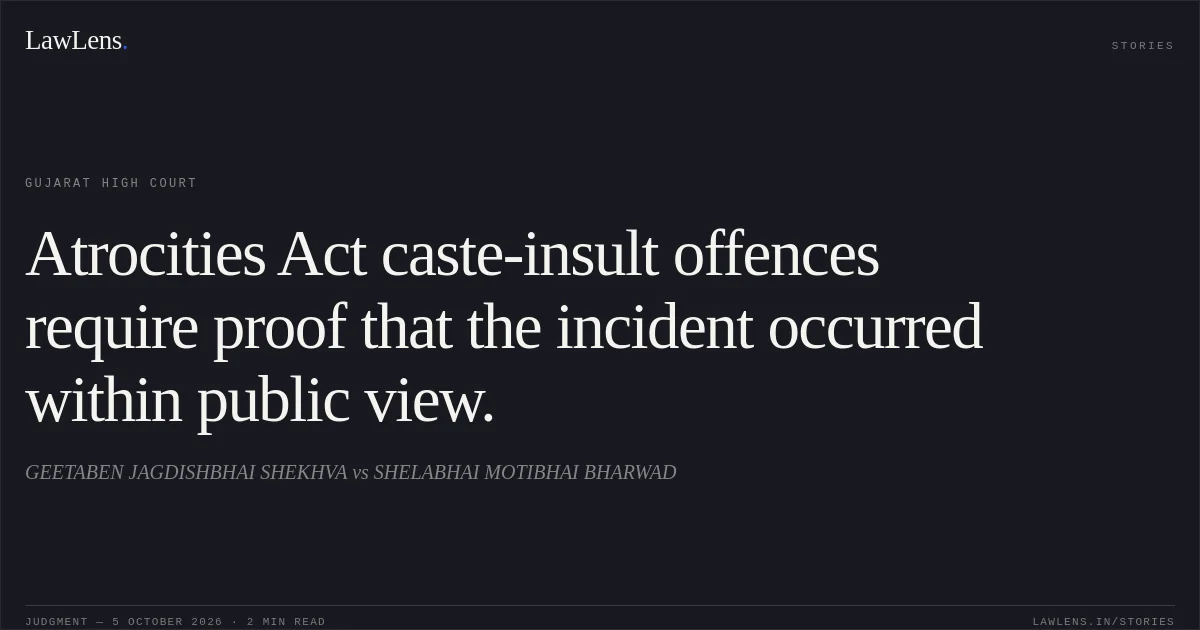
Source reference: para. 11The Court also held that the alleged incident occurred in an agricultural field and that the prosecution had not proved the required public-view ingredient of the Atrocities Act offences.
Source reference: para. 12–13Finding no credible evidence sufficient to displace the trial Court’s conclusions, and applying the heightened restraint applicable to an appeal against acquittal, the Court declined to interfere.
Source reference: para. 14–20Holding
The Court held that the prosecution had not proved the charges beyond reasonable doubt and that the trial Court had committed no error warranting reversal.
The appeal was dismissed, the acquittal was confirmed, the bail bond was cancelled, and the record and proceedings were directed to be returned to the trial Court.
Source reference: para. 21Acts & Sections Cited
7 provisions across 3 statutes referred to in this judgment. Each provision opens on LawLens.
Code of Criminal Procedure, 19732
Indian Penal Code, 18604
Scheduled Castes and the Scheduled Tribes (Prevention of Atrocities) Act, 19891
Original Court PDF
GEETABEN JAGDISHBHAI SHEKHVAvsSHELABHAI MOTIBHAI BHARWAD
Click to open original judgment
Original judgment, available to read, download and summarize on LawLens.in