Facts
A dispute arose between the appellant and his cousin co-tenants over payment of rent in a shared accommodation at Madangir, New Delhi. During the altercation, the appellant allegedly picked up a knife, assaulted Shahid Ahmed on the left side of his chest, and stated that he would kill him. Mohd. Iqbal intervened and sustained injuries to his arm.
Source reference: pp.1–2Shahid was medically found to have a sharp-cut wound measuring approximately 3×4 inches above and below the left clavicle, with pneumothorax and a punctured/collapsed left lung; Iqbal suffered simple sharp-weapon injuries.
Source reference: pp.5, 18–19The case was registered as FIR No. 491/1993 at P.S. Ambedkar Nagar under Sections 307 and 324 IPC. Shahid was declared unfit for statement, and the prosecution proceeded substantially on the statement and testimony of injured witness Mohd. Iqbal.
Source reference: p.2The Trial Court convicted the appellant under Section 307 IPC and sentenced him to five years’ rigorous imprisonment, a fine of ₹2,000, and, in default, two months’ simple imprisonment.
Source reference: p.2The appeal was initially dismissed after the appellant failed to surrender and was declared a proclaimed offender. After the appellant surrendered on 19 February 2025, the Supreme Court remanded the appeal for decision on merits.
Source reference: pp.3–4Issues
1. Whether the appellant’s act of stabbing Shahid Ahmed was accompanied by the intention or knowledge necessary to constitute an attempt to murder under Section 307 IPC, or whether it amounted only to causing hurt?
Source reference: pp.4, 6–9, 17–212. Whether the testimony of the injured and related witnesses could be relied upon in the absence of independent public witnesses?
Source reference: pp.4, 11–153. Whether the alleged lapses in investigation, including the non-joining of independent witnesses and the presence of bloodstains in the passage, created a reasonable doubt in the prosecution case?
Source reference: pp.15–174. Whether the conviction and sentence imposed by the Trial Court required interference?
Source reference: pp.20–21Law Applied
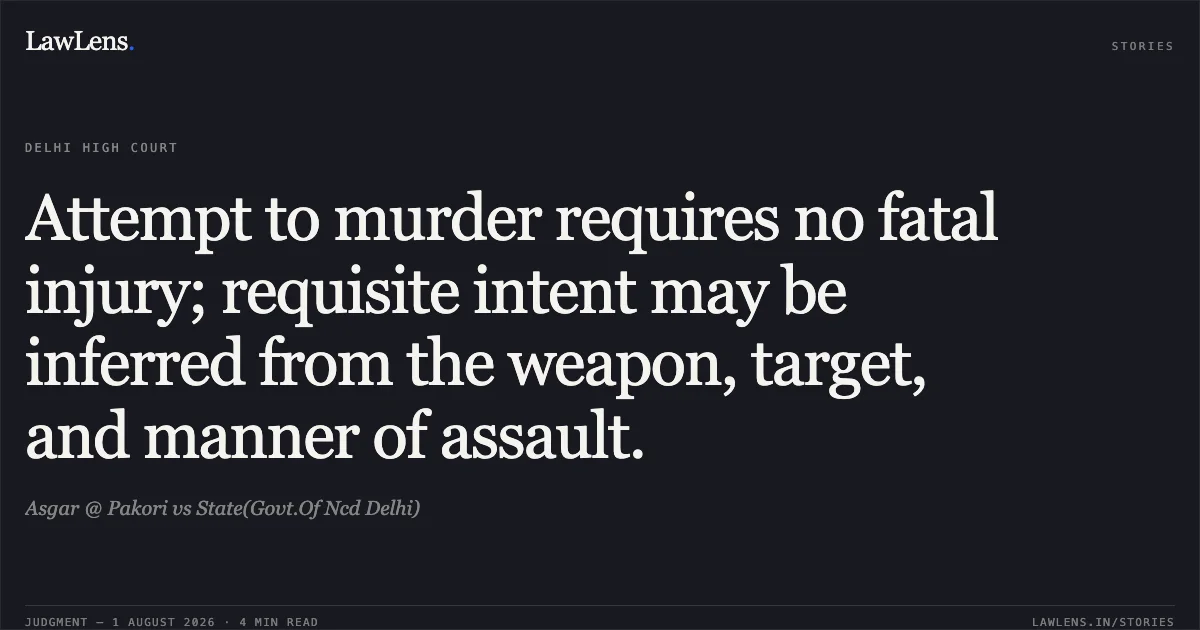
The Court applied Section 307 IPC, under which an act constitutes attempt to murder when performed with such intention or knowledge, and under such circumstances, that if death had resulted, the accused would have been guilty of murder; the actual infliction of a fatal injury is not essential.
Source reference: pp.6–8Following Hari Singh v. Sukhbir Singh, State of Madhya Pradesh v. Saleem @ Chamaru, and Prakash Chandra Yadav v. State of Bihar, the Court held that intention must be inferred from the weapon used, the manner of its use, the part of the body targeted, the severity of the blow, the surrounding circumstances and the accused’s conduct, and that injury is neither indispensable nor by itself determinative.
Source reference: pp.6–8The distinction between intention and knowledge was explained with reference to Kesar Singh v. State of Haryana and Jai Prakash v. State (Delhi Administration).
Source reference: pp.10–11On evidence, the Court relied on Sarwan Singh v. State of Punjab, Balraje v. State of Maharashtra, and Mohd. Rojali Ali v. State of Assam, holding that related witnesses are not inherently unreliable and that their evidence requires careful scrutiny, not automatic rejection; an injured witness ordinarily carries a strong assurance of presence and reliability.
Source reference: pp.12–15, 19–20Defective investigation, unless it affects the substratum of the prosecution case or creates reasonable doubt, does not by itself warrant acquittal, as held in C. Muniappan v. State of Tamil Nadu, Ganga Singh v. State of Madhya Pradesh, Sunil Kundu v. State of Jharkhand, and Surajit Sarkar v. State of West Bengal.
Source reference: pp.16–17Reasoning
The Court found that the appellant used a knife, targeted the victim’s chest, expressly threatened to kill him, and proceeded with the assault despite attempts by the co-occupants to pacify him.
Source reference: pp.17–20The resulting 3×4-inch wound caused pneumothorax and collapse of the left lung and was potentially fatal; the fact that the victim survived because of timely medical treatment did not negate the requisite mens rea under Section 307 IPC.
Source reference: pp.18–20The appellant’s alternative explanation that the injury was caused when he and the witnesses fell into a drain was rejected because it was unsupported by evidence, had not been put to the material witnesses in cross-examination, did not explain the victim’s serious chest injury or Iqbal’s injuries, and was inconsistent with the absence of any injury to the appellant.
Source reference: pp.17–18The Court further held that the related witnesses were natural witnesses because the incident occurred inside a private rented room, where independent public witnesses were unlikely to be present.
Source reference: pp.11–15, 18–20Their testimony, particularly that of injured witness Iqbal, was consistent with the medical evidence and therefore could be relied upon without independent corroboration.
Source reference: pp.11–15, 18–20The bloodstains in the passage were explained by the movement of the injured victim from the room to the police vehicle, and the alleged investigative lapses did not undermine the prosecution case.
Source reference: pp.15–17Holding
The High Court held that the appellant’s conduct, the use of a knife on the victim’s chest, the express threat to kill, the serious and potentially fatal injury, and the surrounding circumstances established the intention or knowledge required under Section 307 IPC.
The testimony of the injured and related witnesses was found credible, and the alleged investigative deficiencies did not create reasonable doubt.
Source reference: pp.18–21The conviction under Section 307 IPC and the sentence of five years’ rigorous imprisonment with a fine of ₹2,000, with two months’ simple imprisonment in default, were affirmed.
Source reference: pp.20–21The appeal was dismissed; the appellant was directed to surrender forthwith to undergo the remaining sentence and was granted the benefit of set-off under Section 428 Cr.P.C.
Source reference: pp.20–21Original Court PDF
Asgar @ PakorivsState(Govt.Of Ncd Delhi)
Click to open original judgment
Original judgment, available to read, download and summarize on LawLens.in


