Facts
The police filed a chargesheet against the appellant (a Naib Tehsildar) and co-accused persons for offences under Sections 409, 420, 467, 468, 471, and 120-B of the IPC, and Section 13(2) of the Prevention of Corruption Act, 1988 (PC Act).
Source reference: para. 2The prosecution alleged that the co-accused, Ramesh Kumar Chaudhary (Naib Tehsildar-Sales), illegally sold evacuee department land by issuing a fake sale certificate for ₹3,11,000/-, which was never deposited into the state treasury.
Source reference: para. 2The appellant allegedly forwarded this certificate to the Patwari and sanctioned the mutation of the land despite a government ban on the transfer of evacuee property.
Source reference: para. 2The co-accused persons died during the pendency of the proceedings.
Source reference: para. 5The Trial Court convicted the appellant under Sections 420 and 120-B of the IPC, and Section 13(2) of the PC Act, holding that he acted in conspiracy and misused his position.
Source reference: para. 6The appellant appealed, contending that he acted in his routine official capacity, mutation does not represent a transfer of title, and the prosecution sanction was invalidly granted.
Source reference: para. 7, 9Issues
1. Whether a sale certificate containing false averments or issued in violation of government instructions constitutes a "false document" or forgery under Sections 463 and 464 of the IPC.
Source reference: para. 12, 20, 212. Whether the attestation of a land mutation by a revenue official attracts criminal liability for cheating under Section 420 of the IPC and criminal misconduct under Section 13(2) of the PC Act.
Source reference: para. 24, 25, 263. Whether the prosecution sanction under the PC Act was validly accorded with proper application of mind.
Source reference: para. 32, 33Law Applied
The court primarily applied the definitions of forgery and "making a false document" under Sections 463 and 464 of the IPC.
Source reference: para. 13, 14Ingredients of cheating under Sections 415 and 420 of the IPC.
Source reference: para. 27, 28The principle from Mohammed Ibrahim v. State of Bihar, which established that a document containing a false averment is distinct from a "false document" itself, and execution of a deed by a person without ownership title does not amount to forgery unless there is impersonation or deception.
Source reference: para. 15, 16Adoption of principles from Mir Nagvi Askari v. CBI and Sheila Sebastian v. R Jawaharaj to affirm that criminal liability for forgery necessitates fulfillment of the strict conditions of Section 464 of the IPC.
Source reference: para. 17, 19The principle from Phool Chandra Arya v. State of U.P. that conducting statutory mutation proceedings does not satisfy the ingredients of cheating, forgery, or corruption under Section 13(1)(d) of the PC Act absent proof of deceptive inducement or corrupt pecuniary advantage.
Source reference: para. 25The principle from S.W. Palanitkar v. State of Bihar and G.V. Rao v. L.H.V. Prasad that mens rea or dishonest intent must exist at the inception of a transaction to sustain a cheating charge.
Source reference: para. 27, 28Reasoning
The Court observed that the prosecution failed to establish the foundational element of forgery because there was no allegation that the co-accused impersonated someone else, tampered with a signed document, or obtained it through mental incapacity/deception under Section 464 of the IPC.
Source reference: para. 16, 20Even if the sale certificate violated government instructions, it did not satisfy the statutory definition of a forged document.
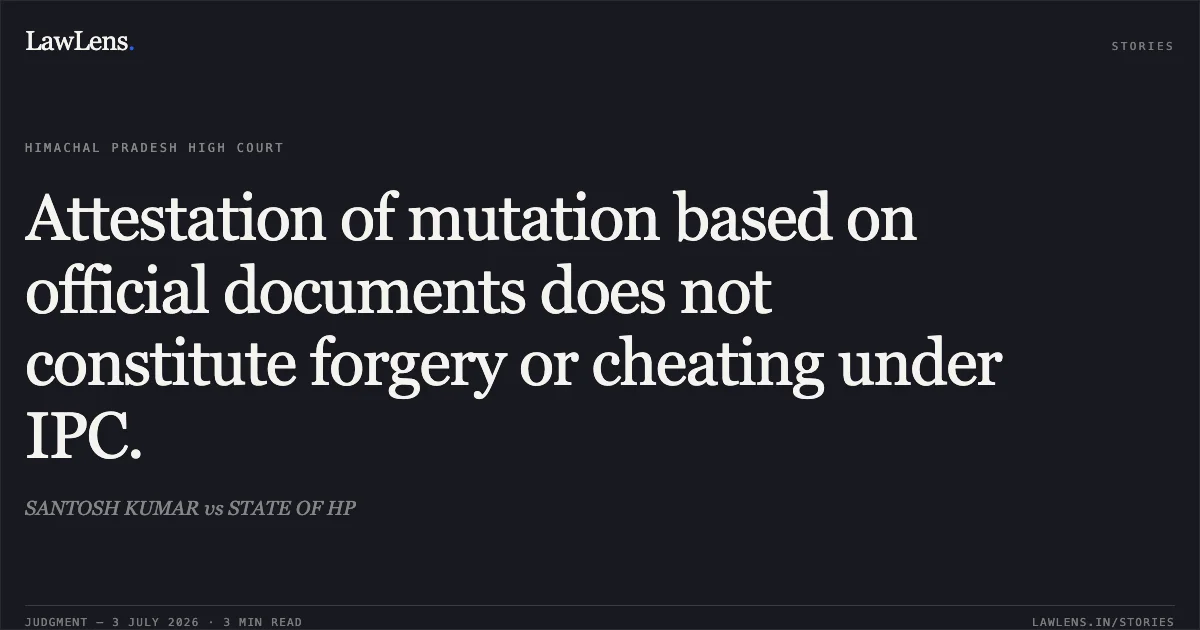
Source reference: para. 21The Court noted that a mutation does not convey or extinguish ownership title, serving merely the fiscal purpose of updating revenue records.
Source reference: para. 24No evidence showed that the appellant received any money or pecuniary advantage for attesting the mutation, meaning the core requirements of cheating and criminal misconduct were completely missing.
Source reference: para. 26, 29, 35Analyzing the testimony of the sanctioning authority (PW37), the Court found that the officer mechanically signed a pre-drafted template, mistakenly stated that the Tehsildar entered rather than attested the mutation, and was textually unsure of the appellant's officer class categorization, which demonstrated a clear absence of independent application of mind.
Source reference: para. 33Holding
The ingredients of Sections 420 and 120-B of the IPC, and Section 13(2) of the PC Act were not satisfied, and that the prosecution sanction was invalidly granted.
The High Court allowed the appeal and set aside the judgment of conviction and order of sentence passed by the Trial Court. The appellant was fully acquitted of all charges and directed to execute a personal bond in accordance with Section 437-A of the Cr.P.C.
Source reference: para. 34, 35, 36Acts & Sections Cited
19 provisions across 5 statutes referred to in this judgment. Each provision opens on LawLens.
Bharatiya Nagarik Suraksha Sanhita, 20231
Code of Criminal Procedure, 19734
Indian Penal Code, 1860
Judges (Protection) Act, 19851
Prevention of Corruption Act, 19881
Original Court PDF
SANTOSH KUMARvsSTATE OF HP
Click to open original judgment
Original judgment, available to read, download and summarize on LawLens.in