Facts
The original plaintiff, Nirmaldas, filed a civil suit for declaration of title and recovery of possession regarding 0.20 acres of land (Khasra No. 794) at Village Kusumjhar
Source reference: para. 2He claimed title through ancestral possession exceeding 100 years and a 1971 family arrangement evidenced by an unregistered memorandum
Source reference: para. 2During the pendency of the suit, Nirmaldas died and was substituted by the appellant, Sunderlal Sonwani, who claimed to be the sole legatee under a Will dated 07.04.2006
Source reference: para. 2-3The defendants contested the suit, asserting title through registered sale deeds from 1964 and challenging the Will as forged
Source reference: para. 4Both the Trial Court (30.04.2018) and the First Appellate Court (28.03.2022) dismissed the suit, finding that the plaintiff failed to prove title, possession, or the validity of the Will
Source reference: para. 5-6The appellant subsequently filed this Second Appeal under Section 100 of the CPC.
Source reference: no citationIssues
1. Whether the plaintiff established title and possession over the suit land through the unregistered memorandum dated 02.09.1971 or revenue records
Source reference: para. 5, 92. Whether the Will dated 07.04.2006 was proved in accordance with the mandatory requirements of the Indian Succession Act and the Evidence Act
Source reference: para. 6, 93. Whether the concurrent findings of fact by the lower courts give rise to any substantial question of law under Section 100 of the CPC
Source reference: para. 11, 16Law Applied
The Court applied Section 100 of the Code of Civil Procedure, 1908, which restricts Second Appeals to cases involving a "substantial question of law" and prohibits interference with concurrent findings of fact unless they are perverse
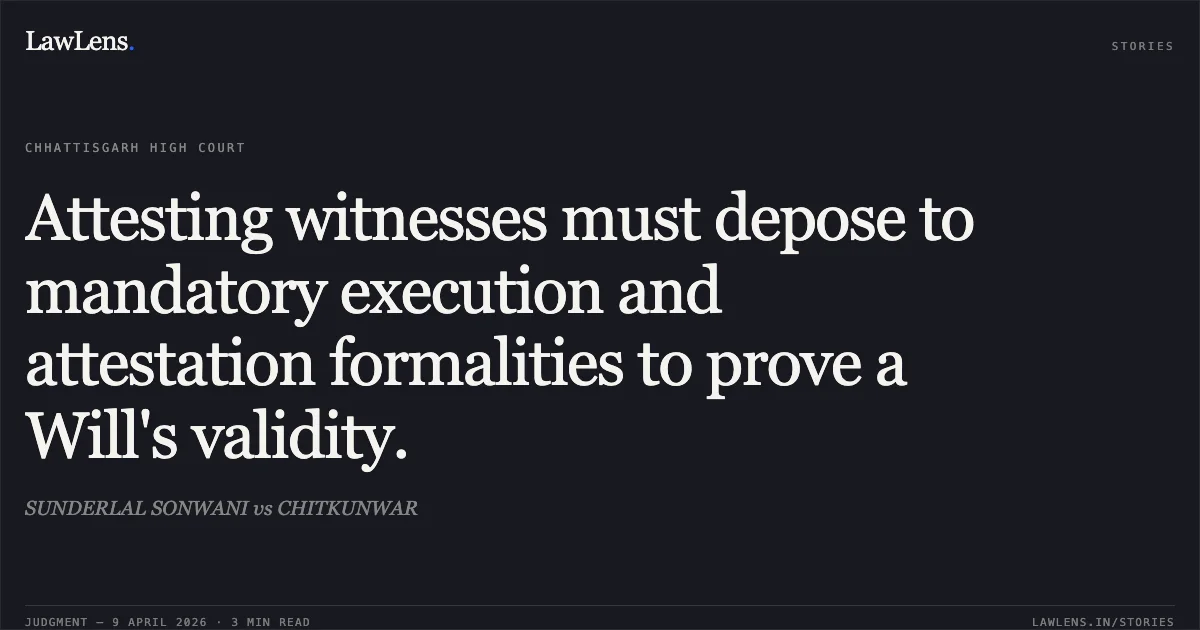
Source reference: para. 11, 15Regarding the testamentary claim, the Court relied on Section 63 of the Indian Succession Act and Section 68 of the Indian Evidence Act, which require a Will to be attested by at least two witnesses who must see the testator sign
Source reference: para. 10It further applied the principles from Gopal Krishan v. Daulat Ram (2025) and Meena Pradhan v. Kamla Pradhan, which mandate that the propounder of a Will must dispel all "suspicious circumstances" surrounding its execution
Source reference: para. 10Reasoning
The Court observed that the appellant failed to produce any documentary evidence, such as a patta or title deed, to establish ownership, and the 1971 memorandum was inadmissible due to lack of registration and proof
Source reference: para. 5, 9On the issue of the Will, the Court found the testimony of the attesting witness (PW-3) deficient; the witness failed to depose that the testator signed in his presence or that he signed in the testator's presence, violating the mandatory requirements of Section 63 of the Succession Act
Source reference: para. 9Furthermore, the Court noted "suspicious circumstances": the Will was executed during pending litigation and excluded the testator’s natural heirs (widow and children) without explanation
Source reference: para. 9The Court held that the appellant failed to dispel these suspicions
Source reference: para. 9Consequently, since the findings of the lower courts were based on a proper appreciation of evidence and lacked perversity, they were deemed concurrent findings of fact that do not warrant interference in a Second Appeal
Source reference: para. 12-16Holding
The High Court dismissed the Second Appeal, holding that no substantial question of law was involved
The Court affirmed that the appellant failed to prove his title or the validity of the Will
Source reference: para. 9, 17The judgments and decrees of the Trial Court and the First Appellate Court were upheld
Source reference: para. 18Acts & Sections Cited
3 provisions across 2 statutes referred to in this judgment. Each provision opens on LawLens.
Code of Civil Procedure, 19082
Indian Succession Act, 19251
Original Court PDF
SUNDERLAL SONWANIvsCHITKUNWAR
Click to open original judgment
Original judgment, available to read, download and summarize on LawLens.in


