Facts
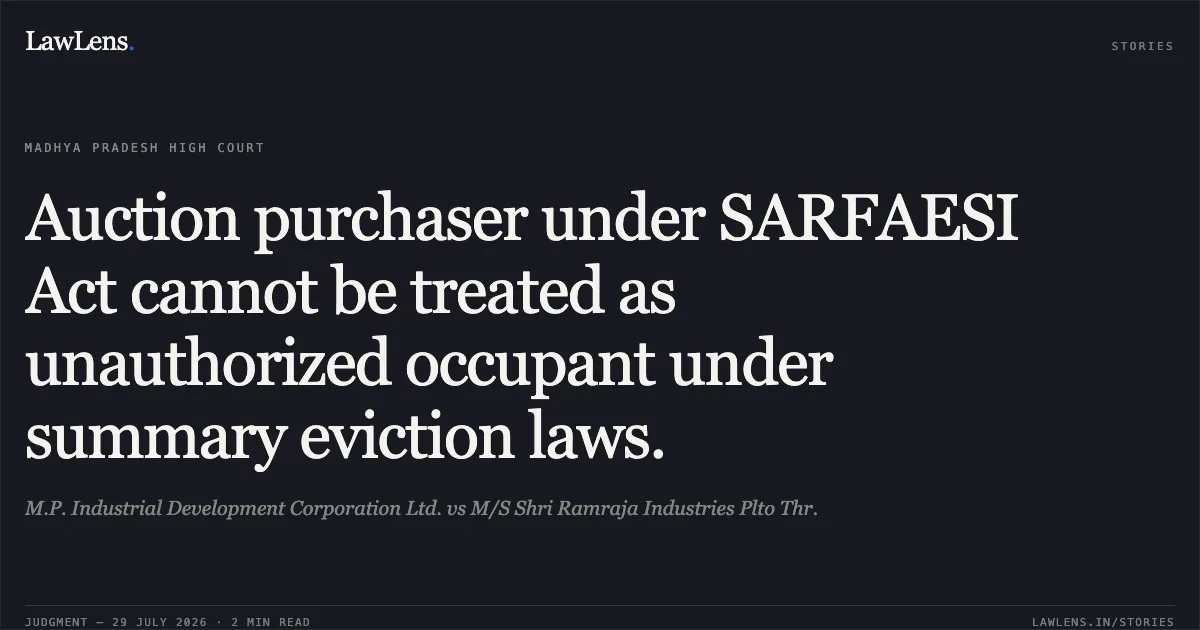
The petitioner, a State body managing industrial land, challenged an appellate order that set aside an eviction notice against Respondent No. 1
Source reference: no citationThe original lessee (Respondent No. 2) defaulted on bank loans, leading the State Bank of India to auction the industrial assets. Respondent No. 1 purchased these assets in 2014 via a SARFAESI Act auction
Source reference: p. 6The petitioner contended that while assets were sold, leasehold rights remained with the State until formally transferred under the 2015 Management Rules
Source reference: p. 2When Respondent No. 1 failed to meet conditions for lease transfer and clear the previous lessee’s arrears, the petitioner cancelled the lease and initiated summary eviction proceedings under the M.P. Lok Parisar (Bedhakli) Adhiniyam, 1974
Source reference: p. 3The District Commissioner reversed the eviction, prompting this writ petition
Source reference: p. 3Issues
1. Whether an auction purchaser under the SARFAESI Act can be classified as an "unauthorized occupant" under the M.P. Lok Parisar (Bedhakli) Adhiniyam, 1974
Source reference: p. 82. Whether summary eviction proceedings are the appropriate legal mechanism to resolve disputes regarding leasehold transfers and recovery of arrears from a previous lessee
Source reference: p. 93. Whether a quasi-judicial authority who passed the original order has the standing to challenge the appellate reversal
Source reference: p. 5-6Law Applied
Section 2(g) of the M.P. Lok Parisar (Bedhakli) Adhiniyam, 1974, which defines "unauthorized occupation" as possession without authority or continued stay after such authority has expired
Source reference: p. 8Rule 9 of the Security Interest (Enforcement) Rules, 2002, regarding "free from encumbrance" sales
Source reference: p. 7Principle from Mohtesham Mohd. Ismail v. Special Director, Enforcement Directorate, establishing that an adjudicating officer cannot generally appeal against a superior order reversing their own decision
Source reference: p. 6Reasoning
The court reasoned that Respondent No. 1 did not enter the premises as a trespasser but through a legitimate statutory auction, which precludes their status as an "unauthorized occupant" under the 1974 Act
Source reference: p. 9The Judge observed that the core of the dispute was not illegal possession but a disagreement over administrative lease transfers and financial liabilities
Source reference: p. 9The court found that the summary eviction process was misapplied to settle a complex recovery issue involving a third-party secured creditor
Source reference: p. 9Furthermore, the court highlighted that the petitioner sought to unfairly burden the auction purchaser with the previous owner’s debts despite the "free from encumbrance" nature of the SARFAESI sale
Source reference: p. 9Holding
The court held that the respondent’s possession was based on a legal foundation and could not be termed unauthorized merely because of pending lease formalities
The High Court dismissed the writ petition, upholding the appellate order that set aside the eviction. While the eviction was quashed, the court granted the petitioner the liberty to pursue separate legal remedies for the recovery of outstanding dues from the parties legally liable for them
Source reference: p. 10Acts & Sections Cited
1 provisions across 1 statute referred to in this judgment. Each provision opens on LawLens.
Securitisation and Reconstruction of Financial Assets and Enforcement of Security Interest Act, 20021
Original Court PDF
M.P. Industrial Development Corporation Ltd.vsM/S Shri Ramraja Industries Plto Thr.
Click to open original judgment
Original judgment, available to read, download and summarize on LawLens.in


