Facts
The dispute arose from a recovery certificate dated 20 July 1998 issued by the Registrar of Co-operative Societies for recovery of approximately ₹91,378, together with interest, from the original petitioner in respect of a loan obtained from the respondent Society.
Source reference: para. 3After successive auction notices and challenges by the petitioner, the fourth auction notice dated 3 October 2003 fixed the auction for 14 November 2003, on which date respondent No. 5 was declared the highest bidder.
Source reference: paras. 7–9The petitioner’s earlier writ petition challenging the recovery and auction proceedings was withdrawn on 13 November 2003 with liberty to pursue an appropriate remedy in law.
Source reference: para. 10The Division Bench held that the recovery certificate, the dismissal of the statutory appeal, and the earlier revisional order had consequently attained finality.
Source reference: paras. 10–16The petitioner thereafter filed a revision under Section 211 of the Gujarat Land Revenue Code, 1879, without initially impleading the Society or disclosing that the auction had already taken place.
Source reference: paras. 17–19, 34The Society successfully challenged the order passed in the petitioner’s favour on the ground that it had not been heard.
Source reference: para. 20The matter was remanded for fresh consideration after impleading the Society.
Source reference: paras. 20–25On remand, the Joint Secretary (Appeals) rejected the petitioner’s challenge to the auction proceedings by order dated 8/10 November 2005.
Source reference: paras. 36, 42–45The learned Single Judge dismissed the petitioner’s writ petitions on 17 October 2014, holding, inter alia, that no application had been made under Section 178 of the Gujarat Land Revenue Code to set aside the sale and that the sale certificate dated 2 December 2005 had not been challenged.
Source reference: paras. 36, 42–45Issues
Whether the petitioner could challenge the validity of the auction sale through revision proceedings and writ jurisdiction without first filing the statutory application under Section 178 of the Gujarat Land Revenue Code, 1879, for setting aside the sale on the ground of irregularity or mistake?
Source reference: paras. 33, 42–44, 51–53Whether the auction conducted on 14 November 2003 was vitiated by want of 30 days’ notice, non-disclosure or improper fixation of the upset price, or other procedural irregularities?
Source reference: para. 47(i)–(ii)Whether the alleged irregularity in the delivery of possession and the panch rojkam dated 22 November 2003 invalidated the auction sale or warranted interference under Article 226 of the Constitution?
Source reference: paras. 29–31, 47(iii)–(xi)Whether the petitioner was entitled to challenge the sale certificate dated 2 December 2005 and the completed auction proceedings in the absence of a specific statutory challenge to the sale or sale certificate?
Source reference: paras. 43–44, 47(xi)Law Applied
The Court applied Sections 165, 166, 167, 172–175, 178–181 of the Gujarat Land Revenue Code, 1879, which prescribe the procedure for proclamation and conduct of revenue sales, deposit of purchase money, applications to set aside sales, confirmation of sale, delivery of possession, and issuance of a sale certificate.
Source reference: paras. 49–51Section 178 provides the statutory remedy to an aggrieved person to seek setting aside of an immovable-property sale on grounds of material irregularity, mistake, or fraud within the prescribed period; Section 179 contemplates confirmation or setting aside of the sale; and Section 181 requires delivery of possession and issuance of the sale certificate after confirmation.
Source reference: paras. 42, 49–51Rules 127–129 of the Gujarat Land Revenue Rules, 1972 govern auction sales, upset price, and the prescribed forms and procedure.
Source reference: para. 50The Court also referred to Rules 114 and 128 of the Gujarat Co-operative Societies Rules, 1965 as providing a comparable remedy against irregularity in the sale.
Source reference: para. 42It further applied the principle that writ jurisdiction under Article 226 should not ordinarily be used to determine disputed factual allegations concerning auction irregularities where an efficacious statutory remedy exists, particularly after the auction has been completed and the sale certificate issued.
Source reference: paras. 42–44, 53Reasoning
The Court held that the petitioner’s challenge was procedurally misconceived because, after withdrawing the earlier writ petition, he did not invoke Section 178 to challenge the auction sale on the grounds now alleged.
Source reference: paras. 13–16, 33, 42The recovery certificate and prior orders had attained finality, and the petitioner did not dispute the underlying outstanding dues.
Source reference: paras. 14–15, 36The Court found that the petitioner had notice of the auction and that his nephew was present at the auction proceedings, where payment was allegedly offered but not made.
Source reference: paras. 37, 41, 47(i)The alleged absence of the upset price from the auction notice did not invalidate the sale because the applicable forms did not require its inclusion, while the original record showed that the upset price had in fact been fixed by the Talati-cum-Mantri.
Source reference: paras. 41, 47(ii)The allegations concerning possession and the panch rojkam dated 22 November 2003 could not be examined in the present proceedings because they were matters connected with the validity and implementation of the auction, for which the statutory remedy under Section 178 was available.
Source reference: para. 47(iii)The record also demonstrated that the auction purchaser had deposited the purchase money, that the sale had been confirmed, and that the sale certificate was issued on 2 December 2005 after dismissal of the revision.
Source reference: paras. 40, 47(xi), 51–52The Court concluded that the alleged procedural defects, even if assumed for argument, did not establish fraud or material irregularity and could not justify interference under Article 226.
Source reference: para. 53The petitioner’s repeated litigation, failure to pay the dues, suppression of the completed auction in the earlier revision, and failure to implead necessary parties further disentitled him to discretionary relief.
Source reference: paras. 34–35, 55–57Holding
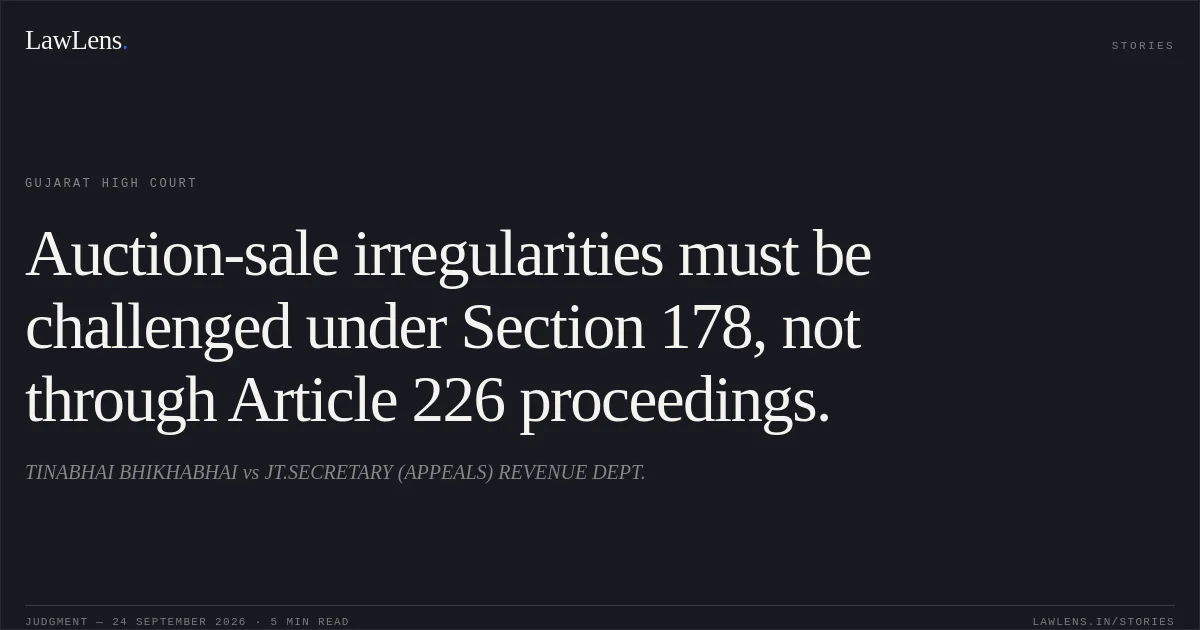
The Division Bench dismissed both Letters Patent Appeals, holding that the petitioner had failed to challenge the auction sale through the statutory mechanism under Section 178 of the Gujarat Land Revenue Code and had not established any legally cognisable material irregularity, fraud, or illegality in the auction conducted on 14 November 2003.
The challenge to the revisional order dated 8/10 November 2005, the auction proceedings, and the sale certificate dated 2 December 2005 was therefore rejected.
Source reference: para. 59The pending civil applications were disposed of as infructuous.
Source reference: para. 59In view of the petitioner’s conduct and repeated litigation, the appeals were dismissed with costs of ₹2,00,000, to be deposited with the Registrar General within three weeks and paid to Bhavnagar District Co-operative Bank, which had taken over the management of the respondent Society, towards litigation expenses.
Source reference: para. 58The Court also rejected the post-pronouncement request for stay of operation of the judgment.
Source reference: Further Order, p. 33Acts & Sections Cited
1 provisions across 1 statute referred to in this judgment. Each provision opens on LawLens.
Gujarat Cooperative societies Act-19611
Original Court PDF
TINABHAI BHIKHABHAIvsJT.SECRETARY (APPEALS) REVENUE DEPT.
Click to open original judgment
Original judgment, available to read, download and summarize on LawLens.in