Facts
The petitioner challenged the State Information Commission’s order dated 17 March 2026 disposing of his second appeal on the ground that the Public Information Officer had supplied the requested information by letter dated 26 February 2026.
Source reference: para. 2The State submitted that the information had been supplied.
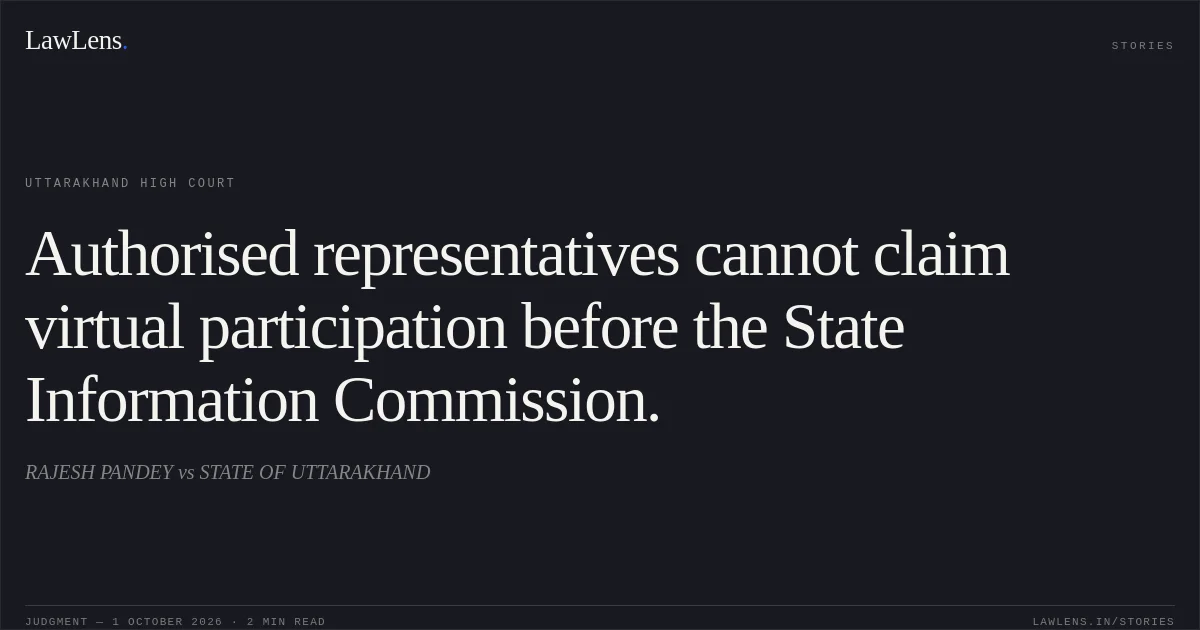
Source reference: para. 3The petitioner also contended that his authorised representative should be permitted to participate in proceedings before the Commission through hybrid mode under the State Information Commission (Appeal Procedure) Rules, 2005.
Source reference: para. 5Issues
Whether the Commission’s decision to dispose of the second appeal, after finding that the requested information had been supplied, warranted interference.
Source reference: paras. 2–4Whether an authorised representative of a party before the State Information Commission is entitled to participate in proceedings through hybrid mode.
Source reference: paras. 5–7Law Applied
The petitioner relied on the State Information Commission (Appeal Procedure) Rules, 2005, concerning assistance by another person in proceedings under the RTI Act.
Source reference: para. 5The Court considered the Supreme Court’s judgment in Kishan Chand Jain v. Union of India & Others, Writ Petition (Civil) No. 360 of 2021, particularly paragraph 23, which the Court understood as permitting litigants—but not their authorised representatives—to appear through hybrid mode before a State Information Commission.
Source reference: para. 6The Court held that a party may participate physically or virtually, but an authorised representative engaged by that party may be required to appear physically; participation through a representative is not a vested right in proceedings of an informal nature.
Source reference: para. 7Reasoning
The Court accepted the State’s submission that the requested information had been supplied and found no substance in the challenge to the Commission’s disposal of the appeal.
Source reference: paras. 3–4On hybrid participation, it distinguished the party’s ability to appear virtually from the position of a lawyer or authorised representative.
Source reference: paras. 6–7Relying on its reading of Kishan Chand Jain, it concluded that the hybrid-mode facility extended to the litigant, not to the representative, and that requiring the representative to attend physically was not unlawful.
Source reference: paras. 6–7Holding
The Court found no ground to interfere with the Commission’s order or the requirement that an authorised representative appear physically.
It dismissed the writ petition.
Source reference: paras. 7–8Original Court PDF
RAJESH PANDEYvsSTATE OF UTTARAKHAND
Click to open original judgment
Original judgment, available to read, download and summarize on LawLens.in