01Facts
The petitioners claim ownership of different portions of Survey No. 8, Mavallipura village, Hesaraghatta Hobli, Yelahanka Taluk, and seek protection of their possession against the State and Panchayat authorities.
¶ 1 / p.6Counsel for the petitioners submitted that the land was proposed for acquisition under Sections 4 and 17 of the erstwhile Land Acquisition Act, 1881.
¶ 2 / p.6The Taluka Panchayath relied on revenue entries made under orders passed under Section 136 of the Karnataka Land Revenue Act, 1964.
¶ 2 / p.7In W.P. No. 23353/2005 and connected matters, filed by the petitioners and others, the High Court quashed those notifications and Section 136 orders, while granting the State liberty to issue fresh notifications after affording the petitioners an opportunity.
¶ 2 / p.7This was affirmed when the writ appeal, W.A. No. 876/2010 and connected appeals filed by the Bengaluru Mahanagara Palike, was dismissed by a Division Bench.
¶ 2 / p.7The petitioners state that no further acquisition or title proceedings have been initiated, but that incursions into the land continue.
¶ 3 / p.8The learned Standing Counsel for the Panchayath and the learned HCGP did not dispute that the acquisition proceedings had come to naught.
¶ 4 / pp.8–902Issues
i.1. Whether, where acquisition proceedings over Survey No. 8 have terminated and no further proceedings are pending, the Panchayath or State authorities may interfere with the petitioners' possession otherwise than through due process of law.
¶ 5 / p.9ii.2. Whether the petitioners are entitled to a direction restraining dispossession unless due proceedings in accordance with law are undertaken.
¶ 5 / p.903Law Applied
The Court's reasoning rests on the proposition that possession cannot be disturbed except through due process of law.
¶ 5 / p.9The Court relies on the lapse of the acquisition initiated under Sections 4 and 17 of the erstwhile Land Acquisition Act, 1881.
¶ 2 / p.6The Court relies on the invalidation of the revenue entries made under Section 136 of the Karnataka Land Revenue Act, 1964.
¶ 2 / p.7The order relies on the binding effect of the decision in W.P. No. 23353/2005, which quashed the notifications and Section 136 orders while leaving the State free to issue fresh notifications after hearing the petitioners.
¶ 2 / p.7The decision in W.P. No. 23353/2005 was confirmed in W.A. No. 876/2010.
¶ 2 / p.7The order does not cite any independent authority for the due process principle.
Provisions in the judgment · 3
Land Acquisition Act, 1881 Section 4Section 17
Karnataka Land Revenue Act, 1964 Section 136
04Reasoning
The Court first accepted the petitioners' account that the acquisition proceedings had ended following the orders in W.P. No. 23353/2005 and the affirmance in W.A. No. 876/2010.
¶ 2, 4 / pp.7–9Because the Standing Counsel and the HCGP did not dispute this, the Court treated the termination as established.
¶ 4 / pp.8–9Since the proceedings had ended and no further proceedings were pending, the Court held that interference with the petitioners' possession by the Panchayath or the State could not be justified without due process.
¶ 5 / p.9The Court therefore granted interim protection against dispossession pending lawful proceedings, without deciding title or the validity of any fresh action.
¶ 5 / p.9The order is brief and records the concessions of the respondents' counsel. Its reasoning depends on those concessions and on the prior orders, which are reproduced as recorded by counsel and are not independently set out in the order itself.
¶ 4 / pp.8–9The prior orders relied upon are reproduced as recorded by counsel and are not independently set out in the order itself.
05Holding
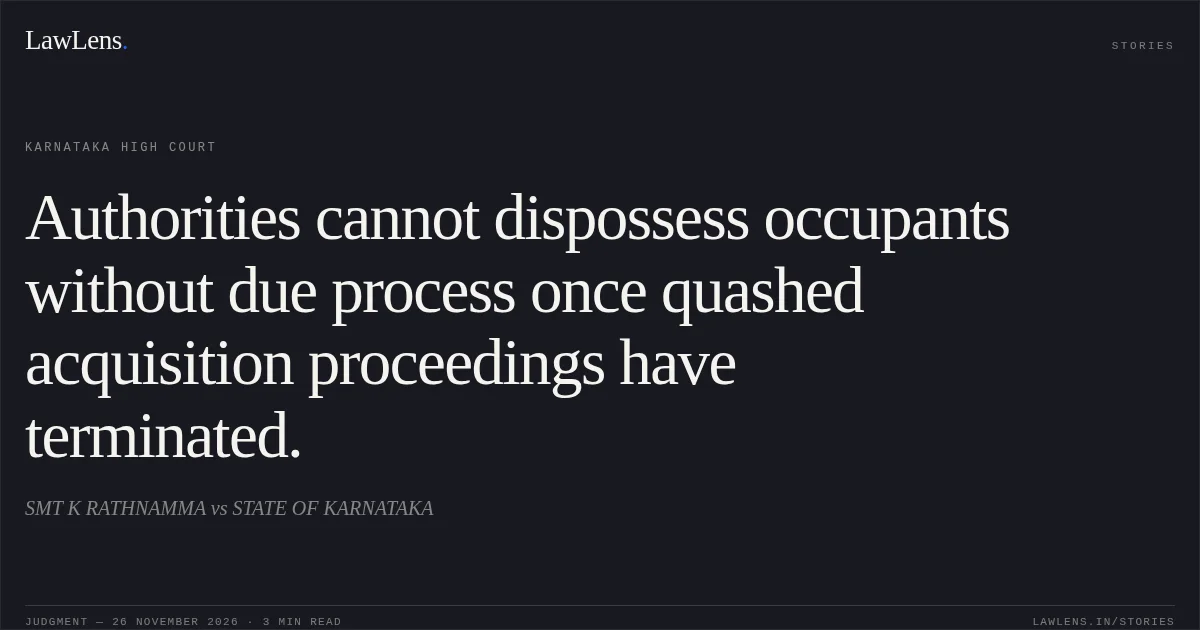
The Court held that, once the acquisition proceedings concerning Survey No. 8 had come to an end and no further proceedings were pending, the respondents could not interfere with the petitioners' possession except through due process of law.
¶ 5 / p.9Both writ petitions (WP No. 6081/2022 and WP No. 4766/2022) were allowed. The respondents were directed not to dispossess the petitioners from the land in Survey No. 8 of Mavallipura village unless and until due proceedings in accordance with law are initiated and concluded. The order does not adjudicate ownership or title to the land.
¶ 5 / p.9Original Court PDF
SMT K RATHNAMMAvsSTATE OF KARNATAKA
Click to open original judgment
Original judgment, available to read, download and summarize on LawLens.in