01Facts
The land was granted to the original grantee in 1947.
The first alienation took place in 1996 by sale deed.
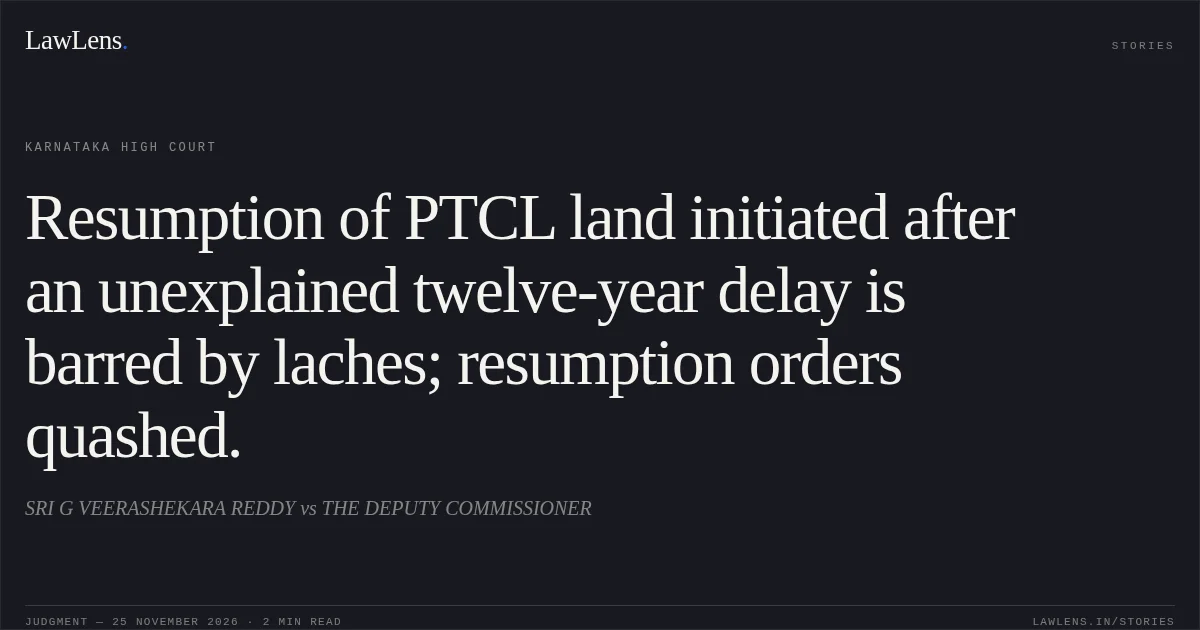
¶ 6 · p. 5Resumption proceedings were initiated in 2008, nearly 12 years after the alienation.
¶ 6 · p. 5The Assistant Commissioner allowed the resumption claim by order dated 18.06.2010 in PTCL (Chikka) No. 10/2008-09.
¶ 6 · p. 5 · prayer (i) · p. 3The Deputy Commissioner affirmed that order in appeal by order dated 26.10.2015 in RA/SCST/31/2013-14.
¶ 6 · p. 5 · prayer (i) · p. 3The petitioner challenged both orders under Articles 226 and 227, specifically contending that the proceedings were initiated after an unreasonable and unexplained lapse of time.
¶ 6 · p. 5Respondent No. 3 argued that, in view of an amendment to the PTCL Act, there was no laches.
¶ 4 · p. 402Issues
i.1. Whether the resumption proceedings, initiated nearly 12 years after the first alienation, are vitiated by unexplained delay and laches.
¶ 6 · pp. 5–6ii.2. Whether the Assistant Commissioner and the Deputy Commissioner erred in failing to consider the delay and laches and the petitioner's specific contention on that ground, thereby rendering the resumption orders unsustainable.
¶ 6 · p. 5 · ¶ 3 · p. 403Law Applied
The principle of laches in resumption proceedings under the PTCL framework. A Division Bench ruling, not named in the judgment, held that laches is a primary requirement when resuming land and that restoration action filed after a significant delay may be barred by laches.
¶ 6 · p. 6Unexplained delay is a relevant and crucial consideration that the authorities were bound to evaluate before ordering resumption, particularly where rights in the land had been settled by a sale deed.
¶ 6 · pp. 5–6The judgment does not identify the specific provisions of the PTCL Act relied upon, nor does it discuss the statutory amendment raised by Respondent No. 3.
04Reasoning
The Court applied the laches principle to the chronology of the case: a grant in 1947, a sale deed in 1996, and resumption proceedings commenced only in 2008.
¶ 6 · p. 5The authorities did not assess whether it was appropriate to proceed after a delay of nearly 12 years, nor did they address the petitioner's specific plea of unexplained delay. The Court treated this omission as a failure to consider a crucial and relevant issue, which vitiated the resumption orders.
¶ 6 · pp. 5–6Because the proceedings were found to be barred by the unexplained delay, the Court did not find it necessary to decide the merits of the resumption itself. The judgment does not expressly engage with Respondent No. 3's argument that the statutory amendment removes laches.
¶ 4 · p. 4 · no citation for any finding on it05Holding
The orders of the Assistant Commissioner and the Deputy Commissioner directing resumption cannot be legally sustained, as they failed to consider the 12-year delay and laches in initiating proceedings.
¶ 6 · pp. 5–6 · ¶ 7 · p. 6The order dated 18.06.2010 (Annexure-B) and the order dated 26.10.2015 (Annexure-F) are quashed.
¶ 8 · p. 7 · ¶ 9 · p. 7The revenue authority is directed to mutate or restore the petitioner's name in the subject land in the revenue records.
¶ 8 · p. 7The writ petition is allowed. Interim orders stand discharged and pending interlocutory applications are disposed of.
¶ 8 · p. 7 · ¶ 9 · p. 7Original Court PDF
SRI G VEERASHEKARA REDDYvsTHE DEPUTY COMMISSIONER
Click to open original judgment
Original judgment, available to read, download and summarize on LawLens.in