Facts
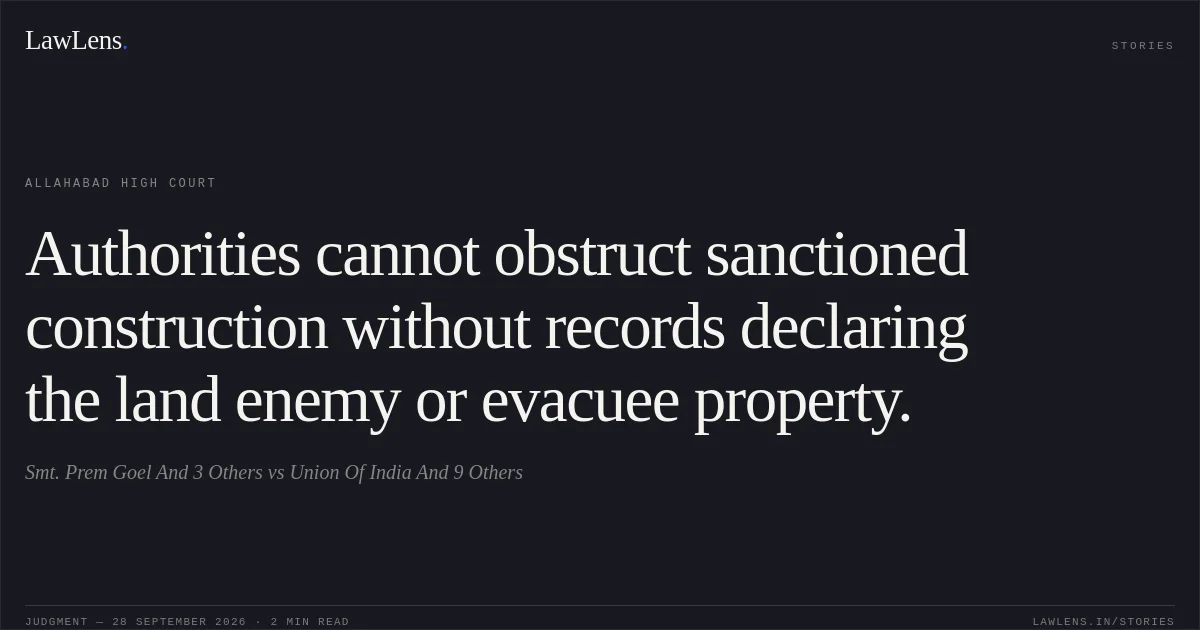
The petitioners claimed rights over 90 sq. metres forming part of Plot No. 25 (old No. 19), Civil Lines, Muzaffarnagar, tracing title through a 1946 registered exchange deed, subsequent transfers and a 1956 civil-court decree.
Source reference: para. 3(i)–(viii), 12Petitioners 3 and 4 purchased the disputed portion from petitioners 1 and 2 in 2018 and obtained a sanctioned construction map on 16 August 2018.
Source reference: para. 3(i)–(viii), 12Following complaints alleging that the land was enemy or evacuee property, the Assistant Custodian of Enemy Property concluded on 2 August 2019 that the relevant remaining portions of Gata Nos. 835 and 843 were not enemy property.
Source reference: para. 3(xiv)–(xv), 15In January 2023, State officials stopped construction, partly demolished the work and marked the property as evacuee property.
Source reference: para. 2, 3(xvi)–(xvii)The petitioners sought protection against interference and removal of the markings.
Source reference: para. 2, 3(xvi)–(xvii)Issues
1. Whether the respondents had a lawful basis to stop the petitioners from carrying out construction on the disputed property.
Source reference: para. 112. Whether the property could be treated as enemy or evacuee property, in the absence of supporting records or proof of its formal identification as such.
Source reference: para. 13, 19–26Law Applied
Section 2(b) and (c) of the Enemy Property Act, 1968 define an “enemy” and “enemy property,” including property belonging to, held by or managed on behalf of an enemy.
Source reference: para. 14Under Section 2(f) of the Administration of Evacuee Property Act, 1950, “evacuee property” is defined by reference to property of an evacuee and specified transfers made after 14 August 1947.
Source reference: para. 23Section 7-A restricted the declaration of property as evacuee property on or after 7 May 1954, subject to stated exceptions.
Source reference: para. 24Rule 7(3) of the Administration of Evacuee Property (Central) Rules, 1950 provided for publication of an updated list of evacuee properties.
Source reference: para. 25The 1950 Act had been repealed with effect from 5 September 2005.
Source reference: para. 23The Court relied on the requirement that State action restricting construction must have a demonstrated legal and evidentiary basis; no precedent was cited.
Source reference: no citationReasoning
The Court found that the construction map remained valid and that the Development Authority had rejected the complaint against the construction.
Source reference: para. 12The Assistant Custodian’s 2 August 2019 order recorded that the relevant land was not enemy property, and the Custodian’s subsequent position was that the disputed property had not been recorded as enemy property.
Source reference: para. 15–18As to the State’s alternative claim that the land was evacuee property, the respondents produced no record showing that it had been declared or recorded as such, or that proceedings for such declaration remained pending; a reference in a letter to an earlier, unproduced communication was insufficient.
Source reference: para. 19–26In those circumstances, the State could not justify stopping construction merely by asserting that the land was evacuee property.
Source reference: para. 26Holding
The Court held that the respondents had no established basis to interfere with the petitioners’ possession and occupation of the disputed property.
It restrained the respondents from interfering with the petitioners’ peaceful possession and occupation of the 90-square-metre portion of Plot No. 25 (old No. 19), but only to the extent covered by the sanctioned map.
Source reference: para. 27The writ petition was allowed on those terms, with no order as to costs.
Source reference: para. 28–29Acts & Sections Cited
1 provisions across 1 statute referred to in this judgment. Each provision opens on LawLens.
Enemy Property Act, 19681
Original Court PDF
Smt. Prem Goel And 3 OthersvsUnion Of India And 9 Others
Click to open original judgment
Original judgment, available to read, download and summarize on LawLens.in