Facts
The petitioner was selected and appointed as an Assistant Teacher (Social Science) in 1994, and his probation was subsequently declared. In 2004, following a complaint alleging that he had produced forged B.A. first- and second-year marks cards during recruitment, the authorities issued a show-cause notice and thereafter cancelled his appointment without conducting a departmental enquiry.
Source reference: para. 2The petitioner challenged that order before the Karnataka State Administrative Tribunal (“Tribunal”). During the proceedings, the Tribunal granted interim protection, and the respondents voluntarily reinstated the petitioner in 2006; the proceedings were thereafter disposed of without reserving liberty to initiate disciplinary action afresh.
Source reference: para. 3In 2020, the petitioner approached the Tribunal seeking increments, pay re-fixation, time-bound advancement benefits and related reliefs. Thereafter, in 2022, the respondents initiated disciplinary proceedings on the same allegation concerning the 1994 recruitment.
Source reference: para. 4The Enquiry Officer relied principally on a letter dated 8 July 2004, allegedly admitting production of fabricated documents, although the petitioner denied authorship and the original marks cards were not produced before the Enquiry Officer. The disciplinary authority dismissed the petitioner from service on 7 March 2024. The Tribunal dismissed his challenge in Application No. 5345/2024 on 16 April 2026, leading to the present writ petition.
Source reference: paras. 1, 4, 11Issues
Whether the respondents could initiate fresh disciplinary proceedings in 2022 on the same allegations that had formed the basis of the 2004 proceedings, after reinstating the petitioner in 2006 without obtaining or reserving liberty to conduct a fresh enquiry.
Source reference: paras. 5, 9, 11Whether the dismissal could be sustained when the alleged forged marks cards were unavailable, the petitioner consistently denied producing forged documents, and the Enquiry Officer relied on an unadmitted letter allegedly amounting to an admission.
Source reference: paras. 4, 10–12Whether, in the circumstances, the petitioner’s alleged fraud could be treated as established notwithstanding the delay of more than three decades from his appointment.
Source reference: para. 12Law Applied
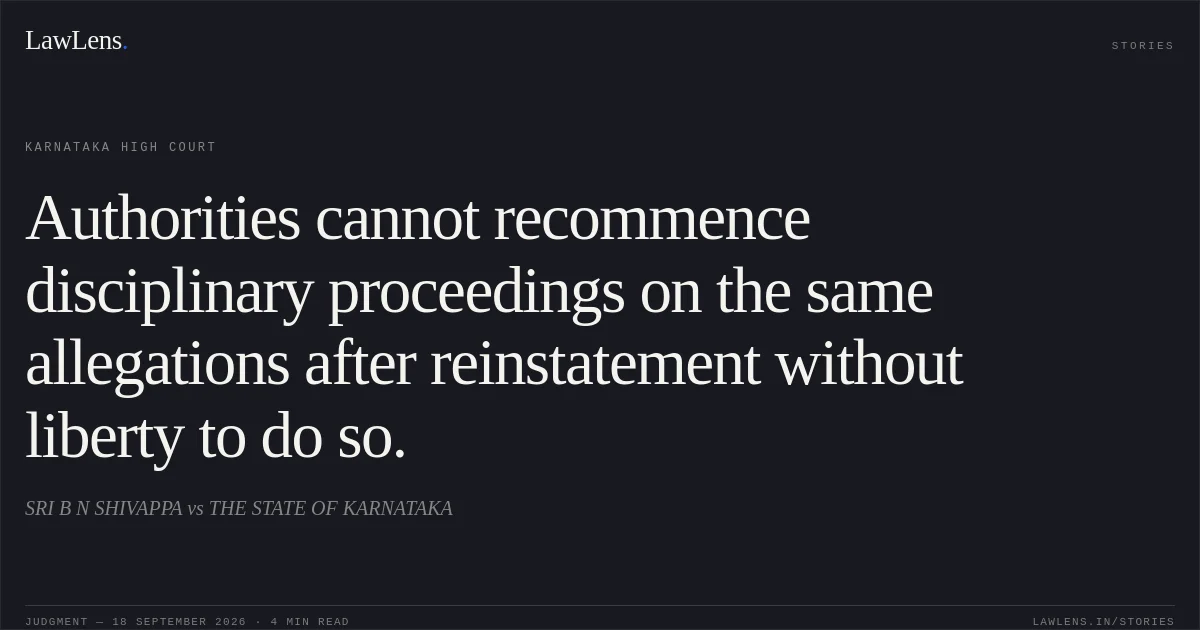
The Court applied the principle that disciplinary proceedings cannot be reinitiated on the same cause of action after an earlier proceeding has been effectively concluded and the employee reinstated, particularly where no liberty to reopen the matter was reserved by the Tribunal.
Source reference: paras. 9, 11It distinguished R. Vishwanatha Pillai v. State of Kerala, (2004) 2 SCC 105, which concerns cases of admitted fraud rendering an appointment void ab initio, and noted that strict rules of the Evidence Act do not ordinarily govern domestic enquiries, as recognised in State of Haryana v. Rattan Singh, (1977) 2 SCC 491 and Union of India v. P. Gunasekaran, (2015) 2 SCC 610.
Source reference: para. 6The Court relied on Smt. Bhavya B.S. v. State of Karnataka, W.P. No. 26642/2023, decided on 9 April 2026, and Vikas Pratap Singh v. State of Chhattisgarh, (2013) 14 SCC 494, for the principle that an administrative or recruiting authority’s mistake cannot be attributed to the candidate in the absence of proved fraud.
Source reference: paras. 5, 10The Court further held that an unadmitted document relied upon as an admission could not, in the circumstances, sustain the finding of misconduct.
Source reference: para. 11Reasoning
The Court held that the 2004 allegation had already been the subject of proceedings before the Tribunal. The respondents accepted the Tribunal’s interim protection, reinstated the petitioner in 2006, and allowed the matter to be disposed of without reserving liberty to initiate a fresh departmental enquiry. They therefore could not reopen the same allegation in 2022, particularly after the petitioner sought service-related benefits before the Tribunal.
Source reference: paras. 9, 11The Court also found that the evidentiary basis for the charge was inadequate: the original marks cards were not produced, the petitioner consistently denied fabricating or submitting them, and the alleged letter dated 8 July 2004 was not admitted by him during the enquiry.
Source reference: paras. 10–11Unlike the cases relied upon by the State, this was not a case of admitted fraud.
Source reference: para. 12Applying Bhavya B.S. and Vikas Pratap Singh, the Court held that any mistake in calculating or assessing the petitioner’s marks during recruitment could not, without proof of intentional fraud by him, be converted into a charge of fraudulent appointment. The initiation of proceedings after more than 30 years of service was therefore impermissible and unsustainable.
Source reference: paras. 10–12Holding
The writ petition was allowed. The High Court set aside the Tribunal’s order dated 16 April 2026, the dismissal order dated 7 March 2024, and the consequential endorsement dated 21 October 2024.
The petitioner was directed to be reinstated with all consequential benefits, including arrears of salary. The respondents were further directed to implement the Tribunal’s orders in Application Nos. 5472, 5627 and 5637 of 2020 and Contempt Application No. 395/2021 within three months from receipt of the order.
Source reference: para. 13Original Court PDF
SRI B N SHIVAPPAvsTHE STATE OF KARNATAKA
Click to open original judgment
Original judgment, available to read, download and summarize on LawLens.in