Facts
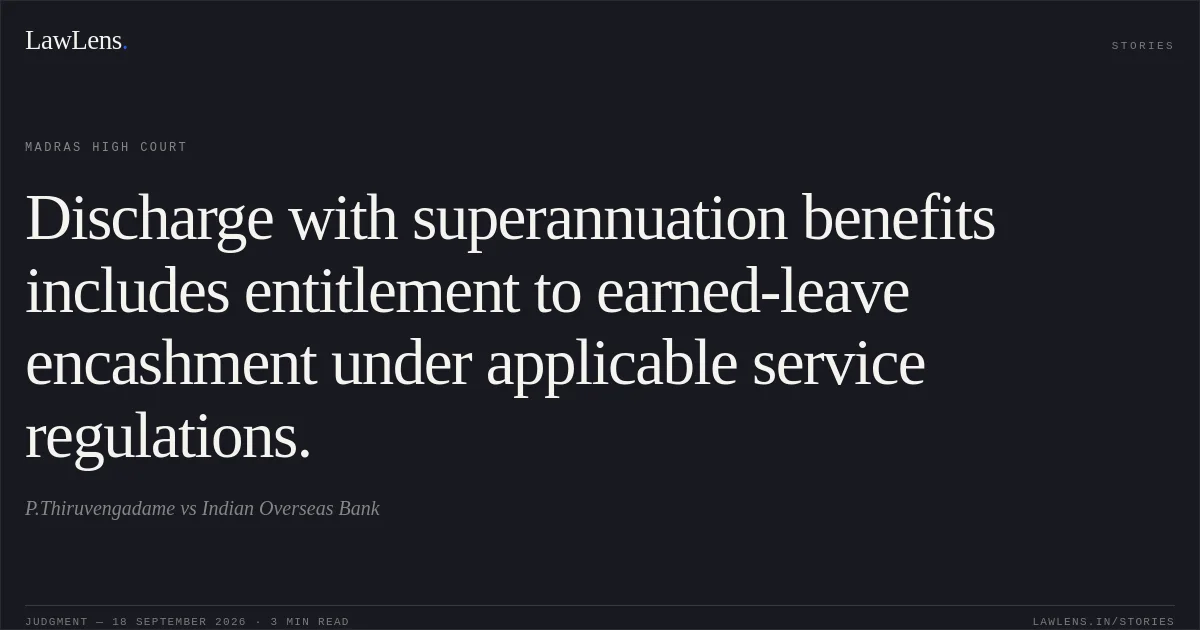
The petitioner, an officer of Indian Overseas Bank, was imposed the punishment of “discharge from service with superannuation benefits” under Clause 6(d) of the Bipartite Settlement dated 10.04.2002, by order dated 23.10.2019.
Source reference: paras. 2, 5, 9He did not challenge the disciplinary order, which consequently attained finality.
Source reference: paras. 2, 5, 9The Bank paid his provident fund and gratuity benefits but denied encashment of accumulated earned/privilege leave on the basis of its Circular dated 13.03.2004, as amended on 03.02.2016, which treated discharged employees as ineligible for leave encashment.
Source reference: paras. 2, 5, 9The petitioner claimed leave encashment for up to 240 days, contending that “superannuation benefits” included all benefits ordinarily available upon retirement.
Source reference: para. 2.1He also argued that leave encashment constituted a property right protected under Article 300-A of the Constitution.
Source reference: para. 2.1The Bank relied on Regulation 38 of the Indian Overseas Bank (Officers’) Service Regulations, 1979, under which leave ordinarily lapsed upon discharge, dismissal or termination, and contended that the petitioner was therefore disentitled to leave encashment.
Source reference: paras. 3, 5–6Issues
Whether an employee discharged from service with superannuation benefits under Clause 6(d) of the Bipartite Settlement is entitled to the terminal benefits ordinarily available to an employee retiring from service, including encashment of accumulated privilege leave up to 240 days?
Source reference: paras. 7–10, 12, 15–16Whether the Bank’s Circular dated 13.03.2004, as amended on 03.02.2016, could deny leave encashment to such an employee contrary to Regulation 38 of the Officers’ Service Regulations?
Source reference: paras. 9, 16Whether the petitioner’s accumulated leave could be treated as lapsed merely because his cessation was formally described as “discharge” rather than retirement?
Source reference: paras. 5–8, 12–16Law Applied
The Court applied Regulation 38 of the Indian Overseas Bank (Officers’) Service Regulations, 1979, which provides for lapse of leave upon resignation, retirement, death, discharge, dismissal or termination, but expressly permits payment equivalent to emoluments for up to 240 days of privilege leave upon retirement or compulsory retirement, including compulsory retirement as a punishment.
Source reference: para. 6It also applied Clause 6(d) of the Bipartite Settlement dated 10.04.2002, under which discharge from service with superannuation benefits carries pension, provident fund and gratuity as would otherwise be due under the applicable rules.
Source reference: para. 8Relying on Bank of Baroda v. S.K. Kool (D) through LRs., (2014) 2 SCC 715, the Court held that “superannuation benefits” include benefits ordinarily available on retirement to an employee otherwise eligible for them.
Source reference: para. 10It followed Central Bank of India v. O. Vijayan, whose decision directing leave encashment for an employee discharged with superannuation benefits was subsequently upheld by the Supreme Court in S.L.P. (C) No.31705 of 2018.
Source reference: paras. 12, 15The Court also relied on State of Jharkhand v. Jitendra Kumar Srivastava, (2013) 12 SCC 210, for the principle that pensionary and terminal benefits constitute “property” and cannot be withheld except by authority of law.
Source reference: para. 11Reasoning
The Court treated the expression “superannuation benefits” in Clause 6(d) as substantive rather than limited to pension, provident fund and gratuity alone.
Source reference: paras. 7–8, 12Since Regulation 38 preserves leave encashment for an employee retiring from service, and the petitioner’s discharge expressly carried superannuation benefits, the Court held that he was entitled to the benefits ordinarily available upon retirement, including encashment of accumulated privilege leave.
Source reference: paras. 7–8, 12The reasoning in S.K. Kool required the phrase “as would be due otherwise” to be construed harmoniously so that the punishment of discharge with superannuation benefits retained meaningful effect and did not deprive an otherwise eligible employee of all retirement-related benefits.
Source reference: para. 10The Court further relied on O. Vijayan, which had directly addressed the same issue and had been affirmed by the Supreme Court.
Source reference: paras. 12–15Accordingly, the Bank’s Circular, insofar as it categorically excluded discharged employees from leave encashment, was held inconsistent with Regulation 38 and incapable of overriding it.
Source reference: para. 16Holding
The Court allowed the writ petition.
It set aside the Bank’s Circular dated 13.03.2004, as amended, to the extent that it was contrary to Regulation 38, and held that the petitioner was entitled to earned/privilege leave encashment up to 240 days as part of his superannuation benefits.
Source reference: para. 17The respondents were directed to disburse the amount within eight weeks from receipt of the order, together with interest at 6% per annum from the date of discharge until payment.
Source reference: para. 17No costs were awarded.
Source reference: para. 17Original Court PDF
P.ThiruvengadamevsIndian Overseas Bank
Click to open original judgment
Original judgment, available to read, download and summarize on LawLens.in