Facts
The petitioner was initially appointed as a Sweeper at Markasa PHC by office order dated 29 December 2006 against the leave vacancy of her father, who had availed 90 days’ earned leave.
Source reference: p.2After her father’s death, she was permitted to officiate against the post on a regular scale by order dated 4 March 2009.
Source reference: pp.2–3The District Medical and Health Officer thereafter issued an order dated 24 November 2009 purporting to regularize her services on compassionate grounds.
Source reference: p.3However, official records and a communication dated 8 October 2025 continued to describe her appointment as adhoc.
Source reference: p.3The State respondents contended that the DMHO lacked competence to grant regularization and that the petitioner’s appointment, treated as commencing on 4 March 2009, fell after the Cabinet-prescribed cutoff date of 31 December 2007 for regularization of adhoc employees.
Source reference: p.3The petitioner accordingly sought regularization of her service.
Source reference: no citationIssues
Whether the petitioner was entitled to regularization on the basis of her initial appointment and continuous service from 29 December 2006, notwithstanding the official recording of her adhoc appointment from 4 March 2009.
Source reference: pp.3–4Whether the petitioner’s service could be considered for regularization by notionally treating 29 December 2006 as the relevant date, despite the alleged lack of competence of the DMHO to regularize her services and the 31 December 2007 cutoff date.
Source reference: p.4Law Applied
The Court applied the State Cabinet’s regularization policy/decision fixing 31 December 2007 as the cutoff date for regularization of adhoc employees.
Source reference: p.3It also applied the administrative-law principle that an order of regularization issued by an authority lacking the requisite competence is legally ineffective or non est.
Source reference: p.4The Court further proceeded on the principle that, while the petitioner might not fall within the existing regularization exercise on the basis of the officially recorded date of appointment, the competent authorities could consider her claim by taking into account the earlier date from which she had in fact been officiating.
Source reference: p.4Reasoning
The Court accepted that the petitioner had served against the same post from 29 December 2006 and was subsequently permitted to officiate on a regular scale from 4 March 2009.
Source reference: p.4It also recognized that the DMHO’s purported regularization order dated 24 November 2009 could not, by itself, confer a right because the DMHO was allegedly not the competent authority to grant regularization.
Source reference: p.4At the same time, the Court noted that treating 4 March 2009 as the commencement of her adhoc service placed her outside the Cabinet’s 31 December 2007 cutoff.
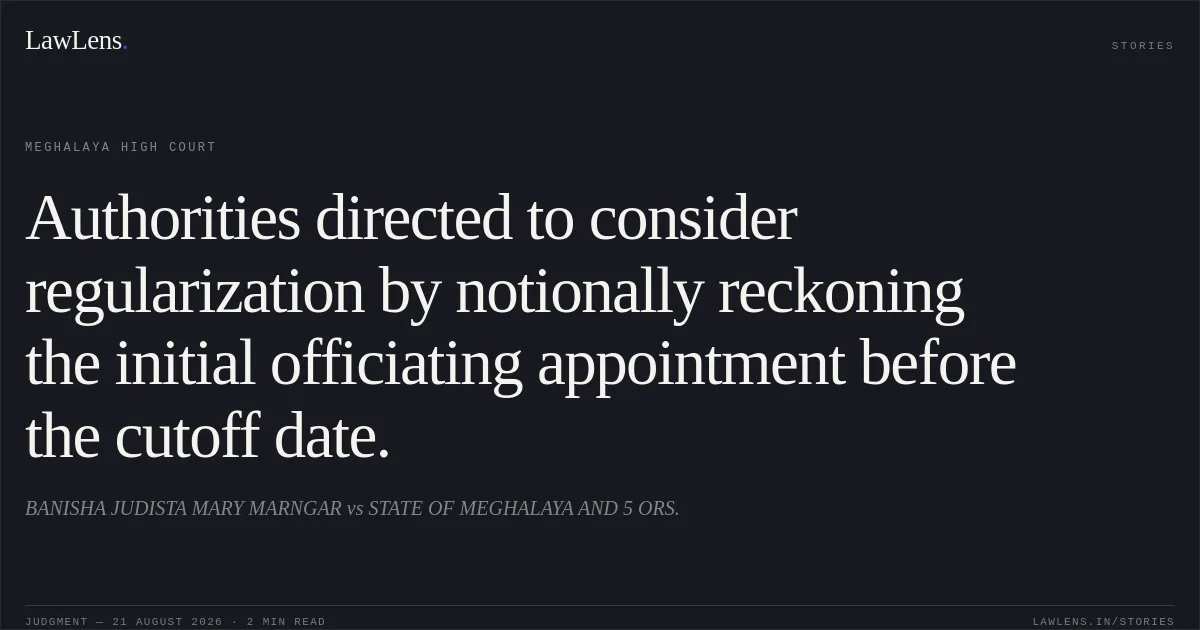
Source reference: p.4Balancing these considerations, the Court did not itself direct regularization but held that the respondents ought to reconsider the petitioner’s claim by notionally taking her initial officiating date of 29 December 2006 into account.
Source reference: p.4Holding
The writ petition was disposed of without granting an immediate order of regularization.
The respondents were directed to consider the petitioner’s prayer for regularization, including by taking into consideration her initial date of officiating appointment, namely 29 December 2006, within six months from the date of the judgment.
Source reference: p.4The matter was accordingly closed and disposed of.
Source reference: p.4Original Court PDF
BANISHA JUDISTA MARY MARNGARvsSTATE OF MEGHALAYA AND 5 ORS.
Click to open original judgment
Original judgment, available to read, download and summarize on LawLens.in