Facts
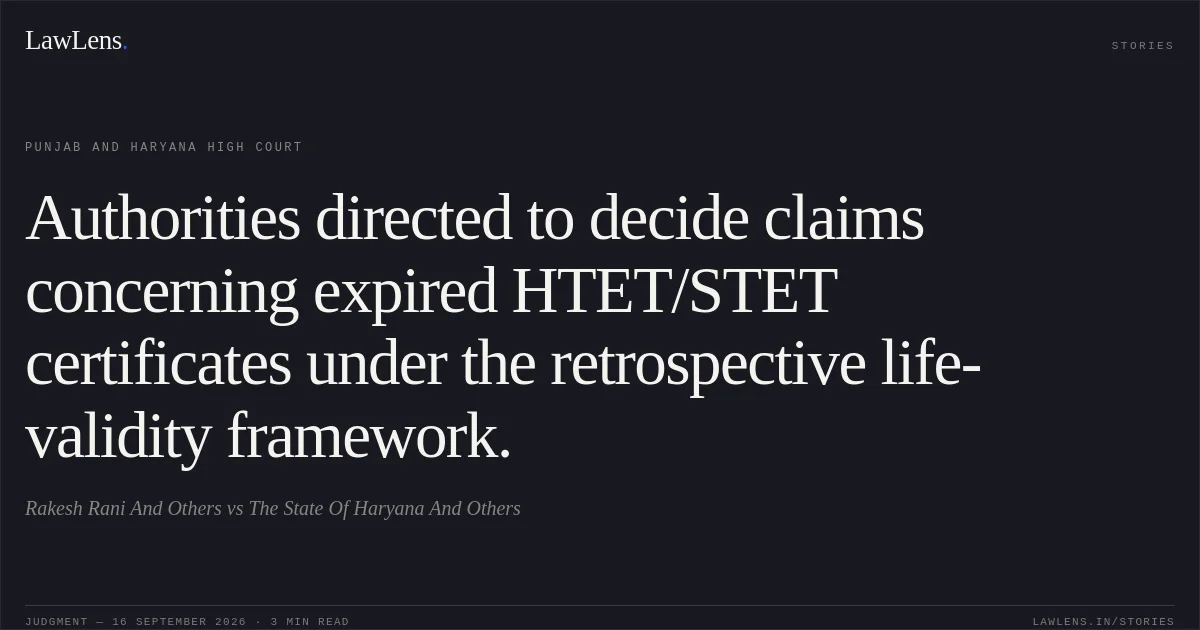
Haryana Kaushal Rozgar Nigam Limited (HKRNL) issued advertisements dated 06.10.2022, 07.10.2022 and 09.10.2022 for various TGT/PGT posts. The petitioners applied for posts including PGT Economics, PGT Hindi, PGT History and TGT Science, were shortlisted, furnished their consent online and were allocated districts/stations, but appointment letters were not issued.
Source reference: para. 2Their candidature was subsequently rejected through communications/SMS dated 03.12.2022 on the ground that their HTET/STET certificates had crossed the earlier seven-year validity period.
Source reference: para. 2.1The petitioners relied on the NCTE notification dated 09.06.2021, which extended the validity of TET certificates for life with effect from 11.02.2011, and on the subsequent judgment in Mamta Devi v. State of Haryana, CWP-25154-2023, decided on 12.08.2026.
Source reference: paras. 2.2–2.5They had earlier challenged the rejection in CWP-29517-2022, which was disposed of on 23.12.2022 with liberty to approach the competent authorities for a speaking decision.
Source reference: para. 2.3During the present proceedings, the petitioners limited their prayer to treating the writ petition as a comprehensive representation and directing the competent authority to decide it in accordance with law.
Source reference: para. 2.6Issues
Whether the petitioners’ candidature could be rejected solely on the ground that their HTET/STET certificates had exceeded the erstwhile seven-year validity period, despite the NCTE notification dated 09.06.2021 extending such validity for life with retrospective effect from 11.02.2011.
Source reference: paras. 2.1–2.3Whether the prospective restriction imposed by the State Government’s order dated 06.08.2024 could be sustained in light of the principles stated in Mamta Devi v. State of Haryana.
Source reference: para. 2.4Whether the competent authority should be directed to reconsider the petitioners’ claim by treating the writ petition as a comprehensive representation and by passing a reasoned and speaking order.
Source reference: paras. 2.6, 3–4Law Applied
The Court considered the NCTE notifications/guidelines dated 23.08.2010 and 11.02.2011, under which TET certificates were initially valid for a maximum period of seven years, and the NCTE notification dated 09.06.2021 amending Clause 11 to extend the validity of TET qualifying certificates for life with effect from 11.02.2011.
Source reference: para. 2.2The Court also considered the judgment in Mamta Devi v. State of Haryana and others, CWP-25154-2023, decided on 12.08.2026, wherein the retrospective operation of the NCTE notification and the alleged discriminatory distinction based on the date of advertisement were examined under Articles 14 and 16 of the Constitution.
Source reference: para. 2.4The applicable procedural principle was that a competent authority must consider the petitioners’ claim in accordance with law and pass a reasoned and speaking order.
Source reference: paras. 2.6, 4Reasoning
The Court did not adjudicate the merits of the petitioners’ entitlement to appointment. It noted that the petitioners’ rejection was based on the earlier seven-year validity requirement, whereas they relied on the NCTE notification dated 09.06.2021 and the subsequent decision in Mamta Devi.
Source reference: paras. 2.1–2.5Since the petitioners confined their prayer to reconsideration and the State had no objection, the Court considered it appropriate to remit the matter to the competent authority rather than determine the validity of the certificates or the appointment claim itself.
Source reference: paras. 2.6, 3–4The authority was therefore required to examine the representation in light of the NCTE notification, the Mamta Devi judgment and the supporting documents, while independently applying the law to the petitioners’ case.
Source reference: para. 4Holding
The writ petition was disposed of without expressing any opinion on the merits.
Respondent Nos. 2 and 3/competent authority were directed to treat the writ petition as a comprehensive representation, consider and decide it in accordance with law and in light of the NCTE notification dated 09.06.2021 and the judgment in Mamta Devi, and pass a reasoned and speaking order within three months from receipt of a certified copy of the order.
Source reference: para. 4The decision was to be communicated to the petitioners forthwith. If the petitioners were found entitled to relief, the competent authority was directed to grant the same in accordance with law.
Source reference: para. 5Any pending miscellaneous applications were also disposed of.
Source reference: para. 6Original Court PDF
Rakesh Rani And OthersvsThe State Of Haryana And Others
Click to open original judgment
Original judgment, available to read, download and summarize on LawLens.in