Facts
Cipla Limited, operating a pharmaceutical unit in Sikkim, claimed budgetary support under the GST-era budgetary support scheme applicable to specified States, including Sikkim.
Source reference: para. 1In its declaration/application dated 19 September 2019, Cipla claimed eligible Input Tax Credit (ITC) of ₹15,28,80,613. Pursuant to the respondents’ direction, Cipla submitted a Chartered Accountant’s certificate showing that the ITC actually availed was ₹10,01,57,759.
Source reference: para. 2The proceedings culminated in an order dated 19 January 2023 that relied on the higher figure in the original declaration without considering the CA certificate or giving Cipla an opportunity to explain the discrepancy.
Source reference: paras. 2–3During the writ proceedings, the High Court directed Respondent No. 6 to afford Cipla a personal hearing and verify its claim regarding the discrepancy.
Source reference: para. 4After the hearing, Respondent No. 6 passed an order dated 24 April 2026, refusing to consider Cipla’s objection on the ground that the scheme did not permit post facto revision or substitution of figures after filing, particularly where the quantum of benefit would change.
Source reference: para. 5Cipla challenged the deduction of ₹5,27,22,856 from its entitlement.
Source reference: para. 3Issues
Whether the respondents could conclude the budgetary-support proceedings by relying on the original declaration without giving Cipla an opportunity to explain the discrepancy between that declaration and the CA certificate.
Source reference: paras. 6–12Whether Cipla was entitled to seek consideration of the lower ITC figure certified by its Chartered Accountant, notwithstanding the absence of an express provision permitting post facto revision of the declaration.
Source reference: paras. 5–8Whether the impugned order was liable to be set aside for violation of procedural fairness and natural justice.
Source reference: paras. 11–14Law Applied
The Court exercised its jurisdiction under Article 226 of the Constitution of India.
Source reference: title pageIt applied the principles of natural justice, procedural fairness, and the requirement that an administrative or quasi-judicial authority provide a reasonable opportunity to explain a discrepancy that forms the basis of its decision.
Source reference: paras. 7, 10–12The Court held that the absence of a specific statutory or scheme provision permitting rectification did not justify concluding proceedings without first seeking an explanation where the record itself disclosed a discrepancy.
Source reference: paras. 6–8It further held that a declaration ordinarily binds the claimant, but this is not an inflexible rule where the claimant alleges an apparent mistake and seeks to substantiate it with supporting documents.
Source reference: paras. 8–11Reasoning
The discrepancy between the declared ITC of ₹15,28,80,613 and the CA-certified ITC of ₹10,01,57,759 was apparent on the record, and the CA certificate had been produced pursuant to the respondents’ own direction.
Source reference: paras. 2, 7Since the discrepancy directly affected the quantum of Cipla’s entitlement, fairness required the authority to call upon Cipla to explain whether the higher figure in the declaration resulted from an error and to produce supporting material.
Source reference: paras. 7, 10–12The Court distinguished ordinary post-conclusion rectification from the present case, holding that the defect lay in the manner in which the proceedings were conducted, because the authority concluded them without considering the discrepancy or hearing Cipla on it.
Source reference: paras. 8, 12The Court did not determine whether Cipla’s explanation was factually correct or ultimately acceptable; it held only that the explanation had to be considered before a decision on merits.
Source reference: para. 10Holding
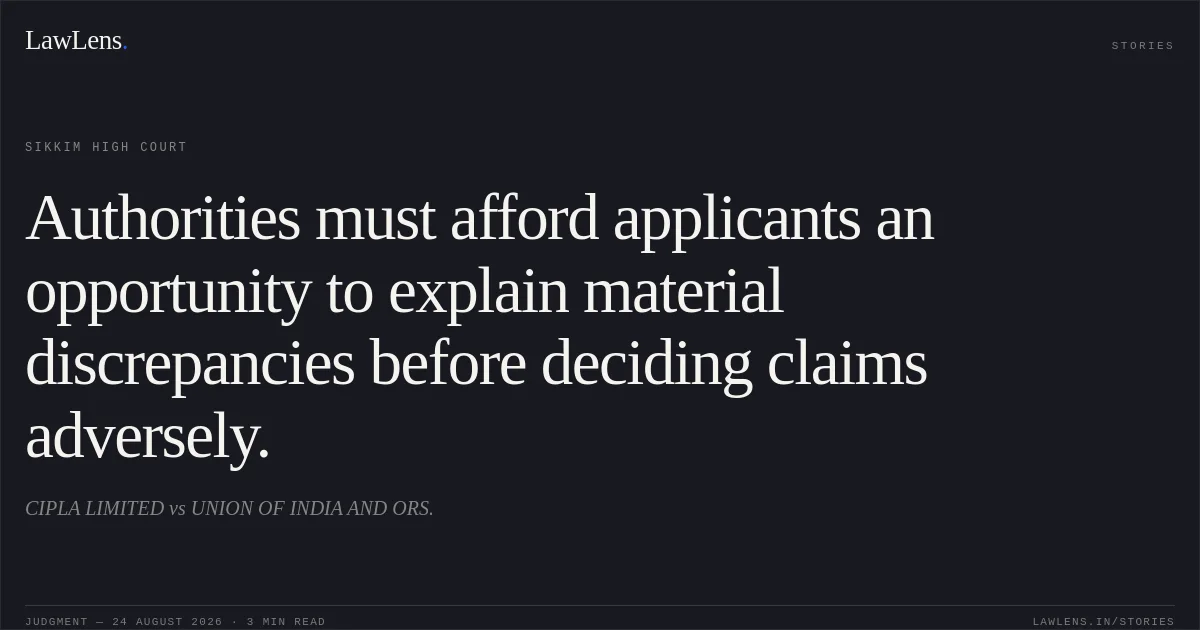
The Court held that the respondents could not validly conclude the proceedings merely by relying on the original declaration without giving Cipla a reasonable opportunity to explain the discrepancy.
The impugned order was set aside to the extent challenged.
Source reference: para. 14Cipla was granted liberty to produce documents substantiating that the higher figure in the declaration resulted from a mistake.
Source reference: paras. 15, 17Respondents Nos. 5 and 6 were directed to reconsider the matter and complete the necessary exercise within eight weeks.
Source reference: para. 16The writ petition was accordingly allowed to that extent.
Source reference: para. 18Original Court PDF
CIPLA LIMITEDvsUNION OF INDIA AND ORS.
Click to open original judgment
Original judgment, available to read, download and summarize on LawLens.in