Facts
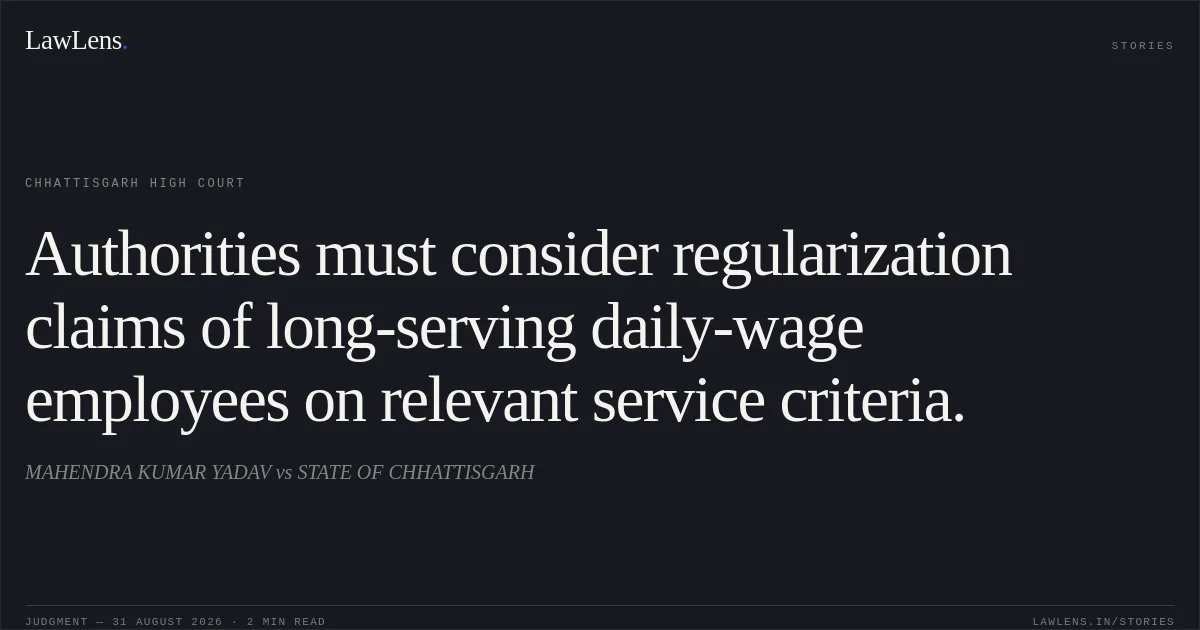
The ten petitioners claimed that they had initially been engaged by the Municipal Corporation, Rajnandgaon, as daily-wage employees and were subsequently appointed on a contractual basis.
Source reference: para. 2They asserted that they had rendered continuous service for approximately 10–20 years, but their requests for regularisation had not been considered by the respondents.
Source reference: para. 2The petitioners therefore sought a writ directing regularisation from the date on which they completed ten years of continuous service, together with arrears, seniority, and other consequential service benefits.
Source reference: para. 1The respondents opposed the petition.
Source reference: para. 3Issues
Whether the petitioners’ claim for regularisation, based on their alleged prolonged and continuous service as daily-wage and contractual employees, was required to be considered by the competent authority.
Source reference: paras. 2, 5Whether the petitioners were entitled to an immediate direction for regularisation with retrospective and consequential service benefits, or whether their claim should first be examined by the competent authority in accordance with relevant factors.
Source reference: paras. 1, 5, 7Law Applied
Referring to Secretary, State of Karnataka v. Umadevi (3) as discussed in Jaggo v. Union of India, the Court recognised the distinction between “illegal” and “irregular” appointments and the principle that employees appointed against duly sanctioned posts who have continuously served for more than ten years may be considered for regularisation as a one-time measure.
Source reference: para. 6The Court further relied on Jaggo v. Union of India, 2024 LiveLaw (SC) 10324, which emphasised that prolonged temporary engagement, particularly where the work is integral to the organisation, may amount to exploitation and that the authority should adopt fair and stable employment practices.
Source reference: para. 6In considering regularisation, the authority was required to examine the nature of employment, length of service, past record, availability of sanctioned vacancies, and other relevant circumstances.
Source reference: para. 5Reasoning
The Court accepted that the petitioners had alleged prolonged and continuous service extending over 10–20 years and that their regularisation claims had not previously been considered.
Source reference: para. 5However, rather than granting automatic regularisation, the Court held that the competent authority must assess the relevant factual and legal conditions, including the nature of the petitioners’ engagement, their length of service, service record, and the existence of sanctioned vacancies.
Source reference: para. 5Applying the principles referred to in Jaggo and the regularisation framework discussed in Umadevi, the Court directed the respondent authority to consider the petitioners’ claims while keeping the Court’s observations in mind.
Source reference: paras. 6–7Holding
The petition was disposed of without an order granting immediate regularisation.
Respondent No. 2—the Directorate of Administration and Development—was directed to consider the petitioners’ claims for regularisation in accordance with law and the observations contained in the order.
Source reference: paras. 7–8The entire exercise was directed to be completed within 120 days from receipt of a copy of the order.
Source reference: paras. 7–8Original Court PDF
MAHENDRA KUMAR YADAVvsSTATE OF CHHATTISGARH
Click to open original judgment
Original judgment, available to read, download and summarize on LawLens.in