Facts
The petitioner filed a writ petition under Article 226 of the Constitution along with four connected petitions concerning land acquisition proceedings initiated pursuant to notification dated 26 July 2024.
Source reference: p.1The petitioners, who were cousin brothers, challenged the approval order under which only one alternative plot was allotted jointly to them, despite an earlier partition having allegedly been effected and mutated in the revenue records among seven individual co-sharers.
Source reference: p.1The petitioners contended that the authority issued notice only to one person and consequently failed to make seven separate allotments.
Source reference: p.2The respondent authority submitted that it had acted on the material available on record and that no partition documents had been produced when notice was issued, although notice had been served on the petitioner’s representative.
Source reference: p.2The petitioners had submitted individual representations dated 30 January 2026, marked as Annexure P-7, which remained undecided.
Source reference: p.2Issues
Whether the respondent authorities were required to reconsider the allotment of alternative land by examining the alleged partition and mutation of the revenue records among the seven co-sharers.
Source reference: pp.1–3Whether the pending representations dated 30 January 2026 were required to be decided in accordance with law before any coercive action was taken against the petitioners.
Source reference: pp.2–4Law Applied
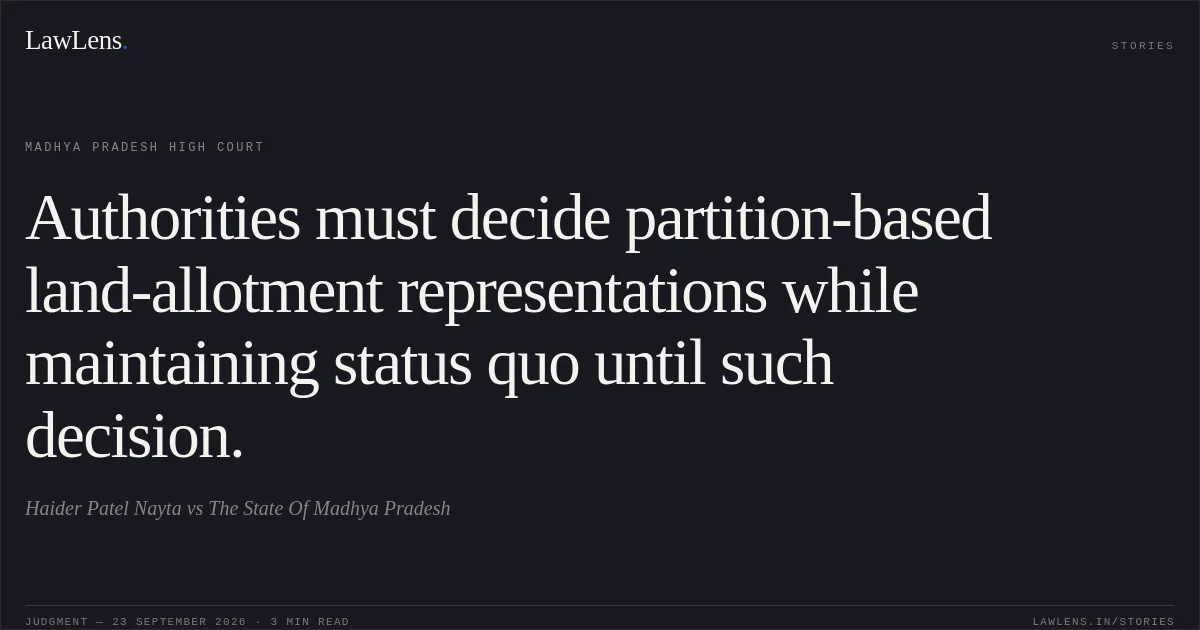
The Court exercised its supervisory and writ jurisdiction under Article 226 of the Constitution to issue a limited mandamus requiring the competent authorities to consider and decide the petitioners’ pending representations in accordance with law.
Source reference: pp.1–4The Court applied the principles of procedural fairness and proper consideration of relevant revenue records and other material before taking administrative action affecting land rights.
Source reference: pp.1–4It did not finally adjudicate the petitioners’ entitlement to seven separate allotments, but directed reconsideration by the respondent authorities within a prescribed period, while protecting the petitioners against coercive action during the decision-making process and for a limited period thereafter.
Source reference: pp.1–4Reasoning
The Court noted that the partition had allegedly already been reflected in the revenue records, whereas the authority had issued notice only to one person and allotted a single plot to all seven claimants.
Source reference: p.1Since the petitioners asserted that the authority had not considered their representations or the relevant partition records, the Court found it appropriate to require the respondent authorities to examine the revenue records and all other material afresh.
Source reference: pp.3–4Without expressing any final opinion on the merits of the allotment claim, the Court considered such reconsideration necessary in the interests of justice.
Source reference: pp.3–4The Court also preserved the existing position during the decision-making process so that the petitioners would not suffer coercive consequences before their representations were duly considered.
Source reference: pp.3–4Holding
The petition was disposed of with a direction to Respondent Nos. 2 and 3 to consider each petitioner’s representation dated 30 January 2026 individually, examine the revenue records and other relevant material, and decide the representations in accordance with law as expeditiously as possible and preferably within, but in any event not later than, 45 days.
The decision was to be communicated individually to each petitioner, preferably by registered post with acknowledgment due.
Source reference: p.3No coercive action was to be taken until the respective representation was decided, and status quo was to be maintained until its outcome.
Source reference: pp.3–4If the decision was adverse, the authorities were further restrained from taking coercive action for 15 days thereafter.
Source reference: pp.3–4The parties were directed to cooperate in the proceedings.
Source reference: no citationOriginal Court PDF
Haider Patel NaytavsThe State Of Madhya Pradesh
Click to open original judgment
Original judgment, available to read, download and summarize on LawLens.in