Facts
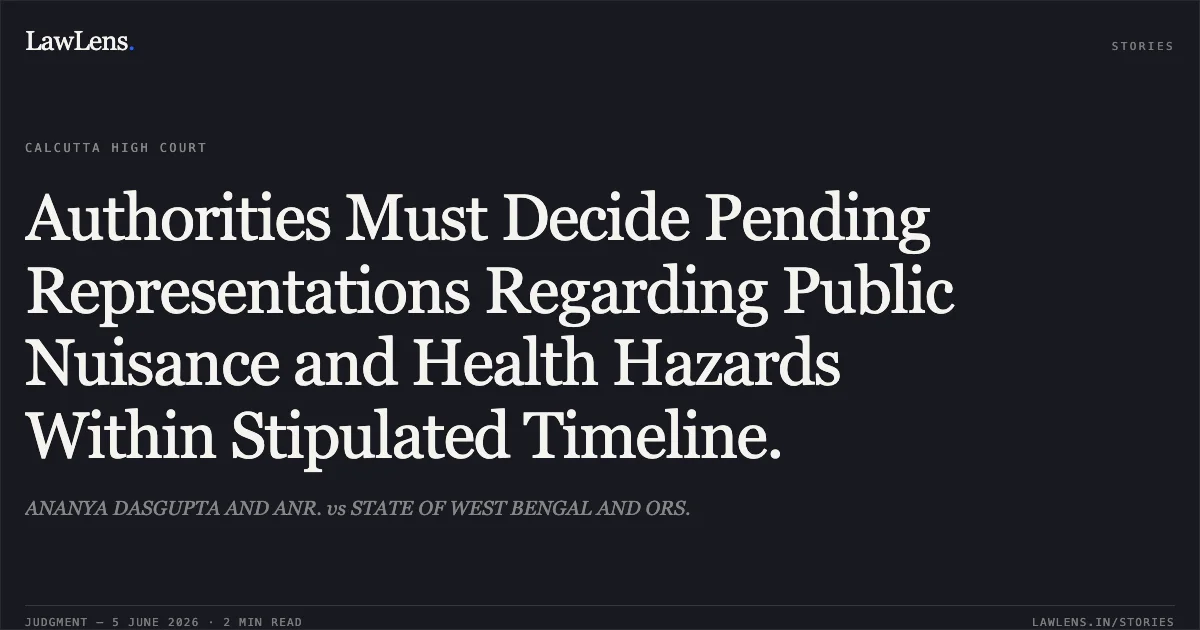
The petitioners filed a writ petition seeking a Mandamus to compel respondent authorities to act upon complaints regarding a "public nuisance" caused by the private respondents keeping multiple "roadside cats" in the petitioners' ancestral house.
Source reference: p. 1-2The petitioners alleged that the overcrowding of cats poses health hazards, including risks of disease and infection.
Source reference: p. 2A formal complaint was lodged on May 18, 2026, which remained pending.
Source reference: para. 4The private respondents challenged the maintainability of the petition, arguing the petitioners lacked locus standi as they reside in Noida and suffered no direct injury in Kolkata.
Source reference: para. 6The State argued the petition was frivolous and disclosed no violation of fundamental rights.
Source reference: para. 7Issues
1. Whether the respondent authorities are obligated to consider and dispose of a representation regarding alleged public nuisance and health hazards caused by domestic/stray animals.
Source reference: para. 82. Whether the writ petition is maintainable given the challenge to the petitioners' locus standi.
Source reference: para. 6, 9Law Applied
The Court applied the principles of Administrative Law governing the duty of public authorities to consider representations within a reasonable timeframe.
Source reference: para. 3It also touched upon the Law of Torts regarding public nuisance and relevant municipal regulations concerning health hazards and animal overcrowding.
Source reference: para. 3The Court exercised its discretionary jurisdiction under Article 226 of the Constitution of India to ensure the "ends of justice" by directing a statutory authority to perform its duty without adjudicating on the underlying merits.
Source reference: para. 8-9Reasoning
The Court observed that the petitioners’ representation dated May 18, 2026, had been pending for a considerable period without action.
Source reference: para. 8Rather than adjudicating on the factual disputes regarding the cats or the legal challenge to the petitioners' locus standi, the Court determined that procedural fairness required the administrative authority to pass a reasoned order.
Source reference: para. 8The Court integrated the principle of audi alteram partem by directing that all stakeholders, including the private respondents and petitioners, be afforded a hearing to resolve the grievances.
Source reference: para. 8By disposing of the matter "without going into the merits," the Court circumvented the State's argument for dismissal in limine, opting instead for a time-bound administrative resolution.
Source reference: para. 9Holding
The Court disposed of the writ petition with a direction to Respondent No. 2 to consider the petitioners' representation dated May 18, 2026.
The authority is ordered to pass a reasoned order in accordance with the law within four weeks, following an opportunity of hearing for all parties, and to communicate the decision within one week thereafter.
Source reference: para. 8No order as to costs was made.
Source reference: para. 10Acts & Sections Cited
1 provisions across 1 statute referred to in this judgment. Linked provisions open on LawLens.
Manipur Municipalities Act,1994.1
Original Court PDF
ANANYA DASGUPTA AND ANR.vsSTATE OF WEST BENGAL AND ORS.
Click to open original judgment
Original judgment, available to read, download and summarize on LawLens.in