Facts
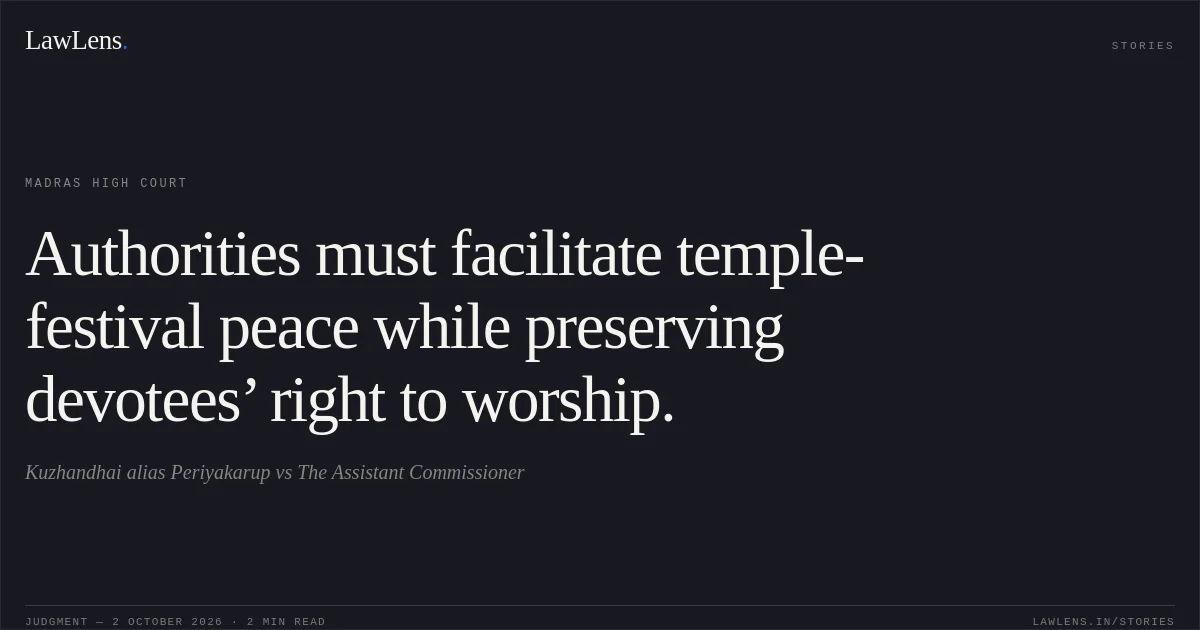
The petitioner sought a mandamus directing the authorities to permit Polakkapatti villagers to hold the traditional Mandhai Amman Temple festival at Survey No. 56/2, relying on a representation dated 10 September 2026.
Source reference: p.1The dispute arose among devotees from 117 families: 11 families had installed a stone and shrine for Karunkachi Amman at Survey No. 55/26, about 300 metres away, and the festivals held at the same time had caused friction.
Source reference: p.3–4Earlier efforts by the Revenue Divisional Officer to agree on different time slots had not resolved the dispute.
Source reference: p.3–4The authorities submitted that the temple was outside the HR&CE Department’s purview and that their role was limited to attempting to facilitate a solution; the land at Survey No. 55/26 was classified as Sarkar Poramboke. The festival was scheduled for 6 October 2026.
Source reference: p.4Issues
1. Whether the Revenue Divisional Officer should be directed to facilitate a resolution between the devotees to avoid friction during the scheduled temple festival.
Source reference: p.4–52. Whether the petitioner was entitled to a direction permitting the festival to be conducted according to the customary practice.
Source reference: p.1, 5–6Law Applied
The Court stated that a citizen’s or devotee’s right to worship in a temple cannot be deprived either by the Court or by the Revenue Authorities.
Source reference: p.5It identified no specific statute, precedent, or further legal test as the basis for its decision; the petition was brought under Article 226 of the Constitution.
Source reference: p.1The Court’s operative approach was to balance the interests of devotees by directing the Revenue Divisional Officer to convene a peace committee meeting and attempt to secure agreement on different festival time slots.
Source reference: p.5Reasoning
Given the recurring friction caused by simultaneous festivals, and the authorities’ limited role in the dispute, the Court did not determine the parties’ competing claims to conduct the festival at particular times.
Source reference: p.5Instead, it balanced the devotees’ right to worship against the need to prevent disharmony, directing the Revenue Divisional Officer to convene a meeting between representatives of the 106 families and the 11 families and to use his good offices to persuade them to accept different time slots. The Court also left it to the officer to decide whether police deployment was needed to maintain law and order.
Source reference: p.5Holding
The Court disposed of the writ petition with directions, rather than granting an unconditional order permitting the festival according to the petitioner’s requested customary practice.
The Revenue Divisional Officer was directed to convene the peace committee meeting on or before 4 October 2026 and attempt to secure agreement on different time slots; he could also assess the need for police personnel.
Source reference: p.5The petitioner’s counsel was directed to provide details of the 11 families who had established the Karunkachi Amman shrine. No costs were ordered.
Source reference: p.6Original Court PDF
Kuzhandhai alias PeriyakarupvsThe Assistant Commissioner
Click to open original judgment
Original judgment, available to read, download and summarize on LawLens.in