Facts
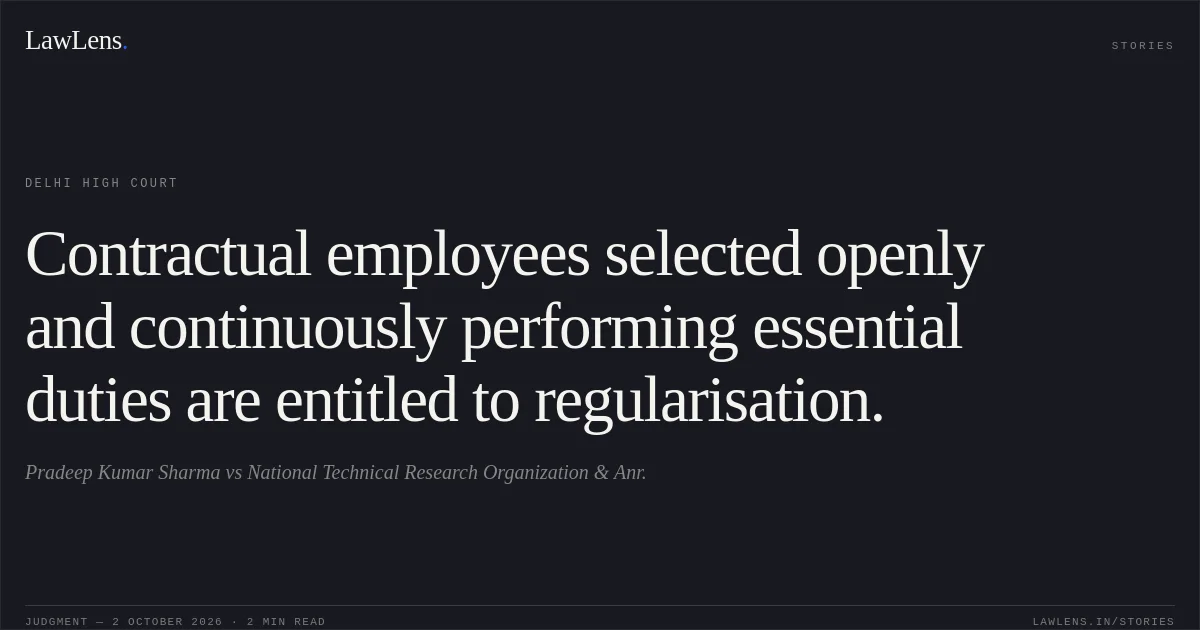
The petitioner was appointed as Scientist-C in the NTRO in 2008 after an advertisement and selection process. No recruitment rules existed for the post at the time.
Source reference: pp. 2–4His contract was periodically extended without a break, and he served continuously; in 2013, the NTRO invited contractual employees to express willingness for regularisation, which the petitioner did, but no further action followed.
Source reference: pp. 2–4After an earlier Tribunal order directed the NTRO to decide his claim, the NTRO rejected his application for regularisation on 28 January 2021. The Tribunal dismissed his subsequent application, reasoning that length of contractual service alone did not entitle an employee to regularisation. The petitioner challenged that decision in the High Court.
Source reference: pp. 3–5Issues
Whether the Tribunal erred in rejecting the petitioner’s claim for regularisation despite his appointment following an advertisement and selection process and his long, continuous service.
Source reference: pp. 4–5, 15Whether the petitioner was entitled to regularisation and consequential service benefits from the date of his initial contractual appointment.
Source reference: pp. 14–15Law Applied
The Court relied on Vinod Kumar v. Union of India, Jaggo v. Union of India, Shripal v. Nagar Nigam and Dharam Singh v. State of U.P., as applied by the Delhi High Court in Pawan Sharma, Kalpana Sharma, Deen Bandhu Garg and Om Prakash Gaur.
Source reference: pp. 5–13It stated that employees selected through a process mirroring regular recruitment, who serve continuously for several years in essential roles, may acquire a substantive right to regularisation, provided their appointments were not illegal, mala fide, surreptitious or “back door”; the contractual or ad hoc label, and the absence of sanctioned posts, do not by themselves defeat that entitlement.
Source reference: pp. 5–13The Court also relied on Articles 141 and 144 of the Constitution, requiring courts to apply and give effect to binding Supreme Court law.
Source reference: pp. 7–9It noted that the principles in these authorities qualified reliance on State of Karnataka v. Uma Devi to deny regularisation in such circumstances.
Source reference: p. 10Reasoning
The petitioner’s appointment followed an NTRO advertisement, and no recruitment rules existed at the time, so the Court found no basis to characterise his appointment as illegal or as a back-door entry.
Source reference: pp. 2–3His contract was extended without interruption over a long period, and the NTRO’s 2013 request for employees’ willingness to be regularised further supported the context of his claim.
Source reference: pp. 3–4Applying the authorities it cited, the Court held that the Tribunal’s reliance on the absence of a rule automatically entitling contractual employees to regularisation did not address the petitioner’s selection, continuous service and the governing precedents.
Source reference: pp. 5–15Holding
The Court allowed the writ petition and set aside the Tribunal’s decision. It held that the petitioner was entitled to regularisation and directed that he be treated as a regular employee from his initial contractual appointment for purposes of notional pay fixation and continuity of service, without back wages.
His pay is to be reworked accordingly, but he is not entitled to seniority over anyone regularly appointed as Scientist-C during his contractual service.
Source reference: p. 15Original Court PDF
Pradeep Kumar SharmavsNational Technical Research Organization & Anr.
Click to open original judgment
Original judgment, available to read, download and summarize on LawLens.in