Facts
The petitioner’s mother, an Auxiliary Nurse Midwife, died in harness on 25 October 1986, when the petitioner was about five years old
Source reference: para. 3–4After attaining majority, he applied for compassionate appointment on 8 September 1998 and subsequently made several representations.
Source reference: paras. 5–8A departmental communication dated 6 November 1998 brought his age at the time of his mother’s death and the question of relaxation of the prescribed period to the competent authority’s attention.
Source reference: paras. 5–8He later acquired the stated qualification for a Class-IV post in 2003.
Source reference: para. 9The petitioner sought consideration under the U.P. Recruitment of Dependents of Government Servants Dying-in-Harness Rules, 1974; the State opposed relief on the ground of delay.
Source reference: paras. 2, 18Issues
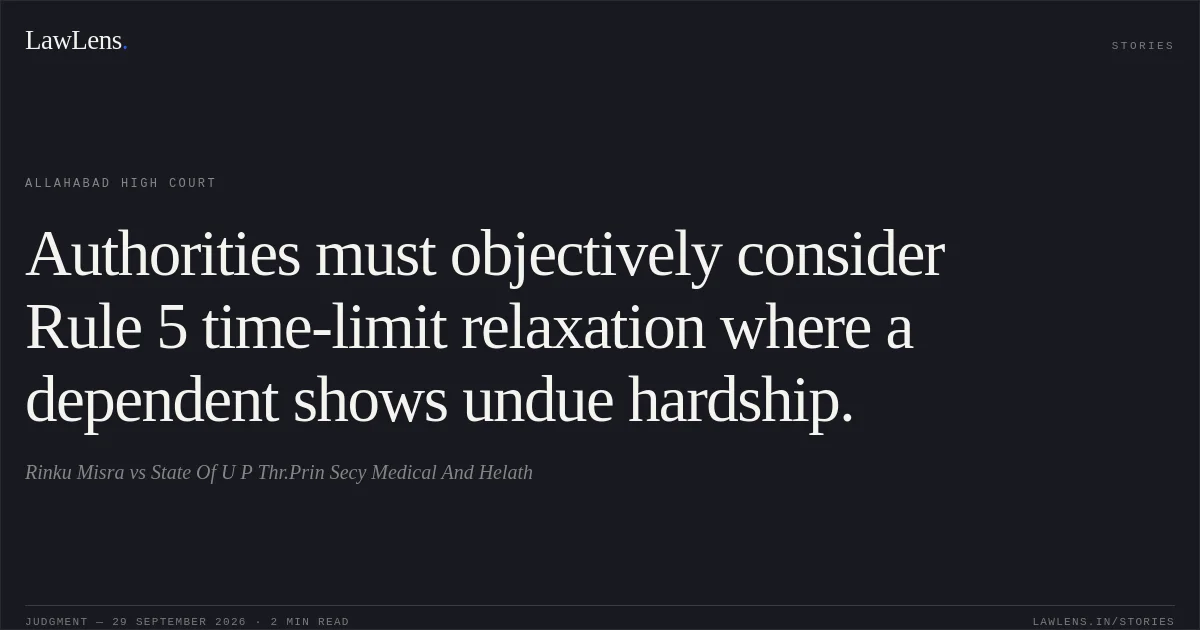
Whether the petitioner’s claim could be rejected or left undecided solely because his application was made outside the ordinary period under Rule 5, without considering relaxation under its first proviso.
Source reference: para. 19Whether the petitioner’s circumstances warranted consideration by the competent authority for relaxation of that period.
Source reference: paras. 22–25, 34Law Applied
Rule 5 of the U.P. Recruitment of Dependents of Government Servants Dying-in-Harness Rules, 1974 ordinarily requires an application for compassionate appointment to be made within five years of the employee’s death, while its first proviso empowers the State Government to relax that period in cases of undue hardship and where justice and equity so require.
Source reference: paras. 20, 23Under the Full Bench decision in Shiv Kumar Dubey v. State of U.P., AIR 2015 All 47, compassionate appointment is an exception to equality in public employment, creates no vested right, and is intended to address the family’s immediate financial crisis.
Source reference: paras. 20–23Delay is relevant, and the applicant bears the burden of establishing undue hardship through reasons and supporting material; minority alone does not suspend the prescribed period or confer an automatic right to appointment.
Source reference: paras. 20–23Reasoning
The Court treated the petitioner’s minority not as an automatic entitlement, but as a relevant circumstance: he was approximately five years old when his mother died and could not independently pursue an application.
Source reference: paras. 24–25It also considered his application after attaining majority, repeated representations, the department’s 1998 communication raising relaxation, and his later qualification as material requiring objective consideration.
Source reference: paras. 26–31Applying Shiv Kumar Dubey, the Court held that the ordinary time limit could not be applied mechanically where the record disclosed circumstances potentially amounting to undue hardship; the competent authority had to decide the relaxation question by a reasoned order.
Source reference: paras. 32–35Holding
The writ petition was allowed.
The respondents were directed to consider the petitioner’s request for relaxation under the first proviso to Rule 5, taking account of the circumstances identified by the Court and issuing a reasoned, speaking order.
Source reference: paras. 36–38If relaxation is granted, the petitioner’s claim for appointment to an appropriate Class-IV post must then be considered under the Rules and subject to other prescribed conditions, including availability and suitability of the post.
Source reference: para. 39The exercise was directed to be completed preferably within three months; no costs were awarded.
Source reference: paras. 40–42Original Court PDF
Rinku MisravsState Of U P Thr.Prin Secy Medical And Helath
Click to open original judgment
Original judgment, available to read, download and summarize on LawLens.in