Facts
The original complainant filed this appeal under Section 378 of the Code of Criminal Procedure, 1973 (“CrPC”), challenging the Trial Court’s judgment dated 24 December 2018 acquitting the accused.
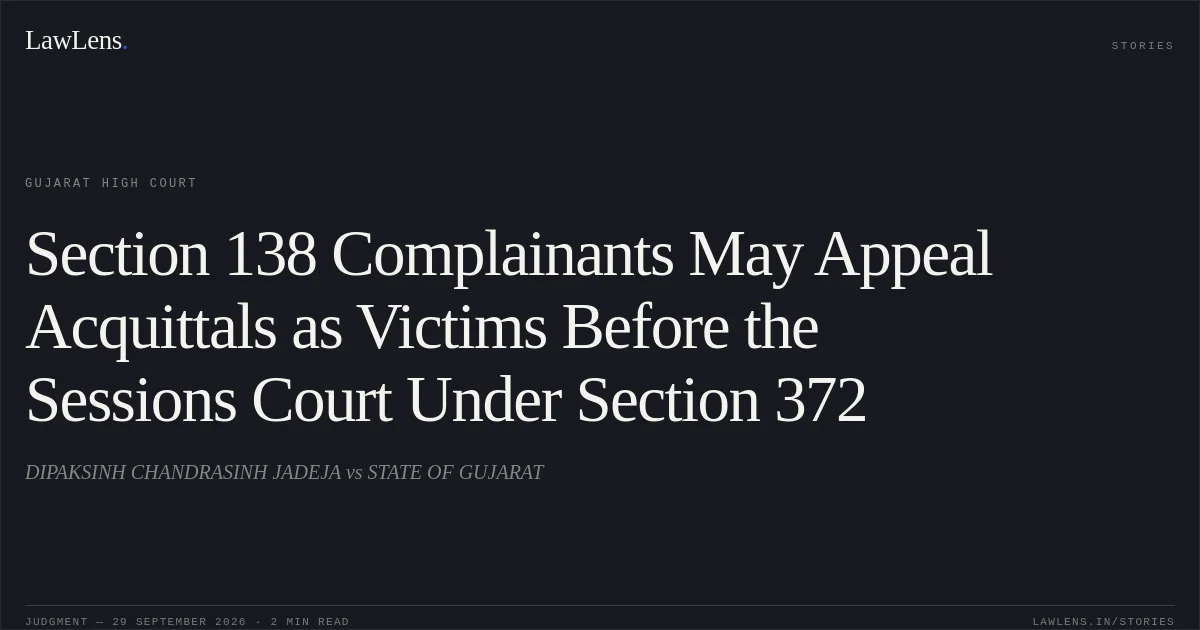
Source reference: para. 1Before considering the merits, the High Court considered the effect of Celestium Financial v. A. Gyanasekaran, which held that a complainant under Section 138 of the Negotiable Instruments Act, 1881 (“NI Act”) is a victim entitled to appeal against acquittal under the proviso to Section 372 CrPC before the immediately superior court, namely the Sessions Court.
Source reference: paras. 3–4, 6The Court was also informed that the issue was pending consideration by a larger Bench of the Supreme Court.
Source reference: para. 5Issues
Whether an original complainant’s appeal against acquittal in a Section 138 NI Act case should be treated as a victim’s appeal under the proviso to Section 372 CrPC and heard by the Sessions Court.
Source reference: paras. 3–7Whether the High Court should consider the merits of the appeal before transferring it to the Sessions Court.
Source reference: paras. 7–8Law Applied
The proviso to Section 372 CrPC gives a victim a right to appeal against acquittal to the court to which an appeal ordinarily lies from the relevant court’s order; under Celestium Financial v. A. Gyanasekaran, a complainant in a Section 138 NI Act case is also the victim of the alleged cheque dishonour and may appeal under that proviso before the immediately superior court, identified as the Sessions Court.
Source reference: paras. 4, 6The judgment also refers to Section 378 CrPC, Section 413 of the Bharatiya Nagarik Suraksha Sanhita, 2023 (“BNSS”), and the Gujarat High Court decisions in Shivsinh Ganpatsinh Solanki v. State of Gujarat and Thakar Hariprasad Dalsukhram v. State of Gujarat and Another.
Source reference: paras. 4, 7The Court noted that the relevant issue was pending before a larger Bench of the Supreme Court and directed that the matter proceed subject to the outcome of that reference.
Source reference: para. 5Reasoning
Applying Celestium Financial, the Court treated the complainant in a Section 138 NI Act case as a victim entitled to appeal under the proviso to Section 372 CrPC.
Source reference: paras. 3–7It therefore concluded that the appeal belonged before the Sessions Court, rather than being considered by the High Court under Section 378 CrPC.
Source reference: paras. 3–7Because the issue was pending before a larger Bench, the transfer was directed subject to the final outcome of that reference.
Source reference: para. 5The Court did not assess the evidence or the merits of the acquittal.
Source reference: para. 8Holding
The High Court disposed of the appeal by directing the Registry to transfer it, together with the relevant record, to the concerned Sessions Court.
The Sessions Court was directed to treat and number it as an appeal under the proviso to Section 372 CrPC or Section 413 BNSS, issue notice to the parties, and endeavour to decide it expeditiously.
Source reference: paras. 7–8The High Court expressly left the merits open.
Source reference: para. 8Acts & Sections Cited
8 provisions across 3 statutes referred to in this judgment. Each provision opens on LawLens.
Code of Criminal Procedure, 19735
Negotiable Instruments Act, 18812
Bharatiya Nagarik Suraksha Sanhita, 20231
Original Court PDF
DIPAKSINH CHANDRASINH JADEJAvsSTATE OF GUJARAT
Click to open original judgment
Original judgment, available to read, download and summarize on LawLens.in