Facts
The petitioners were engaged as Extension Lecturers/Assistant Professors in Environmental Studies and Mathematics by the respondent institutions on 1 February 2016, 5 February 2019, and 5 September 2014, respectively, and claimed to have continuously discharged their academic duties.
Source reference: p.2They challenged the withholding of Ph.D.-related benefits and the reduction of remuneration from ₹57,700 to ₹35,400 per month, allegedly without any written or verbal order.
Source reference: p.1They also sought updating of their eligibility on the Department’s MIS portal, payment of arrears with interest, and parity with similarly placed Guest/Extension Lecturers.
Source reference: p.1The petitioners relied upon the policy guidelines dated 4 March 2020, under which they claimed remuneration of ₹57,700 per month on acquiring NET/Ph.D. qualifications.
Source reference: p.3The State disputed the claim on the ground that the degrees were obtained from OPJS University, Rajasthan; however, it was acknowledged that no final determination regarding the validity of the degrees had been made and the vigilance enquiry remained pending.
Source reference: p.4During hearing, the petitioners agreed to have their claim examined by respondent No.2 in accordance with the 4 March 2020 policy and the Division Bench judgment in Kalyan Singh.
Source reference: p.4Issues
Whether the petitioners’ claim for remuneration and eligibility benefits under the policy guidelines dated 4 March 2020 was required to be examined in light of the Division Bench judgment in Kalyan Singh v. State of Haryana?
Source reference: pp.3–5Whether the petitioners were entitled, at that stage, to a direct mandamus for payment of ₹57,700 per month and arrears, or whether the matter required determination by the competent authority after hearing the petitioners?
Source reference: pp.1, 4–5Whether the pending vigilance enquiry concerning the validity of the petitioners’ degrees precluded consideration of their claim under the applicable policy?
Source reference: p.4Law Applied
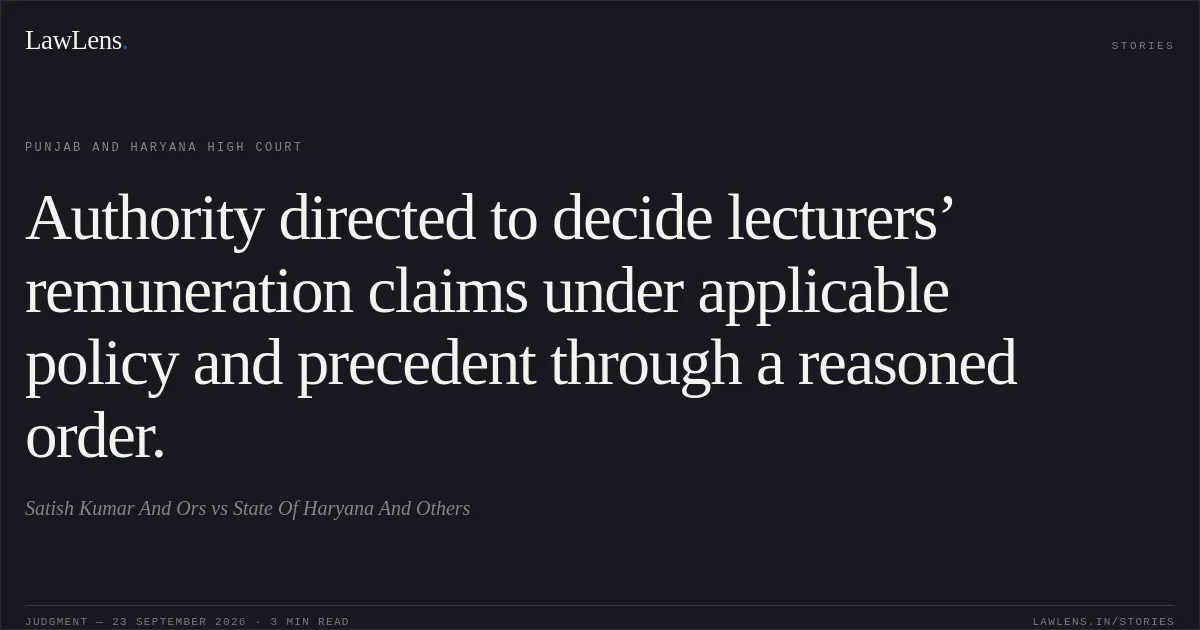
The Court exercised jurisdiction under Article 226 of the Constitution of India to examine the petitioners’ claim for public-law relief and directed the competent authority to take a reasoned decision.
Source reference: p.1The application for placing documents on record was allowed under Section 151 CPC.
Source reference: p.1The Court applied the policy guidelines dated 4 March 2020, which governed the remuneration and eligibility benefits claimed by qualified Extension Lecturers/Assistant Professors.
Source reference: pp.3, 5It also relied upon the Division Bench judgment in Kalyan Singh v. State of Haryana and others, as well as the connected decision in Dr. Dushyant and others v. State of Haryana and another, requiring similarly situated claims to be considered in accordance with the applicable policy and binding judicial interpretation.
Source reference: pp.3–5The governing procedural principle was that the competent authority must consider the claim objectively, afford an opportunity of hearing, and pass an appropriate speaking order; entitlement was not to be finally adjudicated by the writ court without such determination.
Source reference: p.5Reasoning
The Court noted that the petitioners asserted acquisition of NET/Ph.D. qualifications before issuance of the 4 March 2020 policy and relied on decisions concerning similarly situated lecturers.
Source reference: pp.3–4Although the State questioned the validity of the degrees obtained from OPJS University, it could not show that any final finding had been recorded against the petitioners; the vigilance enquiry was still pending.
Source reference: p.4Since the petitioners’ entitlement had to be assessed under the policy and in light of the Division Bench ruling in Kalyan Singh, the Court considered it appropriate for respondent No.2, rather than the writ court in the first instance, to determine the claim.
Source reference: p.5The Court therefore directed a hearing and a reasoned decision, leaving the ultimate entitlement open.
Source reference: p.5Holding
The application under Section 151 CPC was allowed and Annexures A-1 to A-3 were taken on record.
The writ petition was disposed of with a direction to respondent No.2 to examine the petitioners’ claim for remuneration and eligibility benefits under the 4 March 2020 policy and in light of the Division Bench judgment in Kalyan Singh.
Source reference: p.5The decision was to be taken after affording the petitioners an opportunity of hearing and by passing a speaking order within six weeks from receipt of the certified copy of the order.
Source reference: p.5The decision was also to be communicated to the petitioners; if found entitled, the benefits were to be granted forthwith.
Source reference: p.5The Court did not itself declare the petitioners entitled to ₹57,700 per month or arrears, and all pending miscellaneous applications were disposed of.
Source reference: p.5Acts & Sections Cited
1 provisions across 1 statute referred to in this judgment. Each provision opens on LawLens.
Code of Civil Procedure, 19081
Original Court PDF
Satish Kumar And OrsvsState Of Haryana And Others
Click to open original judgment
Original judgment, available to read, download and summarize on LawLens.in