Facts
The petitioners challenged the order dated 09.02.2022 passed by the Chief Judicial Magistrate, Buxar, taking cognizance in Dumaraon P.S. Case No. 201 of 2019 for offences under Sections 341, 323, 498A, 307 and 349 of the Indian Penal Code and Sections 3/4 as recorded in the impugned order.
Source reference: para. 2; p. 1The prosecution arose from allegations that the petitioners, who were relatives of the informant’s husband, harassed and tortured her and drove her out of her matrimonial home.
Source reference: para. 4; p. 2The petitioners contended that they had been implicated through general and omnibus allegations, without any specific role being attributed to them, and that the matrimonial dispute was principally between the informant and her husband.
Source reference: para. 5; p. 2The divorce proceedings culminated in an ex parte decree dated 29.03.2025 in favour of the husband, which, according to the petitioners, had not been challenged.
Source reference: para. 6; pp. 2–3Despite service of notice, the informant did not appear before the High Court.
Source reference: paras. 7–8; pp. 3–4Issues
Whether the criminal proceedings and the order taking cognizance should be quashed where the matrimonial relatives were implicated through general and omnibus allegations without any specific role being attributed to them?
Source reference: paras. 5, 8 and 12; pp. 2, 4, 6Whether continuation of the prosecution against the petitioners, in the circumstances of the matrimonial dispute and subsequent dissolution of the marriage, would amount to an abuse of the process of law?
Source reference: paras. 10–12; pp. 5–6Law Applied
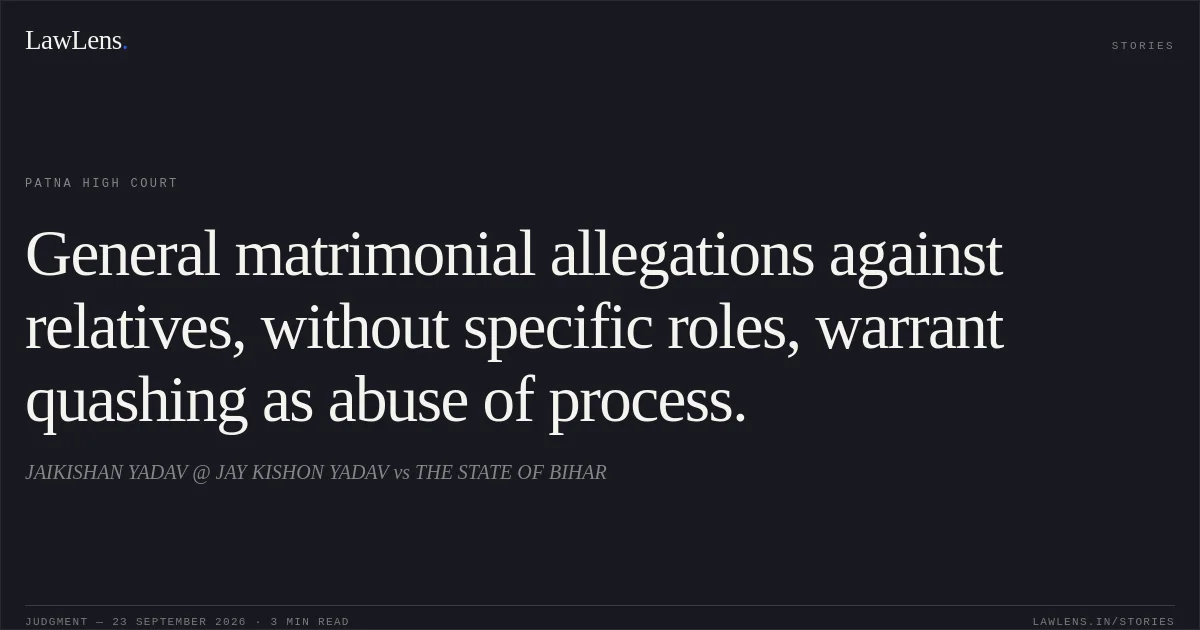
The Court applied the principle that relatives of a spouse should not be compelled to undergo criminal trial on the basis of vague, general or omnibus allegations where no specific role is attributed to them.
Source reference: para. 9; pp. 4–5Relying on Kahkashan Kausar v. State of Bihar, (2022) 6 SCC 599, the Court held that such allegations cannot justify forcing relatives to face the rigours and tribulations of a criminal trial, particularly when an eventual acquittal may cause serious prejudice to them.
Source reference: para. 9; pp. 4–5The Court also relied on Dara Laxmi Narayana v. State of Telangana, (2025) 3 SCC 735, which recognises that unnecessarily implicating family members in matrimonial disputes, particularly relatives against whom there are no specific accusations, may constitute an abuse of the process of court.
Source reference: para. 10; p. 5The Court exercised its jurisdiction to prevent abuse of process and secure the ends of justice.
Source reference: para. 12; p. 6Reasoning
The Court found that the FIR contained general and omnibus allegations against the husband’s family and did not identify any specific overt act committed by the petitioners.
Source reference: para. 8; p. 4Since the petitioners were in-laws and other relatives of the informant’s husband, and the allegations did not disclose individual criminal conduct, the Court applied the rule in Kahkashan Kausar and Dara Laxmi Narayana against subjecting them to a prolonged criminal trial.
Source reference: paras. 9–10; pp. 4–5The Court further considered the informant’s non-appearance in the criminal proceedings and in the matrimonial proceedings, as well as the subsequent ex parte divorce decree, as circumstances supporting the petitioners’ contention that the criminal case had been instituted to exert pressure on the husband’s family.
Source reference: paras. 6–8, 11; pp. 2–4, 5–6On the cumulative facts, continuation of the prosecution was held to be oppressive and an abuse of the process of law.
Source reference: para. 12; p. 6Holding
The High Court answered the issues in favour of the petitioners.
It held that continuation of the criminal proceedings against the petitioners, in the absence of specific allegations and in view of the matrimonial circumstances, would amount to an abuse of the process of law.
Source reference: para. 12; p. 6Accordingly, the order dated 09.02.2022 taking cognizance in Dumaraon P.S. Case No. 201 of 2019, along with all consequential prosecution arising from the case, was quashed.
Source reference: paras. 12–13; p. 6The criminal miscellaneous application was allowed.
Source reference: paras. 12–13; p. 6Acts & Sections Cited
7 provisions across 2 statutes referred to in this judgment. Each provision opens on LawLens.
Indian Penal Code, 18606
Hindu Marriage Act, 19551
Original Court PDF
JAIKISHAN YADAV @ JAY KISHON YADAVvsTHE STATE OF BIHAR
Click to open original judgment
Original judgment, available to read, download and summarize on LawLens.in