Facts
The petitioner, while serving as a District Programme Officer in Gaya, was served a memo of charges on June 13, 2009, regarding irregularities found in three Anganwadi Centres.
Source reference: para. 5Following a departmental inquiry, two charges were found proved/partially proved.
Source reference: para. 5Consequently, an order of punishment was passed on March 15, 2012, which was later modified on July 27, 2012, due to the petitioner’s impending retirement.
Source reference: para. 2, 3, 17The punishment included downgrading of pay, stoppage of increments with cumulative effect, and denial of arrears for the suspension period.
Source reference: para. 3The petitioner’s departmental appeal was rejected on February 21, 2017.
Source reference: para. 4The petitioner challenged these orders primarily on the grounds that the inquiry was initiated/handled by officers of equal rank or below the appointing authority.
Source reference: para. 11Issues
1. Whether a disciplinary proceeding or a second show-cause notice is vitiated if initiated by an authority lower in rank than the appointing authority?
Source reference: para. 11, 192. Whether the order of punishment was invalid for being signed by the Joint Director rather than the Principal Secretary (appointing authority)?
Source reference: para. 11, 23Law Applied
The court relied on Article 311(1) of the Constitution of India, which mandates that a civil servant cannot be dismissed or removed by an authority subordinate to the appointing authority.
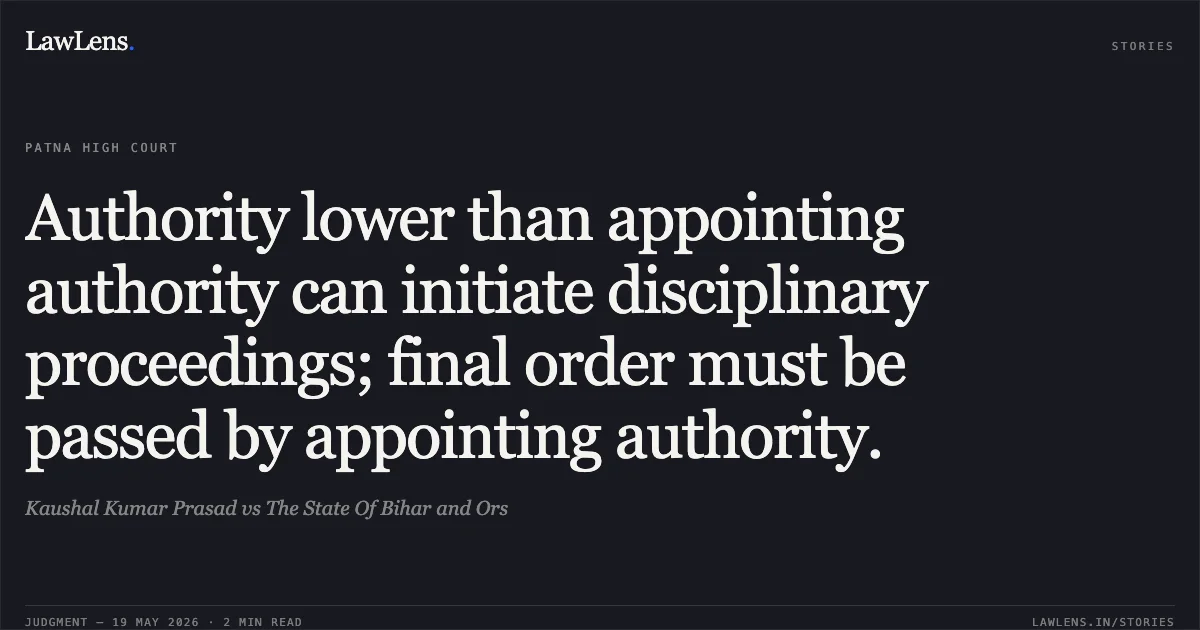
Source reference: para. 20It applied the principle from State of M.P. v. Shardul Singh and State of U.P. v. Chandrapal Singh, holding that while the final penalty must be passed by the appointing authority, the initiation of inquiry or issuance of show-cause notices can be done by a subordinate authority.
Source reference: para. 20-22It also referenced Article 166(2) regarding orders passed in the name of the Governor.
Source reference: para. 12, 23Reasoning
The Court rejected the petitioner's contention that the second show-cause notice was invalid because it was issued by a Deputy Secretary (an officer of similar rank).
Source reference: para. 11, 19Citing Supreme Court precedents, the Court reasoned that Article 311(1) does not require the appointing authority to personally conduct every stage of the inquiry or initiate the proceedings.
Source reference: para. 20-22Regarding the final order of punishment, although it bore the signature of the Joint Director, the Court observed that the order explicitly stated it was issued "on the order of the Governor, Bihar".
Source reference: para. 23Since the Governor is the ultimate appointing authority, the procedural requirement that the punishment be inflicted by the competent authority was satisfied.
Source reference: para. 23Holding
The Court held that there was no procedural illegality in the departmental proceeding or the imposition of punishment.
Directing that a subordinate may initiate an inquiry even if they cannot pass the final order, the Court found the writ application lacked merit. The petition was dismissed.
Source reference: para. 24Original Court PDF
Kaushal Kumar PrasadvsThe State Of Bihar and Ors
Click to open original judgment
Original judgment, available to read, download and summarize on LawLens.in


