Facts
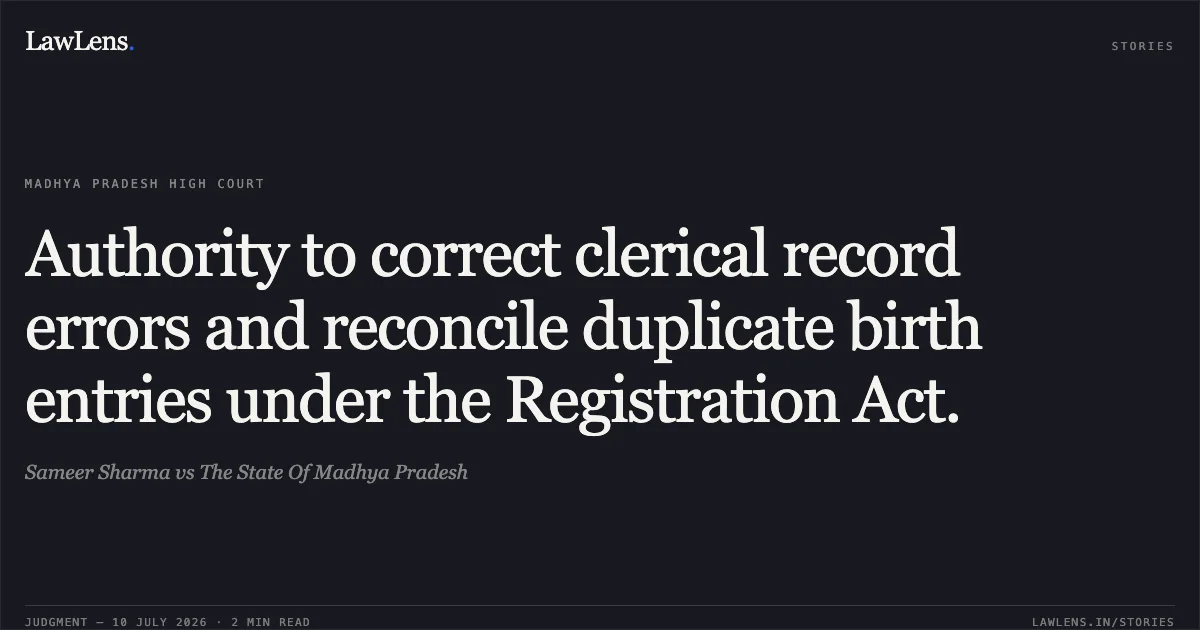
The petitioner, acting as the natural guardian of his minor son, filed a writ petition under Article 226 of the Constitution of India seeking the rectification of birth records.
Source reference: para. 3The dispute arose due to the existence of two conflicting birth certificates issued by the Municipal Corporation of Gwalior for the same individual: one showing a birth date in 2009 and another in 2010.
Source reference: para. 5The petitioner asserts that the 2010 date is correct as it aligns with the minor’s educational records and CBSE certificates.
Source reference: para. 4Despite submitting a formal representation to the Registrar of Births and Deaths on June 18, 2026, to annul the erroneous entry, no action was taken by the authorities.
Source reference: para. 6Issues
1. Whether the respondent authority is under a legal obligation to decide on a representation for the correction or cancellation of duplicate/erroneous birth entries under statutory powers.
Source reference: para. 6 / para. 82. Whether a writ of mandamus should be issued to compel the Registrar to pass a reasoned order regarding the conflicting statutory entries.
Source reference: para. 3 / para. 8Law Applied
The court's directions are rooted in the administrative obligations of the Registrar under Section 15 of the Registration of Births and Deaths Act, 1969, and Rule 11 of the Madhya Pradesh Registration of Births and Deaths Rules, 1999.
Source reference: para. 3These provisions empower and require the statutory authority to correct clerical or formal errors in the register.
Source reference: para. 3The court exercised its discretionary jurisdiction under Article 226 of the Constitution of India to ensure the performance of a public duty by a statutory body.
Source reference: para. 3Reasoning
The Court observed that the petitioner was not seeking a substantive change of a birth date for ulterior motives but rather the resolution of a clerical anomaly where two inconsistent certificates existed for the same person.
Source reference: para. 6Since the respondent’s counsel expressed no objection to a directed disposal of the pending representation, the Court found it unnecessary to delve into the factual merits of which date was correct.
Source reference: para. 7The Court focused on the procedural failure of the Registrar to act upon the petitioner's representation. By directing a "reasoned and speaking order," the Court ensured that the statutory authority would have to apply the Rule of Law (Section 15 of the Act) to the specific facts (the conflicting certificates and educational records) within a fixed timeframe.
Source reference: para. 8Holding
The High Court disposed of the writ petition without expressing an opinion on the merits of the birth date claim.
It issued a writ of mandamus directing Respondent No. 3 (Registrar, Birth & Death) to consider and decide the petitioner’s representation dated June 18, 2026.
Source reference: para. 8The authority is required to pass a reasoned and speaking order in accordance with the law within four weeks of receiving the court’s order.
Source reference: para. 8The petition was disposed of with instructions for the petitioner to provide all necessary documentation to the respondents to facilitate compliance.
Source reference: para. 9-10Acts & Sections Cited
1 provisions across 1 statute referred to in this judgment. Each provision opens on LawLens.
Registration of Births and Deaths Act, 19691
Original Court PDF
Sameer SharmavsThe State Of Madhya Pradesh
Click to open original judgment
Original judgment, available to read, download and summarize on LawLens.in