Facts
On May 8, 2014, Shri Ngawang Gyaltsen was riding his scooty when a motorbike driven by Respondent No. 2 (Amit Kumar Sah) in a rash and negligent manner collided with him, causing grievous injuries.
Source reference: para 2The victim’s wife, Respondent No. 1, filed a claim under the Motor Vehicles Act (originally cited under Section 163, later treated as Section 166) as the victim was bedridden.
Source reference: para 3, 28-29The Motor Accident Claims Tribunal (MACT) awarded ₹12,93,787.11 with 8% interest, directing the Appellant (Insurance Company) to pay.
Source reference: para 4The Appellant challenged the award on grounds of maintainability (claim filed by wife), negligence (alleging an unknown car caused the accident), breach of policy (owner held only a learner’s license without an instructor), and excessive interest/quantum.
Source reference: paras 6-11Issues
1. Whether the claim petition filed by the wife of the injured person is maintainable under Section 166(1) of the Motor Vehicles Act, 1988.
Source reference: para 7, 272. Whether the accident was caused by the rash and negligent driving of the motorbike rider.
Source reference: para 14, 313. Whether the possession of a learner’s license by the rider constitutes a breach of policy conditions under Rule 3 of the Central Motor Vehicle Rules, 1989.
Source reference: para 9, 324. Whether the interest rate of 8% per annum awarded by the Tribunal is excessive.
Source reference: para 11, 37Law Applied
The court applied Section 166(1) of the Motor Vehicles Act, 1988, which allows an "agent duly authorised" to file a compensation claim.
Source reference: para 7, 29It relied on the principle from National Insurance Company Ltd. v. Swaran Singh (2004), establishing that a learner’s license is a valid license under the Act and the insurer remains liable to third parties.
Source reference: para 17, 34Regarding learner’s license conditions, the court applied the reasoning from Senior Divisional Manager, National Insurance Co. Ltd. v. Shri Jyotiba Appaji Shigate, noting that Rule 3(b) of the Central Motor Vehicles Rules, 1989 (requiring an instructor) is physically and practically inapplicable to motorcycles.
Source reference: para 18, 33Reasoning
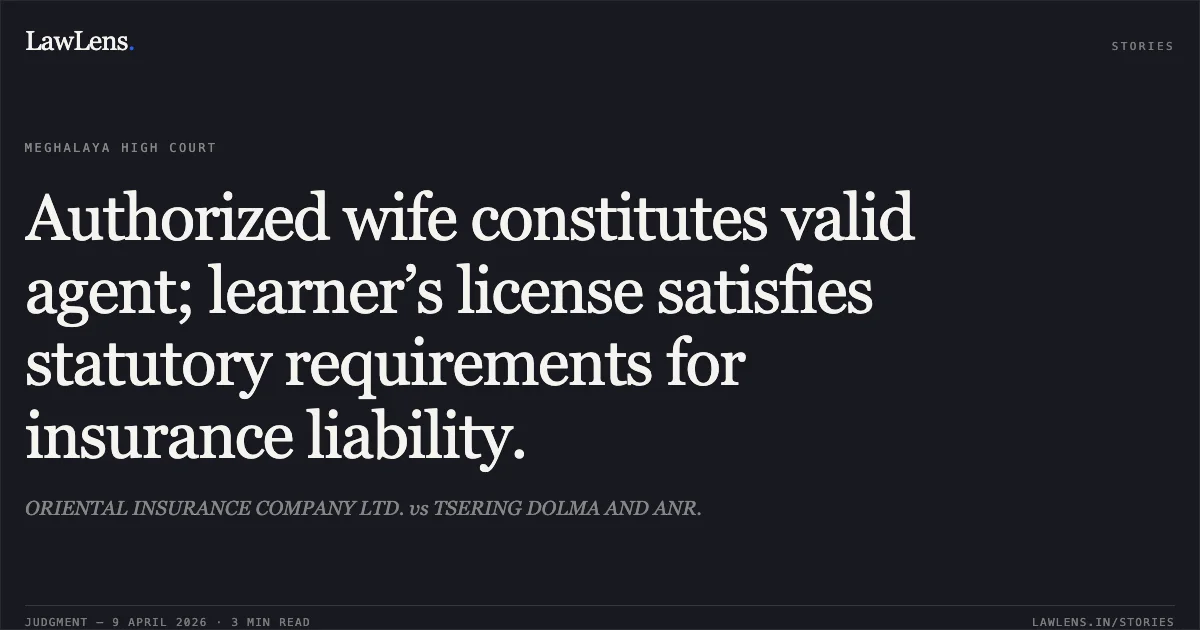
The Court first dismissed the maintainability objection, ruling that a wife authorized by a bedridden husband qualifies as an "agent" under Section 166(1)(d).
Source reference: para 30On negligence, the Court prioritized the victim's (CW-2) testimony as a "sterling witness" and the Investigating Officer's evidence that the motorbike was on the wrong side of the road.
Source reference: para 15, 31Regarding the policy breach, the Court held that while Rule 3(b) requires a learner to be accompanied by an instructor, this is not feasible on a motorcycle; thus, the learner's license was valid for the purpose of third-party liability.
Source reference: para 33-34Since there was no breach of policy, the Court found the Insurance Company vicariously liable to indemnify the owner, negating the need for a "pay and recover" order.
Source reference: para 35, 38Finally, the Court reviewed the interest rate, finding 7% more appropriate given current economic conditions and judicial precedents.
Source reference: para 37Holding
The Court upheld the claim's maintainability and the finding of negligence against the motorbike owner.
It held that a learner’s license for a motorcycle does not necessitate a licensed pillion instructor to maintain insurance coverage.
Source reference: para 33, 35The Court modified the impugned judgment only regarding the interest rate, reducing it from 8% to 7% per annum from the date of filing until payment.
Source reference: para 37-38The Appellant was directed to satisfy the total calculated award within 45 days.
Source reference: para 39Acts & Sections Cited
10 provisions across 1 statute referred to in this judgment. Each provision opens on LawLens.
Original Court PDF
ORIENTAL INSURANCE COMPANY LTD.vsTSERING DOLMA AND ANR.
Click to open original judgment
Original judgment, available to read, download and summarize on LawLens.in