Facts
The petitioners, residents of Dima Hasao district, challenged the constitutional validity of the "Constitution of N.C. Hills Autonomous Council (42nd Amendment) Act, 2017".
Source reference: p. 1-3This amendment inserted Rule 18A into the principal rules, providing for the disqualification of elected members of the Council on grounds of defection/anti-defection, mirroring the Tenth Schedule of the Constitution of India.
Source reference: p. 3-5The N.C. Hills Autonomous Council (NCHAC) was established under the Sixth Schedule of the Constitution.
Source reference: p. 7The petitioners contended that the Council exceeded its legislative competence as the Sixth Schedule does not empower it to legislate on anti-defection.
Source reference: p. 9-10Issues
1. Whether the N.C. Hills Autonomous Council has the legislative competence under the Sixth Schedule of the Constitution to frame laws regarding disqualification on the ground of defection.
Source reference: para. 172. Whether the impugned Rule 18A can be sustained by applying the doctrine of pith and substance in relation to the power to set "qualifications" for election.
Source reference: para. 17, 213. Whether the impugned law is inconsistent with the constitutional scheme and the Tenth Schedule of the Constitution.
Source reference: para. 17Law Applied
Paragraphs 2(6) and 2(7) of the Sixth Schedule of the Constitution, which enumerate the specific subjects—such as qualifications for being elected and conduct of business—on which the Governor or District Councils may make rules.
Source reference: p. 7-8, 11Paragraphs 3 and 3A, which list the specific legislative subjects assigned to Autonomous Councils.
Source reference: p. 8-9The Tenth Schedule of the Constitution, which serves as a complete code for anti-defection.
Source reference: p. 13-14Principle from District Council of United Khasi and Jayantia Hills v. Sitimon Sawian, establishing that Autonomous Councils have limited, enumerated powers rather than plenary legislative authority.
Source reference: p. 15-16Reasoning
The court reasoned that unlike Parliament or State Legislatures, Autonomous District Councils are not sovereign legislatures and possess only limited, enumerated powers.
Source reference: p. 6, 12Although the State argued that the power to set "qualifications" under Paragraph 2(6)(d) includes the power to legislate on "disqualification" via the doctrine of pith and substance, the court rejected this, holding that anti-defection is a substantive constitutional matter, not a procedural or incidental one.
Source reference: para. 21, 30The court observed that the Sixth Schedule requires a formal Parliamentary amendment under Paragraph 21 to alter the tenure or core functionality of Council members.
Source reference: p. 13-14The court noted that the pendency of the Constitution (125th Amendment) Bill, 2019, in the Rajya Sabha—which intends to grant Councils the power to legislate on defection—demonstrates that such power does not currently exist.
Source reference: para. 12, 32Because the Council lacks plenary power, it cannot "incidentally" encroach upon a field (anti-defection) that is already occupied by the Tenth Schedule.
Source reference: para. 35-36Holding
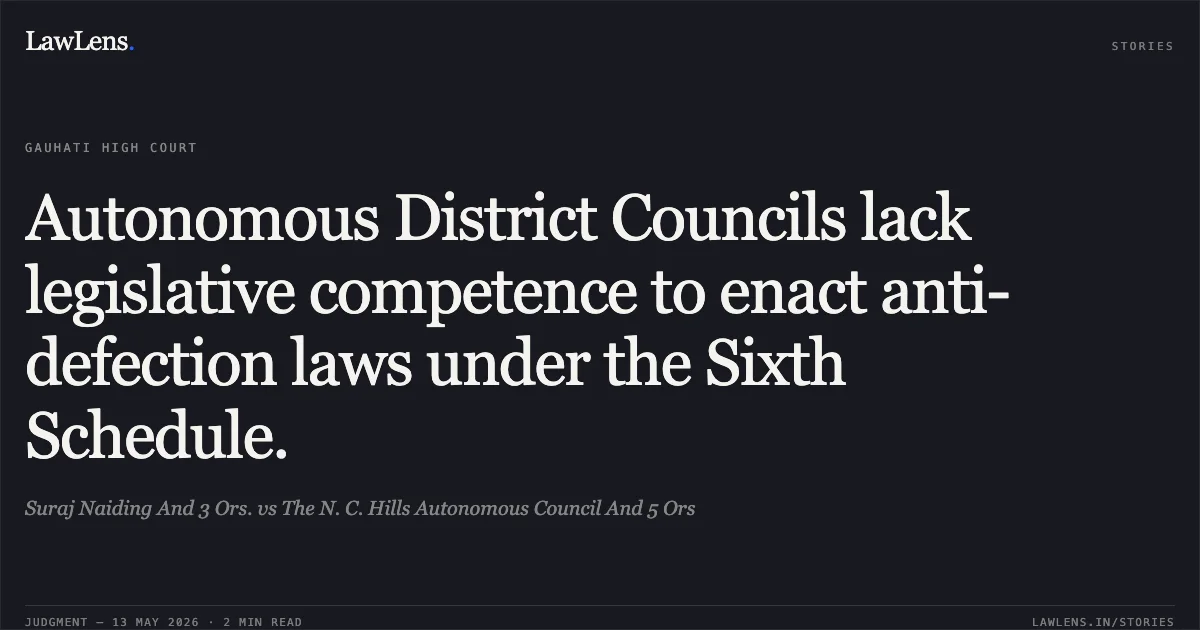
The court held that the N.C. Hills Autonomous Council lacked the legislative competence to enact anti-defection laws.
Rule 18A, introduced by the 42nd Amendment Act of 2017, was declared ultra vires, unconstitutional, and null and void.
Source reference: para. 36-37The court struck down the legislation and allowed the writ petition.
Source reference: para. 38-39Original Court PDF
Suraj Naiding And 3 Ors.vsThe N. C. Hills Autonomous Council And 5 Ors
Click to open original judgment
Original judgment, available to read, download and summarize on LawLens.in