Facts
The petitioner was issued a notice dated 09.10.2018 in Misc. Case No. 42/11-12 by the Certificate Officer, Munger, demanding payment of ₹2,28,063/- for rice supplied under the SGRY and FFW Schemes
Source reference: p. 1-2Previously, the petitioner had challenged a 2011 demand notice in CWJC No. 25398 of 2013 on the grounds that notice under Section 6 of the Bihar Practice Procedure (Public Discovery Recovery) Act (PDR Act) was not served
Source reference: p. 2On 24.08.2018, a co-ordinate Bench set aside the previous notice and remitted the matter to the Certificate Officer to issue a fresh notice under Section 7 of the PDR Act
Source reference: p. 2The petitioner filed the present writ seeking to quash the fresh notice and the entire proceeding, citing a similar matter stayed by a Division Bench
Source reference: p. 2-3Issues
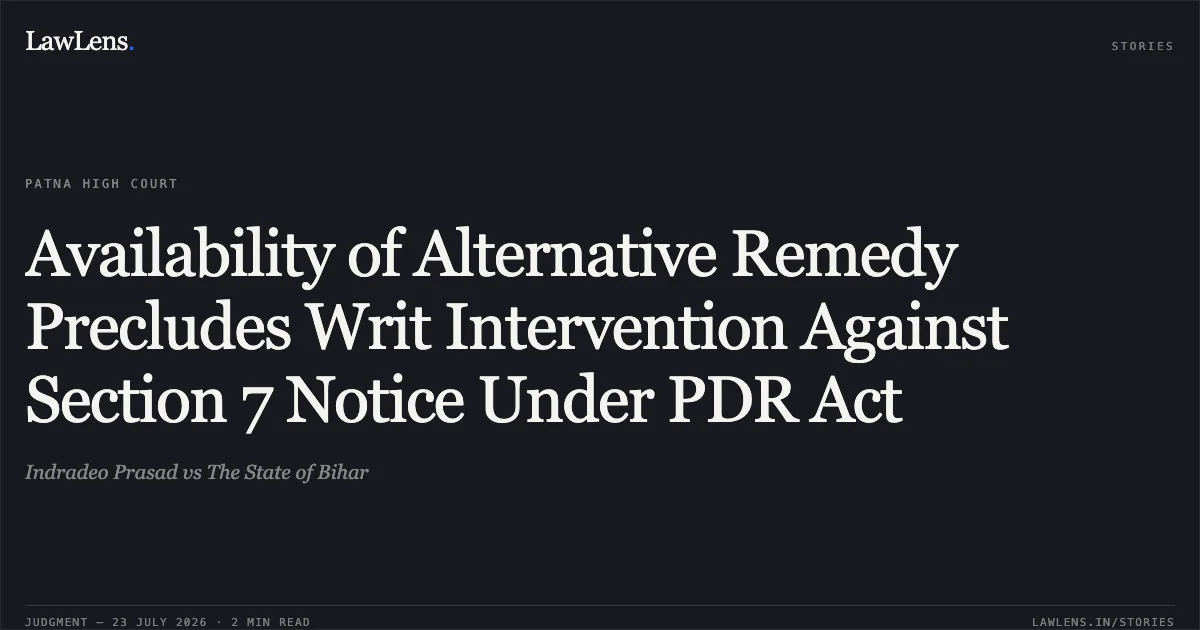
1. Whether the writ petition is maintainable when an alternative statutory remedy is available under the PDR Act?
Source reference: p. 4, para. 92. Whether the respondent authorities should be restrained from taking coercive actions pending the statutory adjudication?
Source reference: p. 4-5, para. 10Law Applied
Section 7 regarding the service of notice and copy of the certificate
Source reference: p. 2Section 9 regarding the filing of a petition denying liability
Source reference: p. 4Section 10 regarding the hearing and determination of such petitions
Source reference: p. 5principle of "Alternative Remedy," which dictates that writ jurisdiction should generally not be exercised when a specific statutory forum for grievance redressal exists
Source reference: p. 4Reasoning
The Court observed that the respondents issued the fresh notice under Section 7 of the PDR Act in strict compliance with the High Court’s previous directions in CWJC No. 25398 of 2013
Source reference: p. 4While the petitioner sought to quash the proceeding based on pending batch matters (CWJC No. 20474 of 2021), the Court noted that the PDR Act provides a robust alternative remedy under Section 9, allowing the petitioner to file a formal objection before the appropriate authority
Source reference: p. 4The Court determined that since the notice was issued in accordance with the law, the petitioner must first exhaust this statutory remedy before seeking extraordinary relief under Article 226
Source reference: p. 4However, to ensure equity and align with common orders passed in similar matters, the Court found it necessary to provide interim protection against coercive measures until the objection is decided on merits
Source reference: p. 4-5Holding
The Court declined to quash the notice but disposed of the writ petition with specific directions: the petitioner is directed to file an objection under Section 9 of the PDR Act within one month
The respondent authority is directed to hear the petitioner and pass a reasoned order within three months of receiving the objection. Crucially, the Court ordered that no coercive steps shall be taken against the petitioner until a reasoned order is passed under Section 10 of the PDR Act
Source reference: p. 4, para. 9 and p. 5, para. 10Acts & Sections Cited
4 provisions across 1 statute referred to in this judgment. Linked provisions open on LawLens.
Bihar and Orissa Public Demands Recovery Act, 19144
Original Court PDF
Indradeo PrasadvsThe State of Bihar
Click to open original judgment
Original judgment, available to read, download and summarize on LawLens.in