Facts
Swati Jain (the writ petitioner) was declared the successful bidder in a mega e-auction for a mortgaged property conducted by the State Bank of India (Bank) on January 10, 2023
Source reference: para. 2-3Under auction Condition No. 8, she was required to deposit 25% of the bid amount (less EMD) by the next working day, which she failed to do
Source reference: para. 3-4Consequently, the Bank cancelled the auction and forfeited her 10% EMD via letter dated January 20, 2023
Source reference: para. 2, 7The petitioner filed WP No. 32441/2025, and on January 23, 2026, the Court upheld the cancellation but directed the Bank to reconsider refunding the EMD without interest
Source reference: para. 1Both parties filed review petitions: the petitioner alleged factual errors regarding her efforts to pay, while the Bank contended the writ was non-maintainable due to an alternative remedy and that the order was passed without hearing the Bank
Source reference: para. 5, 6, 13Issues
1. Whether there were errors apparent on the face of the record in the order dated January 23, 2026, warranting review under Order 47 Rule 1 CPC
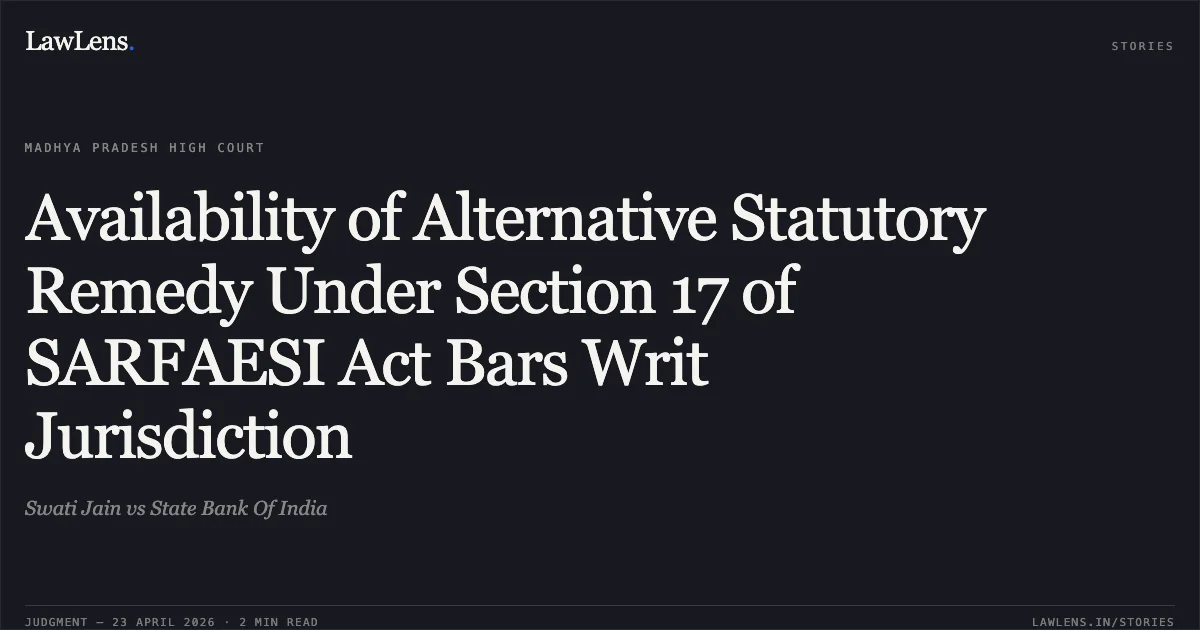
Source reference: para. 5, 142. Whether the writ petition was maintainable despite the availability of an alternative statutory remedy under Section 17 of the SARFAESI Act, 2002
Source reference: para. 7-93. Whether the principles of natural justice were violated by failing to grant the Bank an opportunity of hearing
Source reference: para. 13Law Applied
The court primarily applied Order 47 Rule 1 of the CPC regarding the power to review judgments for errors apparent on the face of the record
Source reference: para. 1, 16Section 17 of the SARFAESI Act, 2002, which provides a mandatory alternative remedy before the Debt Recovery Tribunal (DRT) for any person aggrieved by measures taken under Section 13(4)
Source reference: para. 7Agarwal Tracon Pvt. Ltd. v. Punjab National Bank & Ors. (2017), establishing that "any measures" under Section 17 include forfeiture of deposits
Source reference: para. 8High Court’s plenary power as a "Court of Record" under Article 215 to correct its own records, as upheld in M.M. Thomas v. State of Kerala (2000) and Naresh Shridhar Mirajkar v. State of Maharashtra (1967)
Source reference: para. 10Reasoning
The Court determined that the previous order dated January 23, 2026, suffered from manifest legal and factual errors. Factually, the petitioner’s claim that she lacked the IFSC code was contradicted by the record, which showed she had successfully used the online portal for 15% of the price previously
Source reference: para. 11Legally, the Court found that it had overlooked the statutory bar of an efficacious alternative remedy; since the dispute involved auction forfeiture under SARFAESI measures, the petitioner was bound to approach the DRT per Agarwal Tracon
Source reference: para. 8-9, 12, 15The Court acknowledged a procedural lapse in that the Bank was never granted a notice of hearing, violating the principles of natural justice and necessitating a recall of the order
Source reference: para. 13, 15Holding
The Court allowed both review petitions, holding that the presence of an alternative remedy and the failure to hear the respondent Bank constituted sufficient grounds for review
The Court recalled the order dated January 23, 2026, and dismissed WP No. 32441 of 2025. The writ petitioner was granted liberty to approach the Debt Recovery Tribunal in accordance with the law
Source reference: para. 16Acts & Sections Cited
3 provisions across 2 statutes referred to in this judgment. Each provision opens on LawLens.
Code of Civil Procedure, 19081
Securitisation and Reconstruction of Financial Assets and Enforcement of Security Interest Act, 20022
Original Court PDF
Swati JainvsState Bank Of India
Click to open original judgment
Original judgment, available to read, download and summarize on LawLens.in