01Facts
The appellant, an NRI residing in Canada, purchased a residential plot in "Athina Township – Stage I" from a developer, Joseph Chacko, in 1994 via a registered sale deed
¶ 8In 2006, the respondents and other accused persons allegedly trespassed upon the layout, demolished structures, and erected boards for "City Scape Properties"
¶ 9The appellant alleged that the accused formed a fraudulent welfare society to mislead NRI purchasers into handing over original title documents and signing papers under the pretext of initiating civil litigation
¶ 10-13These signatures were allegedly used to create forged "confirmation deeds" to transfer properties to respondent K.V. Rajagopal Reddy without the owners' consent or consideration
¶ 15-16A private complaint was filed, and the Magistrate directed an investigation under Section 156(3) of the CrPC
¶ 20The High Court of Karnataka quashed the FIR, reasoning that the dispute involved the identity of land and registered instruments which must first be cancelled under Section 31 of the Specific Relief Act (SRA) before criminal proceedings could lie
¶ 23-2502Issues
i.Whether the High Court was justified in exercising its inherent jurisdiction under Section 482 CrPC to quash the criminal proceedings at the nascent stage of an investigation directed under Section 156(3) CrPC
¶ 40, 52ii.Whether the initiation of civil proceedings for the cancellation of a registered instrument under Section 31 of the Specific Relief Act is a sine qua non for launching a criminal prosecution involving allegations of fraud and forgery
¶ 28, 5103Law Applied
The court primarily applied Section 482 of the CrPC regarding the High Court's inherent powers and Section 156(3) of the CrPC regarding the Magistrate’s power to order an investigation
¶ 20, 40It relied on the principles established in Neeharika Infrastructure (P) Ltd. v. State of Maharashtra, which held that the High Court must exercise great circumspection and should not stifle a genuine investigation at the threshold if the FIR discloses a cognizable offence
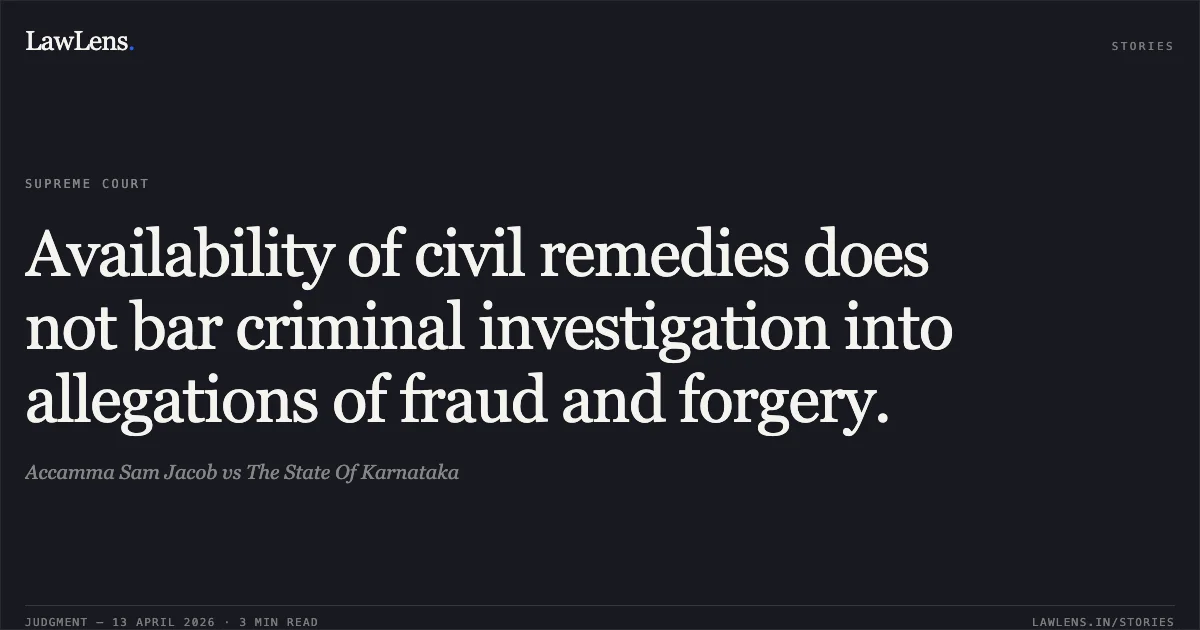
¶ 55The court further applied the principle that the existence of a civil remedy does not bar criminal proceedings when the allegations prima facie disclose the commission of cognizable offences
¶ 56Provisions in the judgment · 24 · Linked ones open on LawLens
Code of Criminal Procedure, 1973 Section 156Section 482
Indian Penal Code, 1860 20 provisions
Section 107Section 115Section 116Section 117Section 118Section 120Section 379Section 381Section 383Section 409Section 415Section 420Section 463Section 465Section 466Section 467Section 468Section 471Section 474Section 477Specific Relief Act, 1963 Section 31
Bharatiya Nagarik Suraksha Sanhita, 2023 Section 175
04Reasoning
The Supreme Court observed that the High Court erred by conducting a "mini-trial" at the threshold stage
¶ 54By evaluating the sale deeds and disputed questions of land identity, the High Court overstepped the limited scope of Section 482 CrPC
¶ 54The court noted that a Magistrate exercising power under Section 156(3) CrPC is only required to determine if the facts prima facie disclose a cognizable offence, not to adjudicate the merits
¶ 52The Supreme Court specifically rejected the High Court’s logic that a criminal court cannot proceed until registered deeds are cancelled under Section 31 of the SRA, stating that such a requirement would effectively stifle investigative processes for fraud and forgery
¶ 54, 56the court highlighted that it had previously set aside a similar High Court judgment involving the same developer, reinforcing that serious allegations of conspiracy and forgery against NRIs require a full investigation rather than summary quashing
¶ 47-5105Holding
The Supreme Court allowed the appeals and set aside the High Court’s judgment dated September 28, 2016
¶ 58, 61The court held that the High Court was not justified in quashing the proceedings merely because the dispute had a civil veneer, as the allegations of forgery and criminal conspiracy required investigation
¶ 56-57The FIRs and criminal proceedings were revived and restored to the file of the concerned police station and Magistrate for investigation in accordance with law
¶ 58The court clarified that parties remain at liberty to present their respective defenses during the investigation or trial at the appropriate stage
¶ 59-60Original Court PDF
Accamma Sam JacobvsThe State Of Karnataka
Click to open original judgment
Original judgment, available to read, download and summarize on LawLens.in