01Facts
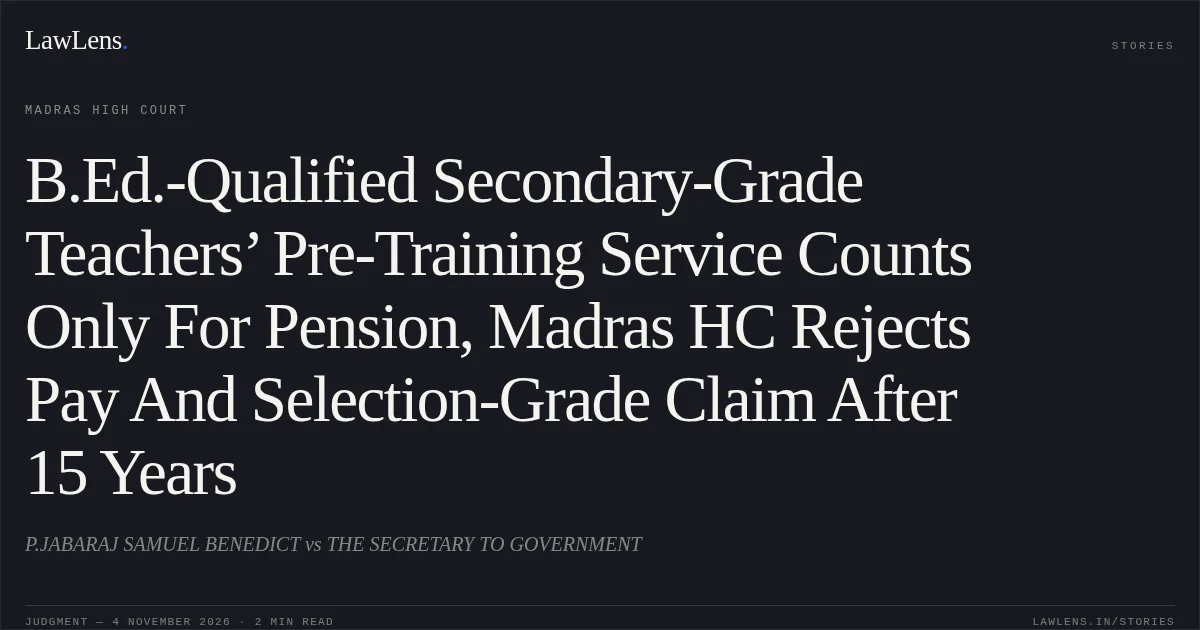
The petitioners, graduates appointed as Secondary Grade Teachers in aided minority schools between 1995 and 1997, had their appointments approved only from 2 June 2003, after completing the prescribed Child Psychology training.
pp. 3–8 · ¶ 2.1–2.6They sought to have service counted from their initial appointment dates for pay fixation, increments and Selection Grade, relying on earlier judgments and benefits given to other teachers.
pp. 10–15 · ¶ 4–9The State opposed the claim, relying on G.O.Ms. No. 155 dated 3 October 2002, the Division Bench ruling in State of Tamil Nadu v. Pallivasal Primary School, and the delay in bringing the claim.
pp. 16–23 · ¶ 10–1702Issues
i.1. Whether the petitioners were entitled to have their service as Secondary Grade Teachers counted from their initial appointment dates for pay fixation, increments and Selection Grade, notwithstanding approval only from completion of Child Psychology training.
p. 24 · ¶ 18ii.2. Whether the petitioners’ delay in seeking that relief, and their reliance on benefits granted to other teachers, disentitled them to relief.
pp. 28–33 · ¶ 24–3103Law Applied
G.O.Ms. No. 559 dated 11 July 1995 restricted the appointment of higher-qualified graduates to Secondary Grade Teacher posts; G.O.Ms. No. 155 dated 3 October 2002 provided for approval of the affected appointments only from completion of Child Psychology training.
pp. 24–27 · ¶ 19–21In State of Tamil Nadu v. Pallivasal Primary School, 2004 (2) LW 591, the Division Bench upheld G.O.Ms. No. 155, allowing pre-training service to count for pension but not displacing the Government Order’s restrictions on approval and other service benefits.
pp. 24–27 · ¶ 19–21The Director of Elementary Education v. Sundaravel Raj, W.A.(MD) Nos. 74 of 2015 and 957 of 2016, held that pre-training service did not entitle teachers to salary or other monetary benefits contrary to G.O.Ms. No. 155.
pp. 18–22 · ¶ 14 · p. 28 · ¶ 23The Court also applied the principles on recurring pay claims and laches in M.R. Gupta v. Union of India, (1995) 5 SCC 628, and the “fence-sitter” principle in State of Uttar Pradesh v. Arvind Kumar Srivastava, (2015) 1 SCC 347.
pp. 29–33 · ¶ 25–30Provisions in the judgment · 1
G.O.Ms.No.155 dated 03.10.2002 Section 3
04Reasoning
The Court held that the petitioners’ appointments were made contrary to G.O.Ms. No. 559 and that, under G.O.Ms. No. 155 as upheld in Pallivasal, their approval took effect only upon completion of training.
pp. 27–28 · ¶ 21–23Pre-training service was preserved for pension purposes, not for pay fixation, increments or Selection Grade; Sundaravel Raj confirmed that inconsistent single-judge decisions and administrative orders could not confer a benefit contrary to the governing order.
pp. 27–28 · ¶ 21–23The Court distinguished M.R. Gupta: the petitioners challenged the consequence of a single, unchallenged approval decision, not an ongoing erroneous pay fixation.
pp. 29–30 · ¶ 25–27Their prolonged failure to challenge the approval, without an acceptable explanation, also attracted laches; benefits obtained by other teachers did not create an enforceable right for these petitioners as late claimants.
pp. 31–33 · ¶ 29–3105Holding
The Court held that the petitioners were not entitled to count their service from their initial appointment dates for pay fixation, increments or Selection Grade.
p. 33 · ¶ 31–32Finding the claim inconsistent with G.O.Ms. No. 155 and barred by delay and laches, the Court dismissed the writ petition without costs.
p. 33 · ¶ 31–32Original Court PDF
P.JABARAJ SAMUEL BENEDICTvsTHE SECRETARY TO GOVERNMENT
Click to open original judgment
Original judgment, available to read, download and summarize on LawLens.in