Facts
The appellant (private employee), initially appointed as a temporary Peon in 1979, was compulsorily retired by the Bihar Industrial Area Development Authority (BIADA) on 30.11.2007 following charges of unauthorized absence.
Source reference: para. 5The learned Single Judge previously set aside the retirement order in 2014, directing the authorities to consider back wages in light of the Novartis India Ltd. precedent.
Source reference: para. 5BIADA subsequently rejected the claim for back wages, leading to further litigation.
Source reference: no citationIn a subsequent writ petition (C.W.J.C. No. 12211 of 2017), the learned Single Judge directed BIADA to pay 70% back wages for the period 01.12.2007 to 03.07.2014.
Source reference: para. 2Both parties appealed: the employee seeking 100% back wages [para. 3], and BIADA seeking to set aside the 70% award on grounds of the employee's poor service record and temporary status.
Source reference: para. 4Issues
1. Whether the learned Single Judge erred in awarding 70% back wages instead of full back wages to an employee whose termination was held illegal.
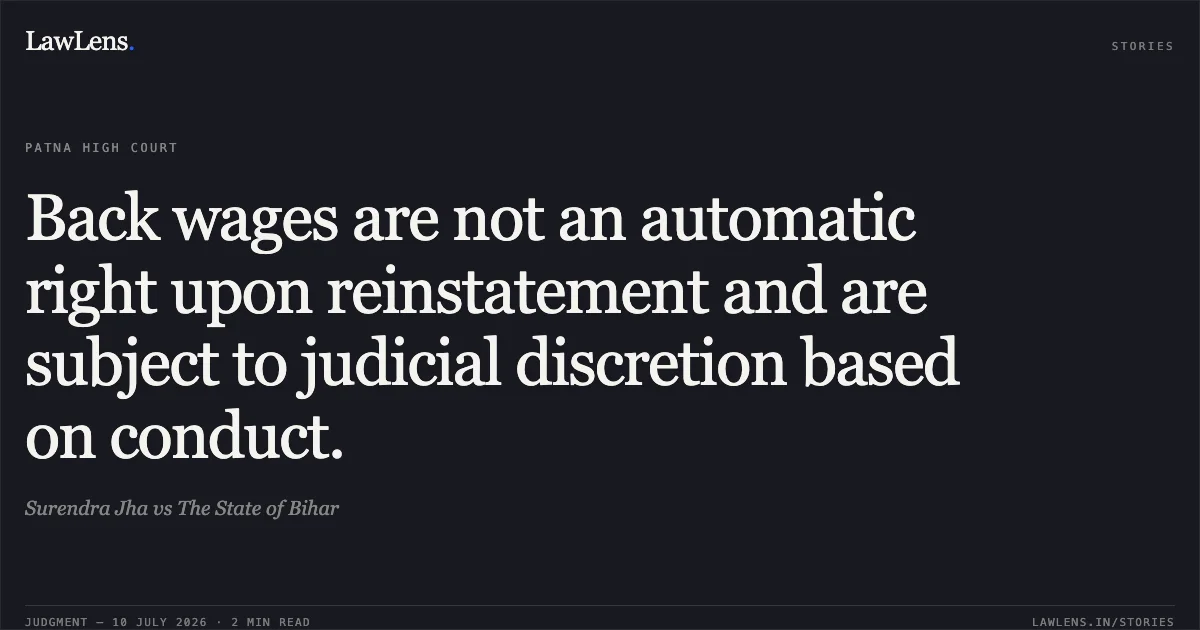
Source reference: para. 102. Whether back wages are an automatic entitlement upon reinstatement or subject to judicial discretion based on the conduct of the employee.
Source reference: para. 13, 18Law Applied
The court primarily relied on the principle that back wages are not a matter of right but are subject to judicial discretion based on the facts of each case, as established in Novartis India Ltd. v. State of West Bengal.
Source reference: para. 5, 13It applied the "shift in legal position" noted in Jagbir Singh v. Haryana State Agriculture Marketing Board, which held that relief of reinstatement with full back wages is not automatic.
Source reference: para. 17The court also referenced Deepali Gundu Surwase v. Kranti Junior Adhyapak Mahavidyalaya regarding the burden of proof for gainful employment.
Source reference: para. 11Rajasthan State Road Transport Corporation v. Phool Chand, affirming that courts may award partial back wages by exercising judicial discretion.
Source reference: para. 15Reasoning
The Court observed that there is no "strait-jacket formula" for awarding back wages and that the quantum depends on the conduct of the employee and the specific circumstances of the case.
Source reference: para. 16, 18While the employee argued for 100% wages based on his long service and lack of other employment [para. 7], BIADA contended that his record of unauthorized absence and temporary status disentitled him from any further payment.
Source reference: para. 8-9The Court found that the learned Single Judge exercised valid judicial discretion in balancing these factors by awarding 70% back wages.
Source reference: para. 19The Bench emphasized that in a Letters Patent Appeal, it should not interfere with a reasoned judgment of a Single Judge merely because an alternative view is possible, provided there is no manifest error or perversity.
Source reference: para. 20Holding
The Court dismissed both appeals, upholding the judgment of the learned Single Judge.
It held that the award of 70% back wages for the period 01.12.2007 to 03.07.2014 was a proper exercise of discretionary power and did not suffer from patent illegality.
Source reference: para. 19-20All pending interlocutory applications were disposed of accordingly.
Source reference: para. 22Acts & Sections Cited
1 provisions across 1 statute referred to in this judgment. Linked provisions open on LawLens.
Bihar Industrial Area Development Authority Act, 19741
Original Court PDF
Surendra JhavsThe State of Bihar
Click to open original judgment
Original judgment, available to read, download and summarize on LawLens.in