Facts
The petitioner, a Sub-Inspector of Police appointed on 21 August 1994, was subjected to departmental proceedings culminating in an order of dismissal dated 10 February 2012. His departmental appeal was also dismissed.
Source reference: paras. 3–4; pp. 2–3He challenged both orders in CWJC No. 17923 of 2013. By judgment dated 3 May 2016, the High Court set aside the dismissal and appellate orders for non-compliance with Article 311(1) of the Constitution and Rules 825(c) and 656 of the Bihar Police Manual, while permitting the competent disciplinary authority to reconsider the enquiry report and proceed further in accordance with law.
Source reference: para. 4; pp. 2–3Pursuant thereto, the respondents issued Magadh Region Order No. 65 of 2018 dated 28 April 2018, setting aside the dismissal, reinstating the petitioner, accepting his joining, and directing payment of suspension allowance. The order also directed that a fresh departmental proceeding under Section 17 of the Bihar Government Servants (Classification, Control & Appeal) Rules, 2005, would continue.
Source reference: para. 5; p. 3The petitioner sought payment of salary arrears, after adjustment of any suspension allowance, for the period from 1 May 2012 until his reinstatement on 20 March 2018, relying principally on Deepali Gundu Surwase v. Kranti Junior Adhyapak Mahavidyalaya (D.Ed.) & Ors., (2013) 10 SCC 324.
Source reference: paras. 2 and 6; pp. 1 and 4The respondents opposed the claim on the ground that the fresh departmental proceeding remained pending.
Source reference: para. 7; p. 4Issues
Whether the petitioner was entitled, at this stage, to arrears of salary for the period between his dismissal and reinstatement, after adjustment of the suspension allowance, merely because the dismissal order had been set aside?
Source reference: paras. 6–9; pp. 4–5Whether the principle laid down in Deepali Gundu Surwase applied when the petitioner’s fresh departmental proceeding, initiated pursuant to the liberty granted by the earlier judgment, was still pending?
Source reference: paras. 6–9; pp. 4–5Law Applied
The Court applied Article 311(1) of the Constitution and Rules 825(c) and 656 of the Bihar Police Manual, which require disciplinary action against a police officer to be taken by the competent disciplinary authority and in accordance with the prescribed procedure.
Source reference: para. 4; pp. 2–3It also considered Section 17 of the Bihar Government Servants (Classification, Control & Appeal) Rules, 2005, governing departmental proceedings.
Source reference: para. 5; p. 3The Court considered the principle in Deepali Gundu Surwase v. Kranti Junior Adhyapak Mahavidyalaya (D.Ed.) & Ors., (2013) 10 SCC 324, concerning consequential monetary benefits following the setting aside of an unlawful termination, but held that the principle could not assist the petitioner before the fresh departmental proceeding had concluded.
Source reference: paras. 6 and 8; pp. 4–5Reasoning
The earlier judgment had not finally exonerated the petitioner; it had set aside the dismissal on the ground of procedural invalidity while expressly granting the competent disciplinary authority liberty to proceed afresh in accordance with law.
Source reference: para. 4; pp. 2–3The respondents acted on that liberty by reinstating the petitioner and commencing a fresh proceeding under Section 17 of the CCA Rules, while ordering payment of suspension allowance.
Source reference: para. 5; p. 3Since that proceeding remained pending, the Court considered the petitioner’s entitlement to salary for the intervening period to be incapable of final determination. The ultimate outcome of the fresh proceeding could affect the question of back wages and consequential benefits.
Source reference: paras. 7–9; pp. 4–5Accordingly, the Court held that Deepali Gundu Surwase was not applicable at that stage and that the petitioner could seek the claimed relief before the appropriate forum after the departmental proceeding concluded.
Source reference: paras. 7–9; pp. 4–5Holding
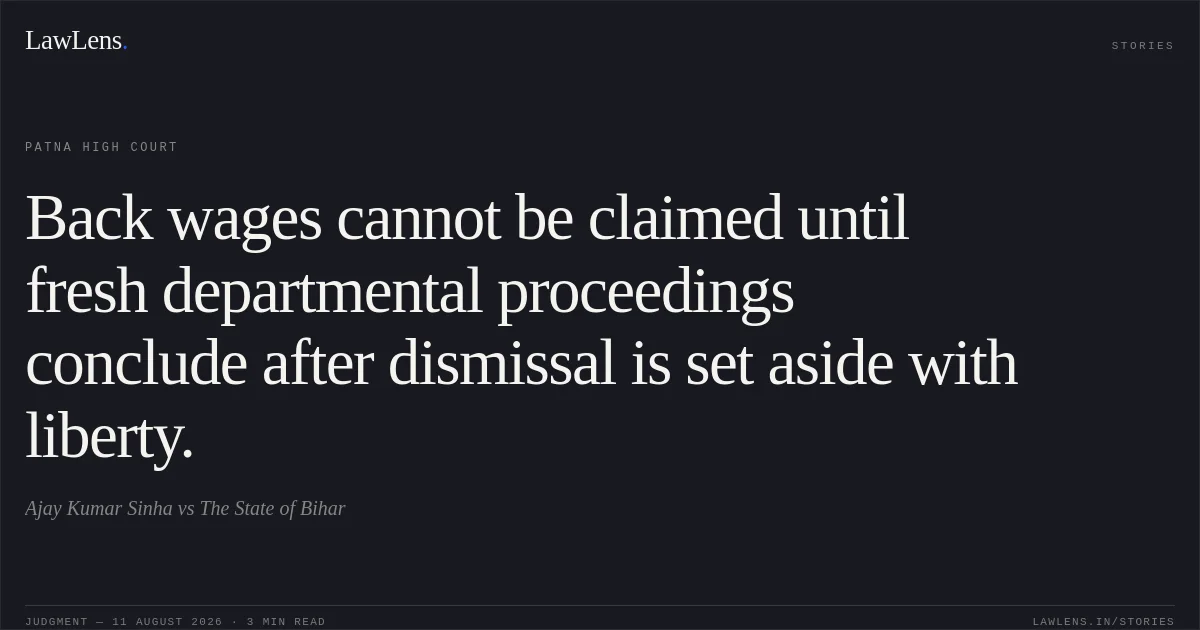
The Court answered the issues against the petitioner. It held that the petitioner was not entitled, at the pending stage of the fresh departmental proceeding, to a direction for payment of salary arrears for the period between dismissal and reinstatement.
The writ petition was dismissed for want of merit, with liberty to the petitioner to approach the appropriate forum or court for the monetary relief after conclusion of the fresh departmental proceeding.
Source reference: paras. 8–10; p. 5Original Court PDF
Ajay Kumar SinhavsThe State of Bihar
Click to open original judgment
Original judgment, available to read, download and summarize on LawLens.in