Facts
The Petitioner’s personal gold jewellery was confiscated by the Customs Department, leading to the filing of a writ petition
Source reference: p. 1-2During the proceedings, the Court observed a recurring pattern of bona fide international travelers facing harassment and arbitrary seizure of personal jewellery under the "Baggage Rules, 2016" and "Baggage Regulations, 2013"
Source reference: p. 2-4, para 2-9Under the 2016 Rules, "personal effects" specifically excluded jewellery, and duty-free limits were capped at 20 grams/₹50,000 for men and 40 grams/₹1,00,000 for women—values the Court found outdated relative to current market gold rates
Source reference: p. 4-7Procedurally, the Court noted that Customs officials frequently forced passengers to sign pre-printed waiver forms to bypass the statutory requirement for a Show Cause Notice (SCN) and personal hearing
Source reference: p. 8-9, para 11Consequently, the Court directed the Central Board of Indirect Taxes and Customs (CBIC) to overhaul the regulatory framework
Source reference: p. 7, para 19Issues
1. Whether the Baggage Rules, 2016 and the definition of "personal effects" required revision to protect bona fide passengers from arbitrary harassment and reflect current market values of gold
Source reference: p. 7, para 17-182. Whether the practice of using pre-printed standard waiver forms for SCNs and personal hearings complied with the principles of natural justice and Section 124 of the Customs Act, 1962
Source reference: p. 15, para 26; p. 16, para 343. Whether the Customs Department’s procedure for detention receipts, communication of notices, and disposal of goods required standardization to ensure transparency
Source reference: p. 16-17, para 13Law Applied
The Court primarily applied Section 79 of the Customs Act, 1962, which empowers the Central Government to make rules regarding baggage clearance
Source reference: p. 4, para 7It strictly interpreted Section 124 of the Customs Act, 1962, which mandates a written notice, an opportunity to make a representation, and a reasonable opportunity of being heard before confiscating goods
Source reference: p. 13-15The Court relied on the principles of natural justice and the Revised Kyoto Convention (International Convention on the Simplification and Harmonization of Customs Procedures) to redefine "personal effects"
Source reference: p. 31-32, para 27-28Additionally, the Court evaluated the newly notified Baggage Rules, 2026, and the Customs Baggage Declaration and Processing Regulations, 2026
Source reference: p. 24-25Reasoning
The Court reasoned that the 2016 Baggage Rules created a lack of clarity, allowing for the arbitrary exercise of power by Customs officers, particularly by excluding jewellery from "personal effects"
Source reference: p. 4, para 9It analyzed the statutory mandate of Section 124, holding that pre-printed waiver forms do not satisfy the legal requirement for an "oral" waiver, as they bypass the passenger's informed consent and the three-fold requirement of notice, representation, and hearing
Source reference: p. 14-15, para 25-26The Court oversaw a collaborative process between CBIC and various ministries to modernize the rules
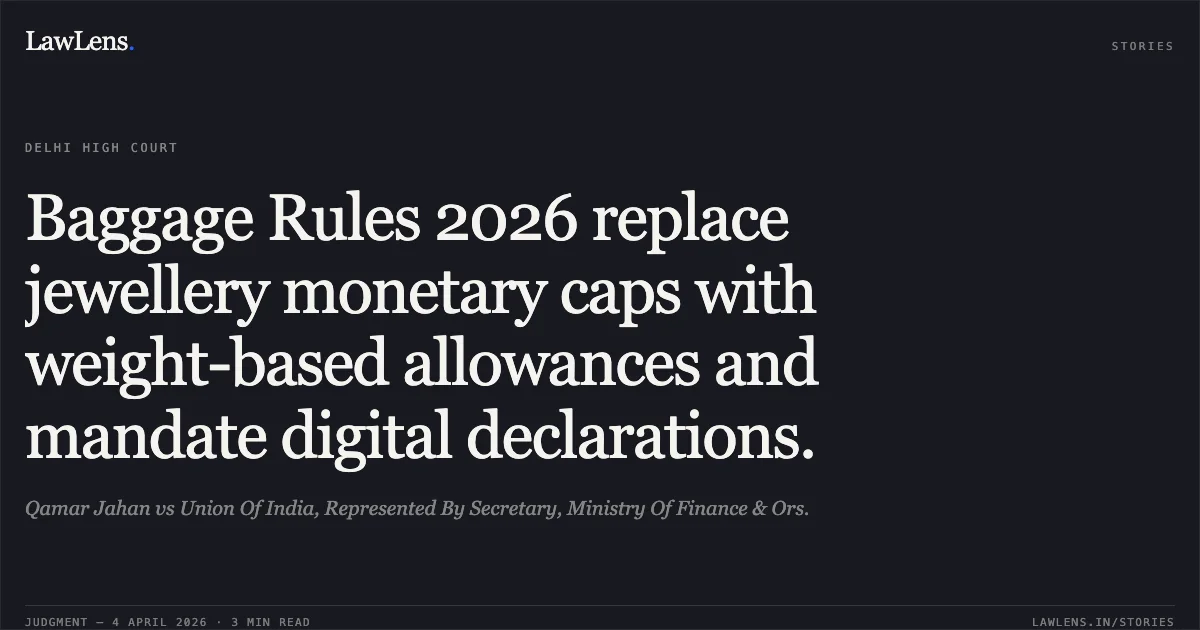
Source reference: p. 17-18In the new "Baggage Rules, 2026," the Court noted the inclusion of "jewellery ordinarily worn by a person" within "personal effects" and the replacement of outdated monetary caps with weight-based limits (20g/40g) for eligible passengers
Source reference: p. 24-25, para 24The Court further approved the "ATITHI 2.0" digital platform, which utilizes AI-based chatbots and electronic filing to minimize human discretion and reduce harassment at the first point of interface with tourists
Source reference: p. 33-35Holding
The Court held that the overhauled regulatory regime, including the Baggage Rules, 2026, and the Master Circular No. 04/2026, sufficiently addresses the systemic deficiencies previously highlighted
It specifically ordered that storage charges shall not be levied on baggage found to be bona fide after detention
Source reference: p. 27-28, para 26Regarding the Petitioner, the Court noted that her gold items were released in November 2025
Source reference: p. 35, para 34The petition was disposed of with the observation that the new framework is significantly more passenger-friendly, featuring mandatory digital photographs of seized items and electronic communication of orders
Source reference: p. 35-36No further orders were deemed necessary as the legislative and procedural changes effectively resolved the issues raised
Source reference: p. 35, para 35Acts & Sections Cited
5 provisions across 1 statute referred to in this judgment. Each provision opens on LawLens.
Customs Act,19625
Original Court PDF
Qamar JahanvsUnion Of India, Represented By Secretary, Ministry Of Finance & Ors.
Click to open original judgment
Original judgment, available to read, download and summarize on LawLens.in