Facts
The respondent, Raja Saha, was accused of demanding ₹2 crores and threatening the informant and her family in connection with a 2018 land transaction, leading to the registration of East Agartala P.S. Case No. 119 of 2024
Source reference: p. 11The Learned Additional Sessions Judge granted the respondent pre-arrest bail on 18.11.2024, observing that no materials existed to attract Sections 109 and 308(5) of the Bharatiya Nyaya Sanhita (BNS), 2023
Source reference: p. 2The State filed this petition under Section 528 of the Bharatiya Nagarik Suraksha Sanhita (BNSS) seeking cancellation of bail on two grounds: first, that the initial order was perverse and failed to consider the gravity of the offense; and second, that the respondent violated bail conditions by threatening a witness, Dipa Dasgupta, on 25.09.2025
Source reference: p. 1, 2By the time of this hearing, the Trial Court had already framed charges against the respondent and he had secured regular bail
Source reference: p. 7, 13Issues
1. Whether the order granting pre-arrest bail was perverse or illegal due to the trial court's observation on the non-applicability of certain penal sections.
Source reference: p. 12 / para. 062. Whether the respondent’s subsequent conduct and the alleged involvement in a new FIR constitute sufficient "supervening circumstances" to warrant the cancellation of bail.
Source reference: p. 13-14 / para. 07-08Law Applied
Section 528 of the BNSS (corresponding to Section 482 Cr.P.C.) regarding inherent powers to set aside perverse orders
Source reference: p. 1Principle from State of Karnataka v. Sri Darshan and Ajwar v. Waseem to distinguish between the annulment of a perverse bail order and the cancellation of bail due to post-grant conduct.
Source reference: p. 3, 4The principle from Bharatbhai Bhimabhai Bharwad v. State of Gujarat, which establishes that cancellation requires "cogent and overwhelming reasons" such as tampering with evidence or threatening witnesses.
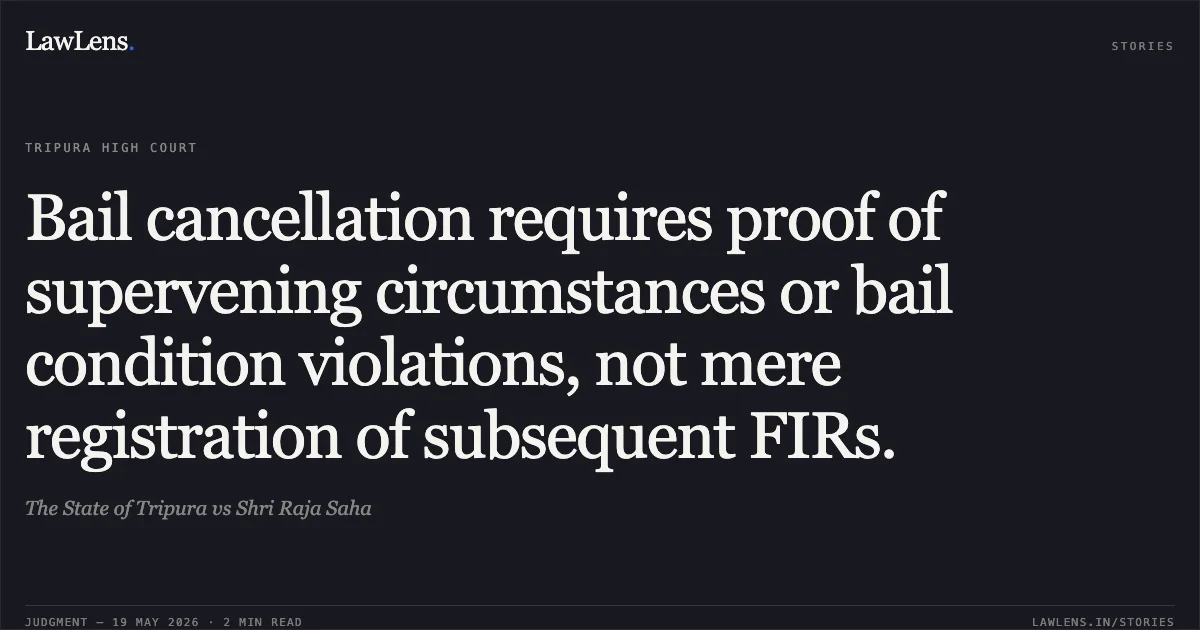
Source reference: p. 8Renjith v. State of Kerala, which clarifies that the mere registration of a subsequent FIR does not result in automatic cancellation of bail.
Source reference: p. 9Reasoning
The Court noted that while the Trial Court had initially expressed doubts about Sections 109 and 308(5) of the BNS, it eventually framed charges under those very sections, indicating that the respondent was not exonerated from the gravity of the allegations
Source reference: p. 13The Court highlighted a significant "long delay" in the State’s application: the bail was granted in November 2024, the alleged witness intimidation occurred in September 2025, and the petition for cancellation was not filed until December 2025. The State failed to provide any explanation for this delay.
Source reference: p. 12, 13Applying the relevant precedents, the Court found that the prosecution did not present "cogent materials" or evidence of a breach of liberty that would outweigh the respondent's right to freedom, especially since regular bail had already been granted and the case had progressed to the trial stage
Source reference: p. 13-14Holding
The Court held that the State failed to demonstrate any merit or "supervening circumstances" justifying the interference with the respondent's liberty after such a significant lapse of time
The petition for cancellation of bail was dismissed. The Court directed the Trial Court to prioritize the disposal of the trial and ordered the return of the Case Diary to the Investigating Officer.
Source reference: p. 14-15Acts & Sections Cited
16 provisions across 3 statutes referred to in this judgment. Each provision opens on LawLens.
Bharatiya Nagarik Suraksha Sanhita, 20237
Bharatiya Nyaya Sanhita, 20236
Code of Criminal Procedure, 19733
Original Court PDF
The State of TripuravsShri Raja Saha
Click to open original judgment
Original judgment, available to read, download and summarize on LawLens.in